The Pysanka: Ukraine's Most Iconic Easter Tradition
The pysanka (Ukrainian: писанка, plural: писанки, pysanky) is a decorated egg produced using a wax-resist batik technique that represents one of the oldest and most continuously practiced forms of Ukrainian folk art. The name derives from the verb pysaty (to write), reflecting the practice of applying intricate patterns using a stylus called a kistka dipped in beeswax. Unlike simply painted eggs, pysanky are "written" with wax before being dipped in progressively darker dye baths, with each successive layer protected by additional wax applications until the desired multicolored design is revealed when the wax is melted away at the end of the process.
Archaeological evidence suggests that Ukrainian predecessors practiced egg decoration thousands of years before the common era, investing eggs with symbolic power as representations of the sun, rebirth, and cosmic creation in pre-Christian Slavic religion. With the Christianization of Ukraine beginning in 988, these ancient fertility symbols were seamlessly integrated into Eastern Christian Easter observances, acquiring new theological dimensions as metaphors for Christ's resurrection and the promise of eternal life. The resulting synthesis produced an art form simultaneously pagan and Christian, ancient and living, that Ukrainians carried with them across continents and centuries without interruption.
For Ukrainian-Canadian genealogists, pysanky represent more than beautiful objects. Each egg carries encoded information about its maker's geographic origin, family traditions, and historical era, making them legitimate genealogical artifacts that can help researchers identify ancestral regions and trace lineage through decorative patterns rather than documents alone. A grandmother's pysanka from a specific Galician village may contain design elements traceable to published regional atlases, providing an unexpected visual bridge between the Canadian present and the Ukrainian past.
Did you know? The wax-resist technique behind every pysanka works backwards from how most people expect: the lightest colour is dyed first, and each subsequent layer of wax protects what has already been coloured before the egg is dipped in a darker dye. The final, darkest colour is applied last — and the entire design stays hidden under wax until it is melted away at the very end.
Ukrainian Easter in Canada: Adapting Old World Traditions to a New Land
The Ukrainian Easter calendar follows the Julian (Old Style) calendar observed by the Ukrainian Orthodox Church of Canada and the Ukrainian Greek Catholic Church, which typically places Velykden (Ukrainian Easter) one to five weeks after Western Easter calculated by the Gregorian calendar. For Ukrainian Canadians, this separation in dates provided a practical advantage during the pioneer era: families could attend civic Easter celebrations common in Canadian communities while maintaining their own Velykden observances at separate times, avoiding cultural conflicts while preserving religious distinctiveness.
Ukrainian settlers arriving in the prairie provinces between 1891 and 1914 brought with them not just seeds and farming tools but the entire material culture of their homeland, including beeswax, kistky, and the knowledge of dozens of regional pysanka patterns. On the isolated bloc settlements of Manitoba, Saskatchewan, and Alberta, Easter provided the anchor event around which community life reorganized after the long prairie winters. The church blessing of Easter baskets (sviachennia), the midnight liturgy (Voskresna sluzhba), and the collective exchange of pysanky among families created social networks that sustained immigrant communities through hardship.
Ukrainian Easter traditions adapted to Canadian conditions in practical ways. Prairie winters meant that natural dyes from local plants had to supplement or replace those imported from Ukraine. The introduction of commercial aniline dyes in the early twentieth century expanded the color palette available to Canadian pysanka makers, gradually shifting regional preferences toward brighter hues while traditional geometric patterns were preserved and transmitted through family workshops and church hall gatherings.
How PEI's Ukrainian Community Celebrates Easter Pysanka
Prince Edward Island never attracted the mass Ukrainian settlement that transformed the Prairie provinces into Ukrainian cultural heartlands, but a small and committed community of Ukrainian-Canadian families has maintained cultural traditions on the Island since the early twentieth century. Today, Easter pysanka workshops organized through community organizations and church groups provide the primary venue for transmitting egg-decoration skills to younger generations born far from the ancestral settlements of Alberta or Saskatchewan. For researchers working on Ukrainian folk traditions preserved in Canada, these PEI workshops represent a living archive of cultural continuity that extends the prairie heritage to Atlantic Canada.
PEI's Ukrainian community Easter celebrations typically begin on Holy Thursday with the preparation of Easter baskets (koshyk) containing smoked sausage (kovbasa), cheese (syrets), ham, decorated eggs, horseradish, beeswax candles, and a decorated braided bread (paska). These baskets are carried to church on Holy Saturday for the blessing ceremony (sviachennia), where priests circle the congregation and sprinkle baskets with holy water in a rite that Ukrainian families trace directly to their grandparents' practice on the prairies and, before that, to their great-grandparents' parishes in Galicia and Bukovyna.
The production of pysanky for PEI's Easter celebrations typically begins weeks in advance, with experienced community members hosting workshops where traditional techniques are taught using raw eggs, beeswax, kistky, and commercial dyes. Some workshops supplement traditional practice with historical education, showing participants photographs of pysanky from specific regions of western Ukraine that correspond to the ancestral origins of PEI Ukrainian families — making the egg-decorating session simultaneously a genealogical exploration and an artistic exercise.
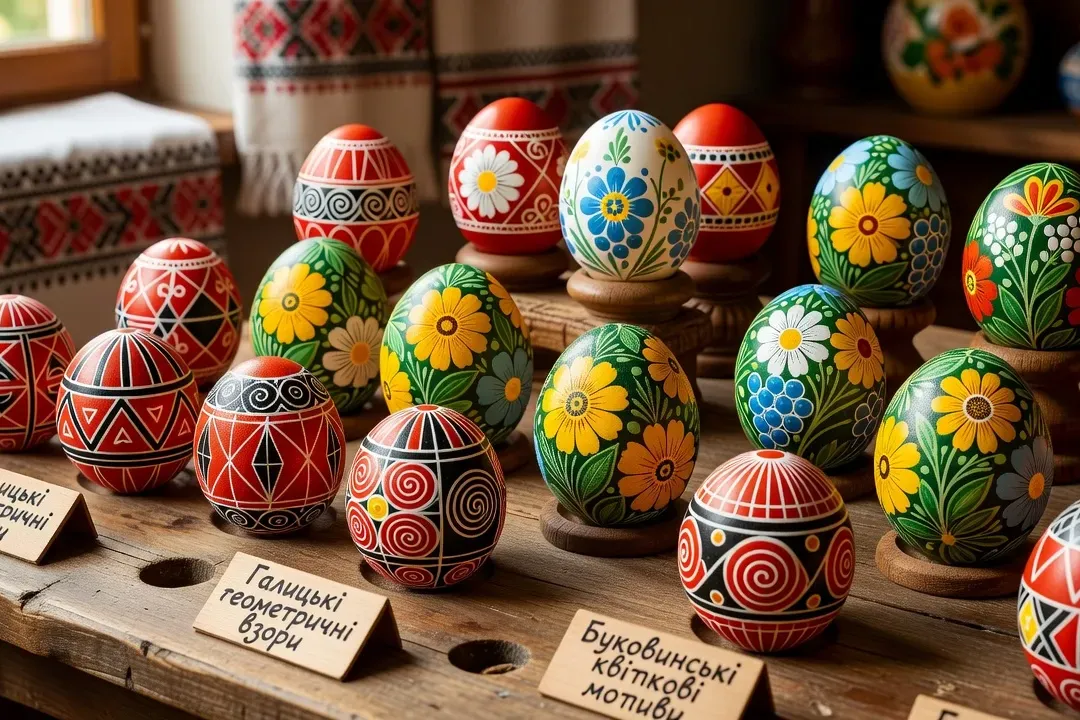
Display of traditional Ukrainian pysanka Easter eggs in various regional patterns on wooden surface.
The Symbolism of Pysanka Designs: What Each Pattern Means
The vocabulary of pysanka symbolism is one of the richest in Ukrainian folk art, encoding meanings that range from simple fertility wishes to complex cosmological statements. Understanding these symbols is practically relevant for genealogists because regional design preferences can help identify ancestral origins even when documentary records are incomplete or destroyed. A systematic knowledge of pysanka iconography transforms a decorative object into a map of the maker's cultural geography.
The eight-pointed star (vosmipromineva zirka), one of the most universally recognized pysanka motifs, represents the sun in its ancient Slavic pre-Christian form and simultaneously serves in Christian contexts as a symbol of divine grace. Its presence on a pysanka does not indicate specific geographic origin because it appears across virtually all Ukrainian regions. More diagnostic symbols include the ram's horns (baraniachi rohvy) associated with Podillia and parts of Galicia, the crab motif (rak) favored in Hutsul regions of the Carpathians, and the intricate meander patterns (bezkonechnyk, meaning "endless") characteristic of Poltava and central Ukraine.
Color choices also encode regional and temporal information. Traditional Galician pysanky favor combinations of red (symbolizing joy and the sun), black (earth and fertility), and yellow (the harvest and stars), while Bukovynian work introduces stronger greens and blues reflecting the forested Carpathian landscape. The introduction of white backgrounds, rare in older Galician work, becomes more common in Canadian prairie pysanky from the mid-twentieth century, reflecting either influence from neighboring traditions or adaptation to Canadian aesthetic preferences and the availability of new commercial dye colors.
| Motif | Associated region | Meaning |
|---|---|---|
| Eight-pointed star | All regions | Sun; divine grace |
| Ram's horns (baraniachi rohvy) | Podillia, parts of Galicia | Strength, abundance |
| Crab (rak) | Hutsul (Carpathians) | Regional folk motif |
| Meander (bezkonechnyk) | Poltava, central Ukraine | Eternity, endlessness |
- Galician palette — red (joy, the sun), black (earth, fertility), yellow (harvest, stars)
- Bukovynian palette — stronger greens and blues reflecting the forested Carpathian landscape
- White backgrounds — rare in older Galician work, more common in Canadian prairie pysanky from the mid-20th century onward
Point to remember: the eight-pointed star appears across virtually every Ukrainian region and carries no diagnostic regional value on its own — it is motifs like the ram's horns, the crab, or the meander pattern, combined with the colour palette, that give genealogists a usable geographic clue.
Techniques for Making a Traditional Pysanka — Step by Step
The technical process of creating a traditional pysanka requires patience, dexterity, and an understanding of how wax and dye interact. The fundamental principle is progressive layering: wax applied to white egg protects those areas as yellow dye is added; more wax on yellow protects those areas as red dye is added; and so on, working from lightest to darkest colors before the final wax removal reveals the complete design. Mistakes cannot be erased — only incorporated into the design — which gives experienced makers a distinctive improvisational skill.
Equipment needed for traditional pysanka making:
- A raw or blown egg (goose eggs are traditional; chicken eggs are most common in Canada)
- A kistka (a small funnel-shaped stylus that holds melted beeswax)
- Beeswax and candles for heating the kistka
- Commercial or natural dyes in progressive shades from light to dark
- A soft cloth for buffing, and a waterproof finish if the egg is to be preserved as a long-term display piece
Detailed step-by-step instructions, including alphabet and geometric grid methods for planning designs, are available in our guide to Ukrainian Easter traditions and the art of pysanky.
Modern workshops typically use commercial dye packets designed for pysanka work, available through Ukrainian cultural organizations and online suppliers. Natural dyes remain an option for those who prefer historical authenticity: onion skins produce warm yellows and oranges; beet juice yields reds and purples; dried weld plants make bright yellows. Natural dyes typically require longer immersion times and produce more muted, variable results than commercial equivalents, but they connect the maker directly to the material world that Ukrainian settlers navigated when commercial supplies were unavailable on the prairies.
- Egg — goose eggs are traditional; chicken eggs are most common in Canada
- Kistka — small funnel-shaped stylus that holds melted beeswax
- Beeswax and candles — for heating the kistka
- Dyes — commercial or natural, applied in progressive shades from light to dark
- Soft cloth and waterproof finish — for buffing and long-term preservation
| Natural dye source | Colour produced |
|---|---|
| Onion skins | Warm yellows and oranges |
| Beet juice | Reds and purples |
| Dried weld plants | Bright yellows |
Point to remember: the fundamental principle of pysanka-making is progressive layering — wax always protects the lightest colour underneath as darker dyes are added. Mistakes cannot be erased, only incorporated into the design, which is why experienced makers develop a distinctive improvisational skill over years of practice.
Regional Variations: Galician vs Bukovynian Pysanka Styles
The two regions that supplied the vast majority of Ukrainian immigrants to Canada — Galicia and Bukovyna — developed distinct pysanka traditions that genealogists can use as rough regional markers. Galician pysanky from the Lemko and Boyko sub-regions of the Carpathian foothills tend toward geometric precision, with intricate diamond lattices, triangles, and the characteristic batih (whip) motif. Color palettes in this tradition tend toward high contrast, with red, black, and white predominating. Galician pysanky from the lowland Podillia region, by contrast, often incorporate elaborate floral motifs alongside geometric elements, reflecting the more fertile agricultural landscape.
Bukovynian pysanky are distinguished by their expressive naturalistic imagery, particularly stylized birds (usually the heron or pelican), deer, horses, and the distinctive tree-of-life motif that appears less frequently in Galician work. The palette of Bukovynian pysanky typically incorporates strong yellows and warm reds against dark backgrounds. Many Bukovynian patterns reflect the cultural blending characteristic of that historically multicultural Habsburg province, incorporating motifs shared with Romanian, Moldovan, and Hutsul neighbors. The connection between Ukrainian diaspora communities and Ukrainian cultural organizations keeping traditions alive internationally has been essential to preserving these regional distinctions in Canada.
For PEI researchers whose families arrived from Chernivtsi Oblast (formerly Bukovyna), comparing existing family pysanky against documented Bukovynian examples may provide valuable contextual evidence about specific village origins. Several Canadian Ukrainian cultural institutes have published regional pysanka atlases that serve as genealogical reference tools, with detailed maps linking design clusters to specific district boundaries that correspond to Austrian-era administrative divisions used in church records.
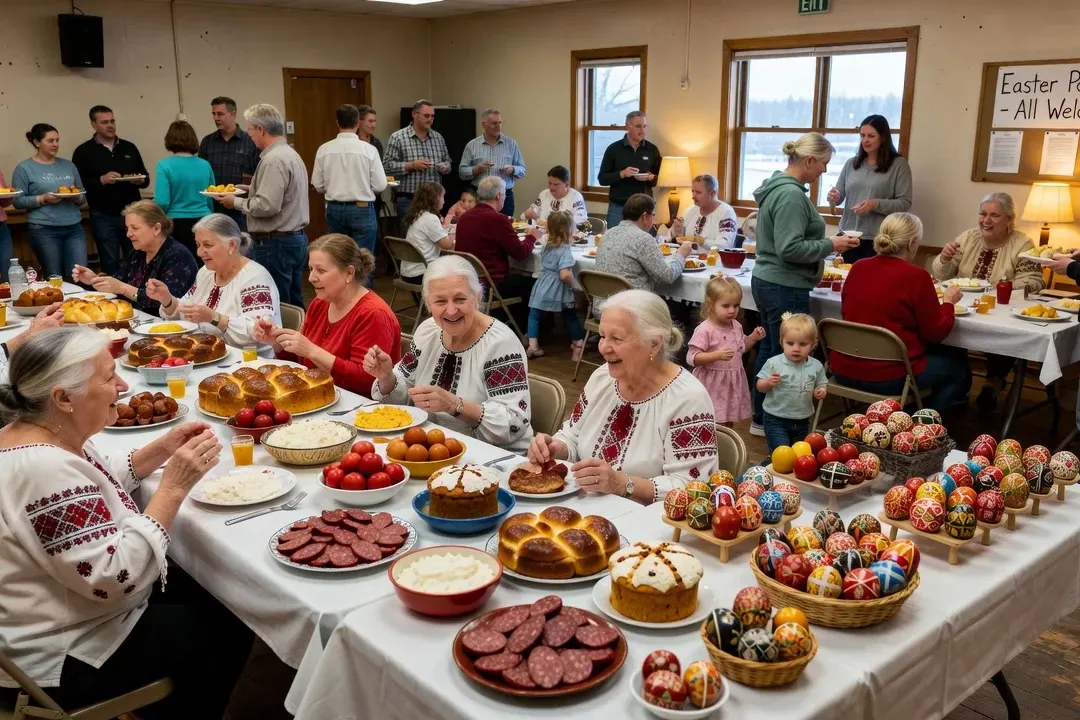
Ukrainian community Easter celebration in PEI church hall with traditional food and pysanka display.
Where to Learn Pysanka Art in Canada in 2026
Opportunities to learn pysanka making have expanded considerably in Canada since the 1990s, when Ukrainian cultural organizations intensified their educational outreach in response to concern that transmission through family channels was becoming unreliable as the grandparent generation — the primary carriers of practical pysanka knowledge — diminished. Today, workshops are offered through Ukrainian cultural organizations in every province with significant Ukrainian-Canadian populations, as well as through online instruction that has made pysanka accessible to Canadians in smaller communities without local teachers.
In PEI, the Ukrainian community in Charlottetown periodically hosts workshops through church groups and the Ukrainian Canadian Congress provincial organization. Advance inquiry is advisable as scheduling varies year to year. For communities in Alberta and Saskatchewan, the Ukrainian Cultural Heritage Village near Edmonton (a living-history museum operated by Alberta Culture) offers summer programs that include traditional arts instruction, while the Ukrainian Museum of Canada in Saskatoon provides year-round educational resources and an extensive pysanka collection available for study.
Online instruction through YouTube, Etsy seller tutorials, and dedicated pysanka websites has created a new generation of practitioners who learned the craft without a Ukrainian family background. While these practitioners generally embrace the artistic dimensions of pysanka making, the genealogical context and regional specificity of traditional designs is sometimes lost in non-heritage settings, making the work of Ukrainian cultural organizations in maintaining community-based knowledge networks particularly important for those who wish to recover specific ancestral design traditions.
Preserving Pysanka Traditions: Grandmothers to Grandchildren
The intergenerational transmission of pysanka skills has followed a consistent pattern in Ukrainian-Canadian families: grandmothers (babusy) teaching grandchildren, often across language barriers created by successive generations' shift to English. This pattern, documented in oral histories collected by Ukrainian cultural institutions across Canada, reveals how a nonverbal, tactile craft survived the loss of Ukrainian-language fluency in the second and third generations. The hands learned what the tongue could no longer transmit.
Many PEI Ukrainian-Canadian families trace their pysanka knowledge to a single skilled practitioner — often a first- or second-generation woman who maintained the practice through the difficult decades when Ukrainian cultural expression was sometimes suppressed or sidelined in the push for Anglophone assimilation. The recovery of pride in Ukrainian heritage that accompanied the independence of Ukraine in 1991 coincided with a renewed interest in pysanka making among younger generations, creating a cultural renaissance that strengthened community organizations across Canada. The celebration of Vyshyvanka Day (Den Vyshyvanky) and Ukrainian embroidery traditions has grown alongside renewed pysanka enthusiasm as part of a broader affirmation of Ukrainian folk art heritage in the diaspora.
For genealogists, the importance of documenting older family members' pysanka skills before they are lost cannot be overstated. A recorded demonstration of a grandmother's specific pysanka technique, combined with her memory of where the patterns came from and which family members taught her, provides irreplaceable evidence of cultural continuity. Even simple notes about color preferences, favorite motifs, and the occasions for which different pysanky were made can become significant genealogical documents when combined with archival research.
Pysanka as a Genealogical Clue: What Family Patterns Reveal
The use of pysanka as genealogical evidence requires the same critical approach applied to any artifact. A single example provides limited information; a collection from multiple generations of the same family, combined with oral tradition about where the patterns came from, begins to constitute meaningful evidence that can support or challenge hypotheses formed from documentary sources. Like handwriting or dialect, pysanka design reflects learned behavior passed within specific communities over generations.
Practical steps for genealogists wishing to use pysanky as research tools:
- Photograph all examples in the family collection with consistent lighting and scale references
- Record provenance information from family members while that knowledge is still available
- Consult regional pysanka atlases available through Ukrainian cultural institutes
The connection between pysanka symbolism and vyshyvanka embroidery patterns from the same region can provide corroborating evidence when documentary records from specific Galician or Bukovynian villages are unavailable. Researchers who find the same motifs recurring across pysanka, embroidery, and weaving traditions from a single family may have strong evidence of regional origin even without a document naming the village.
Ukrainian cultural institutes in Canada have undertaken systematic documentation projects that could assist genealogists willing to contribute family examples to institutional databases. The intersection of material culture research and genealogical inquiry represents one of the most exciting frontiers in Ukrainian-Canadian heritage studies, offering pathways to ancestral origins that go beyond the limitations of surviving archival records. Every pysanka held in a Canadian family's Easter basket carries within its wax-protected colors the memory of hands across an ocean and across generations, waiting for a descendant curious enough to ask what the patterns mean and where they came from.
Frequently Asked Questions
A pysanka (plural: pysanky) is a decorated egg created using a wax-resist batik technique. The name comes from the Ukrainian verb pysaty, meaning "to write," because the designs are applied with a heated stylus called a kistka dipped in beeswax. The wax protects each area of color as the egg is successively dipped in progressively darker dye baths. When the wax is melted away at the end, the hidden multicolored design is revealed. Pysanky are one of the oldest forms of Ukrainian folk art, combining pre-Christian Slavic symbolism with Eastern Christian spiritual meaning.
Ukrainian Orthodox and Greek Catholic communities celebrate Easter (Velykden) according to the Julian calendar, which typically places it one to five weeks after Western (Gregorian) Easter. The date varies each year. The celebrations begin on Holy Thursday with preparations, continue through Holy Saturday with the blessing of Easter baskets (sviachennia), and culminate in the midnight Resurrection liturgy and Easter Sunday. Ukrainian Canadians following the Julian calendar therefore celebrate Easter on a separate date from most of their neighbours.
Yes, authentic Ukrainian pysanky are available through Ukrainian cultural organizations, craft fairs, and artisan markets across Canada, particularly in cities with significant Ukrainian-Canadian populations such as Edmonton, Saskatoon, Winnipeg, and Toronto. Online sellers on platforms like Etsy and dedicated Ukrainian craft websites also offer pysanky year-round. For PEI, community events and church bazaars periodically offer locally made pysanky. Prices for hand-crafted pysanky typically range from $15 to $80 depending on complexity and the maker's experience.
Traditional pysanka making requires a raw or blown egg, a kistka (a small metal funnel-shaped stylus), beeswax, dyes, and candles for heating the kistka. The dyes are applied from light to dark: the egg typically progresses through yellow, orange, red, and black or dark blue dye baths, with wax applied before each dip to protect the previous color. Modern practitioners often use commercial dye kits designed for pysanka work, which are available from Ukrainian cultural organizations and specialty craft suppliers in Canada.
Yes, Ukrainian Orthodox and Greek Catholic Easter is calculated using the Julian calendar and the ancient Alexandrian method, which typically results in a date one to five weeks later than Western (Gregorian) Easter. This difference exists because the Julian calendar currently runs 13 days behind the Gregorian calendar, and the Julian Easter date is further constrained by rules that prevent it from occurring before the Jewish Passover. In some years both Easters fall on the same date; in other years they can be five weeks apart. Ukrainian Canadians who follow the Julian calendar celebrate Easter separately from neighbours who observe Gregorian Easter.