The Day Ukraine Buttons Up Its Heritage
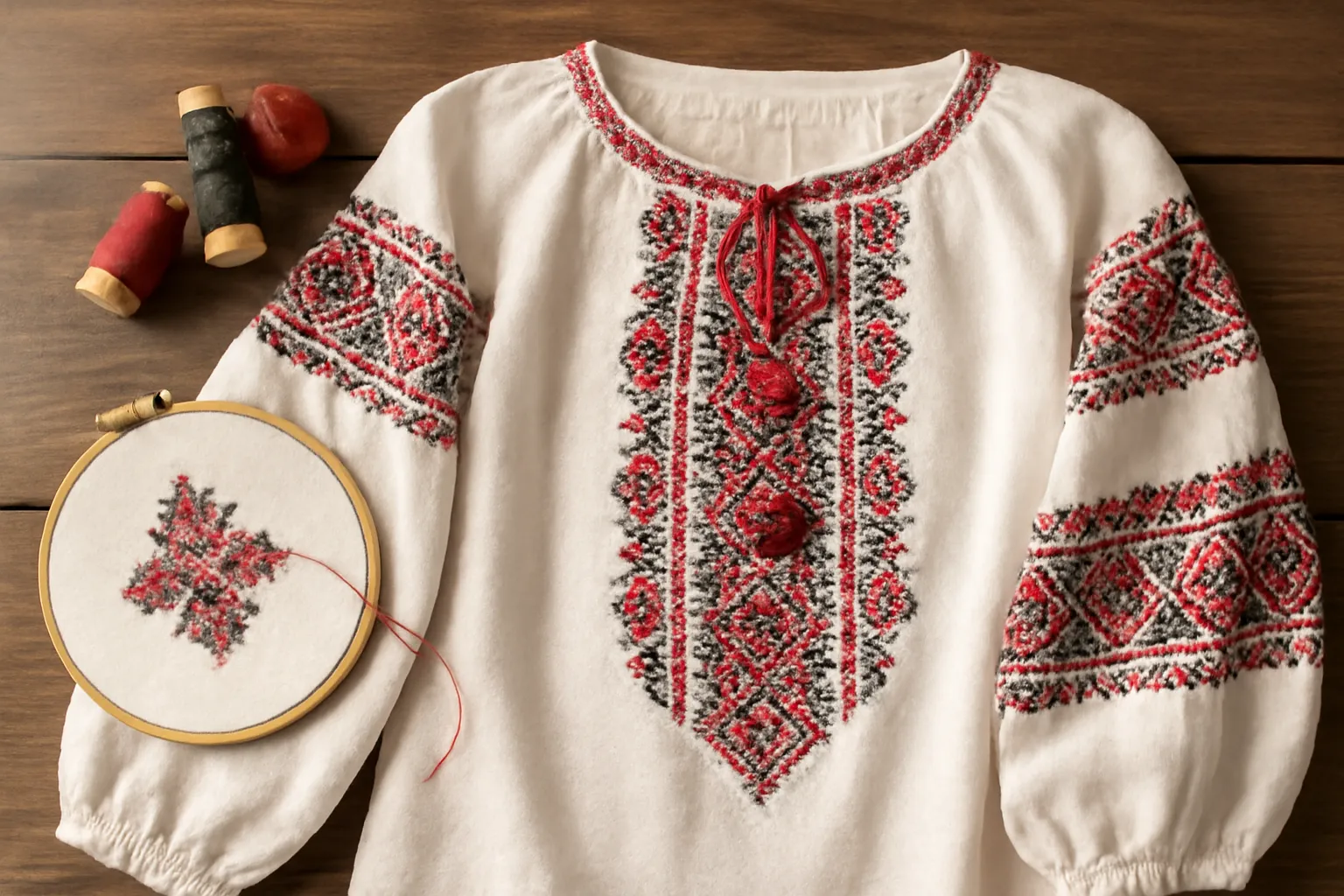
Every year on the third Thursday of May, something remarkable happens across Ukraine and in Ukrainian communities around the world. Millions of people open their wardrobes, reach past the everyday shirts and office wear, and pull out a garment decorated with intricate hand-stitched patterns in red, black, blue, or white. They wear their vyshyvanka — the traditional Ukrainian embroidered shirt — and step out into the world as a visible reminder that a culture more than a thousand years old is still very much alive.
This is Vyshyvanka Day, known in Ukrainian as Den Vyshyvanky (Ден Вишиванки). It is not a solemn commemorative occasion but a joyful, slightly defiant celebration of identity. In 2026, it falls on May 21 — the third Thursday of May, as always. In Canada, from Charlottetown to Vancouver, Ukrainian Canadians and their neighbours join the celebration, making it one of the most visible expressions of Ukrainian heritage in the North American calendar.
For genealogists and descendants tracing their Ukrainian roots, Vyshyvanka Day offers something beyond a cultural moment. The embroidery patterns worn on that day — and the vyshyvanky passed down through family lines — carry encoded geographical information. The style of a garment can indicate which region of Ukraine a family came from, linking a living descendant in Prince Edward Island to a village in Galicia or Bukovyna a century removed.
The Origins of Den Vyshyvanky: A Student’s Idea That Crossed Borders
The story of Vyshyvanka Day begins in a university cafeteria in the autumn of 2005. Lesya Voroniuk, a first-year student at Yuriy Fedkovych Chernivtsi National University in western Ukraine, had an idea. She wanted her fellow students to wear traditional embroidered shirts to mark the university’s anniversary in the spring. The tradition of wearing vyshyvanky was fading in Ukrainian cities, being displaced by Western fashion trends. Voroniuk saw an opportunity to reclaim it.
On May 18, 2006, hundreds of Chernivtsi students arrived at the university wearing vyshyvanky. The sight was striking — an ocean of embroidered shirts in a city centre — and it attracted local media coverage. Students and professors photographed one another, sharing images through the early social media platforms of the time.
The idea resonated far beyond Chernivtsi. The following year, universities across Ukraine began organizing their own Vyshyvanka Days. By 2010, the movement had crossed into the Ukrainian diaspora communities of Canada, the United States, Australia, and Europe. By 2015, the hashtag #VyshyvankaDay was generating hundreds of thousands of posts across social media platforms. In 2017, the United Nations headquarters in New York hosted a Vyshyvanka Day event, with diplomats from around the world wearing embroidered garments to mark the occasion.
| Year | Milestone |
|---|---|
| 2005 | Lesya Voroniuk conceives the idea at Chernivtsi National University |
| May 18, 2006 | First Vyshyvanka Day: hundreds of Chernivtsi students wear vyshyvanky |
| 2007 | Other Ukrainian universities begin organizing their own events |
| 2010 | Movement crosses into diaspora communities in Canada, the US, Australia, Europe |
| 2015 | #VyshyvankaDay generates hundreds of thousands of social media posts |
| 2017 | United Nations headquarters in New York hosts a Vyshyvanka Day event |
What gave the movement its unusual speed and reach was its combination of simplicity and depth. Wearing a vyshyvanka requires no organizational infrastructure, no formal membership, no registration. It is a personal and public act simultaneously: deeply individual (each vyshyvanka is distinct) and immediately collective (a crowd in vyshyvanky is instantly recognizable as Ukrainian). For a diaspora community dispersed across continents, a day when everyone wears the same kind of garment creates a moment of visible unity.
The movement also arrived at a historically significant moment. The years following 2014 — with the Maidan Revolution and the beginning of conflict in eastern Ukraine — saw an intensified interest in Ukrainian identity among the diaspora. The vyshyvanka became one of the symbols of that renewed engagement with heritage, and Vyshyvanka Day its most popular expression.
How the movement spread, year by year:
- 2006 — Lesya Voroniuk organizes the first Vyshyvanka Day at Chernivtsi National University
- 2007 — Universities across Ukraine begin organizing their own Vyshyvanka Days
- 2010 — The movement crosses into diaspora communities in Canada, the United States, Australia, and Europe
- 2015 — The hashtag #VyshyvankaDay generates hundreds of thousands of social media posts
- 2017 — The United Nations headquarters in New York hosts a Vyshyvanka Day event
What the Embroidery Patterns Tell Us
The vyshyvanka is more than a decorative garment. Its patterns constitute a visual language developed over centuries, with distinct dialects corresponding to different regions of Ukraine. Understanding this language can provide genealogical clues for descendants trying to identify where their ancestors originated.
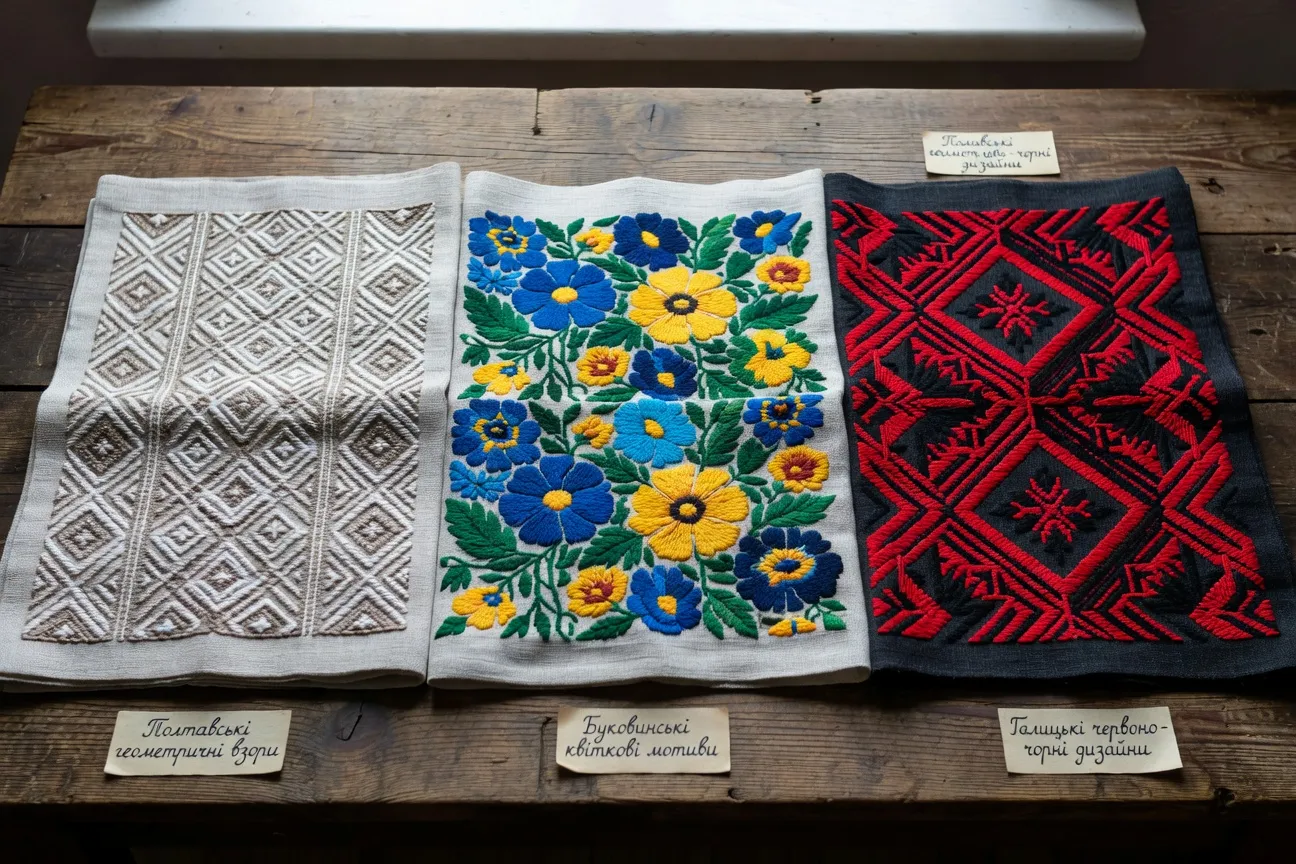
Regional embroidery styles at a glance:
| Region | Dominant colours | Characteristic motifs |
|---|---|---|
| Galicia (Halychyna) | Red and black | Eight-pointed stars, diamonds, dense angular geometry |
| Bukovyna | Red, green, blue, yellow (polychrome) | Floral and curvilinear motifs alongside geometric elements |
| Poltava region | White-on-white | Pulled-thread and satin stitch, texture over colour |
| Podillia | Black-dominant | Striking geometric patterns, unusual black emphasis |
| Volhynia | Red | Clean, symmetrical geometric designs |
| Hutsul region | Multicoloured, metallic thread | Complex beading, exuberant Carpathian folk motifs |
Galicia (Halychyna)
The most recognizable regional style for Ukrainian Canadians — because the majority of the first immigration wave came from this region — is the Galician style. Galician vyshyvanky are characterized by red and black geometric patterns using cross-stitch technique. The motifs are angular, symmetrical, and dense, covering large portions of the fabric. Common elements include eight-pointed stars, diamond shapes, and stylized plant forms. If your family came from Lviv, Ternopil, Ivano-Frankivsk, or the surrounding villages, this is likely the embroidery tradition in your family history.
Bukovyna
Bukovynian embroidery is among the most colorful in Ukraine. The polychrome palette — rich reds, greens, blues, and yellows used together in a single garment — reflects the multicultural history of the region, which was part of the Habsburg Empire and bordered Romanian, Polish, and Jewish communities. Bukovynian patterns tend to be more floral than Galician ones, with curvilinear motifs alongside geometric elements.
Poltava Region
If Galician embroidery is bold, Poltava embroidery is subtle. The famous white-on-white style (bilyi po bilomu) uses pulled-thread work and satin stitch to create patterns that are visible only in certain angles of light. This restraint was a mark of technical mastery — only a highly skilled embroiderer could create patterns visible only through texture, not color. Poltava vyshyvanky represent perhaps the highest expression of the craft as a fine art.
Podillia and Volhynia
Podillia is known for black-dominant embroidery — unusual in a tradition where red usually predominates — with striking geometric patterns. Volhynian embroidery tends toward red with clean, symmetrical geometric designs. Both styles are less commonly seen in Canada than Galician patterns, reflecting the smaller proportion of immigrants from these regions.
Hutsul Region
The Carpathian mountain people — the Hutsuls — produced some of the most exuberant embroidery in Ukraine. Multicolored, complex, and adorned with metallic thread and beading, Hutsul vyshyvanky are statement garments. The designs reflect the region’s strong tradition of folk craftsmanship and its cultural distinctiveness within western Ukraine.
- Galicia — the majority origin of first-wave Ukrainian Canadians; look for red and black geometric cross-stitch
- Bukovyna — polychrome floral patterns reflecting the region's multicultural Habsburg history
- Poltava — subtle white-on-white work, the most technically demanding regional style
- Podillia and Volhynia — less common in Canada, but recognizable by their black-dominant or clean red geometric patterns
- Hutsul — the most visually dramatic, incorporating metallic thread and beading from the Carpathian mountain tradition
Genealogy tip: if a family vyshyvanka has survived, its regional style can narrow down an ancestral search even when documentary records are incomplete — a red-and-black geometric piece points toward Galicia, while a polychrome floral piece points toward Bukovyna.
How Ukrainian Canadians Celebrate Vyshyvanka Day
The celebration of Vyshyvanka Day in Canada has evolved significantly over the two decades since the movement began. What started as a grassroots social media phenomenon has developed into a series of organized community events across the country, with Canadian institutions increasingly participating alongside Ukrainian-Canadian communities.
Schools in cities with significant Ukrainian populations — Winnipeg, Edmonton, Saskatoon, Thunder Bay — often designate Vyshyvanka Day as a cultural awareness occasion, with students encouraged to learn about Ukrainian embroidery traditions. Some schools organize brief presentations or displays of historical vyshyvanky alongside student artwork.
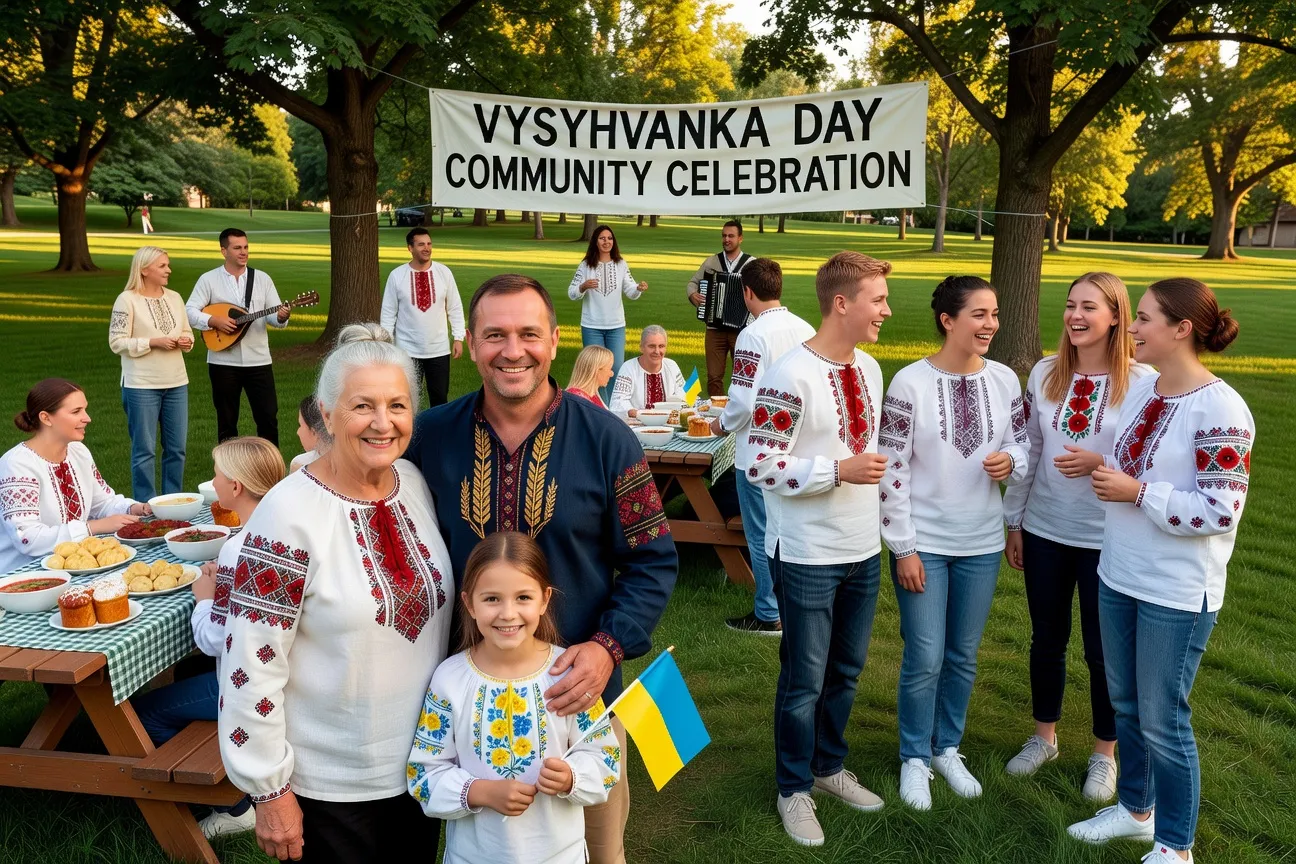
Ukrainian churches hold special services, sometimes with the entire congregation attending in embroidered garments. The visual effect of a church full of vyshyvanky — the patterns representing half a dozen different regions of Ukraine, worn by descendants of immigrants who arrived in different waves — is striking. Services on Vyshyvanka Day often include a blessing of the embroidered garments, connecting the religious and cultural dimensions of the tradition, much as Ukrainian Easter traditions weave liturgical and folk elements together throughout the year.
Community organizations such as Ukrainian Canadian Congresses, Ukrainian cultural centres, and Ukrainian genealogy groups organize events that range from educational exhibitions on regional embroidery styles to community photographs, concerts, and craft workshops where participants learn basic embroidery stitches.
Social media remains central to the day. The tradition of sharing vyshyvanka photographs on Vyshyvanka Day has grown into a practice that visibly connects the Ukrainian diaspora across borders. A scroll through social media on the third Thursday of May reveals vyshyvanka-clad Ukrainians in Toronto, Edmonton, Sydney, Berlin, New York, and Kyiv — a reminder of the scale and spread of the community.
For the Ukrainian Genealogy Group of Prince Edward Island, Vyshyvanka Day has become an occasion to connect heritage and genealogical research. Members are encouraged to wear family heirlooms when possible, photograph them with documentation of their regional origin, and contribute to a growing archive of embroidery samples that can help future researchers identify the geographical origins of their ancestors.
- Schools — cultural awareness presentations and displays in cities with significant Ukrainian populations
- Ukrainian churches — special services, sometimes with a blessing of the embroidered garments
- Community organizations — exhibitions, community photographs, concerts, and embroidery workshops
- Social media — the tradition of sharing vyshyvanka photographs that visibly connects the diaspora across borders
Key takeaway: Vyshyvanka Day works precisely because it requires no organizational infrastructure — wearing a vyshyvanka is simultaneously a personal act and an instantly recognizable collective statement, which is why it spread from one Chernivtsi university cafeteria in 2005 to a global diaspora movement within a decade.
The Vyshyvanka as a Genealogical Tool
For researchers tracing Ukrainian ancestry, the embroidery traditions associated with Vyshyvanka Day offer a practical dimension beyond cultural celebration. A vyshyvanka passed down through a family can serve as a primary source — a physical artifact encoding information about geographical origin.
The regional specificity of Ukrainian embroidery patterns is well enough established that experienced researchers can often identify the oblast or even the district of origin from a garment. This information can help narrow a research focus when documentary records are incomplete or missing. If you know your ancestor came from “somewhere in Ukraine” and you have a family vyshyvanka in the Poltava white-on-white style, you can reasonably hypothesize that the family’s roots lie in central Ukraine rather than in Galicia.
This kind of textile genealogy works best when combined with oral family history and documentary research. A vyshyvanka tells you the style; immigration records, church registers, and census data tell you the names and dates. Together, they create a more complete picture of who your ancestors were and where they came from.
To connect embroidery research with documentary genealogy, see our guide to Ukrainian embroidery regional patterns and genealogy significance. For a specialist’s perspective on how embroidery traditions encode regional identity, see our interview with textile artist Lesia Moroz on Ukrainian embroidery patterns.
Wearing It Forward: The Future of Vyshyvanka Day
The trajectory of Vyshyvanka Day suggests that it will continue to grow in significance — particularly given the global attention on Ukraine since 2022. In communities where Ukrainian identity was previously a quiet background to everyday Canadian life, the past several years have seen a renewed interest in cultural expression and heritage preservation.
For young people of Ukrainian descent who may feel disconnected from a heritage they know mainly through grandparents’ stories, Vyshyvanka Day offers a concrete, accessible point of engagement. You do not need to speak Ukrainian, know your ancestral village, or have researched your family tree to wear a vyshyvanka. But the act of wearing one often sparks curiosity — about where the pattern comes from, who made the garment, and what the stitches meant to the women who worked them by lamplight in a village that may no longer exist under its old name.
That curiosity is the beginning of genealogy. And genealogy is how the threads of a family’s history — like the threads of a vyshyvanka — are gathered, counted, and preserved for the generations that come after.
To remember: A vyshyvanka is more than a garment worn once a year — its regional pattern is a physical clue to where a family's story in Ukraine began. Wearing one on Vyshyvanka Day and documenting it with photographs and provenance notes turns a moment of celebration into a small act of genealogical preservation.
For Ukrainian diaspora members looking to support their homeland beyond cultural preservation, the trilingual resource helptoukraine.pt provides solidarity resources in Ukrainian, French, and Portuguese — connecting the Ukrainian diaspora in Western Europe with verified humanitarian organizations.
Frequently Asked Questions
Vyshyvanka Day 2026 (Den Vyshyvanky) falls on Thursday, May 21, 2026. It is celebrated on the third Thursday of May each year. The date varies slightly from year to year, but always falls in mid-to-late May.
Vyshyvanka Day was started in 2006 by a student named Lesya Voroniuk at Yuriy Fedkovych Chernivtsi National University in western Ukraine. She organized a day for students and faculty to wear traditional embroidered shirts (vyshyvanky) to university. The idea spread via social media and within a few years had become an international phenomenon.
Vyshyvanka Day is a celebration of Ukrainian identity, cultural heritage, and continuity. By wearing the traditional embroidered shirt, Ukrainians affirm a connection to centuries of folk art and to the communities their ancestors came from. For the Ukrainian diaspora, the day is particularly meaningful as a visible expression of heritage maintained across generations and borders.
Ukrainian communities across Canada mark Vyshyvanka Day by wearing embroidered vyshyvanky to school, work, and community events. Churches hold special services, cultural organizations host educational programs and photo events, and social media fills with images of Canadians in their embroidered shirts. In communities with large Ukrainian populations — Winnipeg, Edmonton, Toronto — public gatherings and concerts are organized.
Yes. Many people new to the celebration wear a plain white or light-colored shirt or add an embroidered accessory such as a scarf, pin, or bag. What matters is the spirit of participation. If you are interested in acquiring a vyshyvanka, Ukrainian community organizations, cultural festivals, and online vendors often carry a range of options to suit different budgets.