Why the 1906 Census Is the Single Most Useful Record Set for Ukrainian-Canadian Genealogy
If your Ukrainian ancestors arrived in Canada during the first great migration wave of 1891 to 1914, the 1906 Census of the Northwest Provinces is almost certainly the first place you should look. Taken on June 1, 1906, this special interim census enumerated every household in Manitoba, Saskatchewan, and Alberta — the three provinces that absorbed the overwhelming majority of Ukrainian settlers during this period.
The timing is what makes it extraordinary. Many Ukrainian families arrived between 1896 and 1905, took up homesteads under the Dominion Lands Act, and were recorded for the first time as Canadian residents in the 1906 enumeration. For thousands of researchers tracing the first generation of Ukrainian Canadians, the 1906 census is the earliest official Canadian document in which their ancestors appear.
Unlike the regular decennial censuses, the 1906 census was commissioned specifically to track the explosive growth of the prairies. Settlement was so rapid that the federal government could not wait until 1911 to update its statistics. The result is a snapshot of Ukrainian colonisation at its most active phase — when entire blocs of Galician and Bukovynian villages were transplanted onto the Canadian plains.
What the 1906 Census Covers (and What It Does Not)
The 1906 census enumerated only the three Prairie Provinces. Ontario, Quebec, the Maritimes, and British Columbia were not included. If your Ukrainian ancestors settled in places like Toronto, Montreal, Sudbury, or Cape Breton before 1906, you will not find them in this record set; you will need to wait for the 1911 Census of Canada.
The geographic scope, however, was perfect for capturing Ukrainians. By 1906, more than 120,000 Ukrainian immigrants had arrived in Canada, and the vast majority — perhaps 95% of them — settled within the surveyed area. The block settlements of Stuartburn, Ethelbert, Dauphin, Yorkton, Rosthern, Vegreville, and Mundare were all enumerated. Many homesteads recorded that year are still farmed by descendants of the original Ukrainian families today.
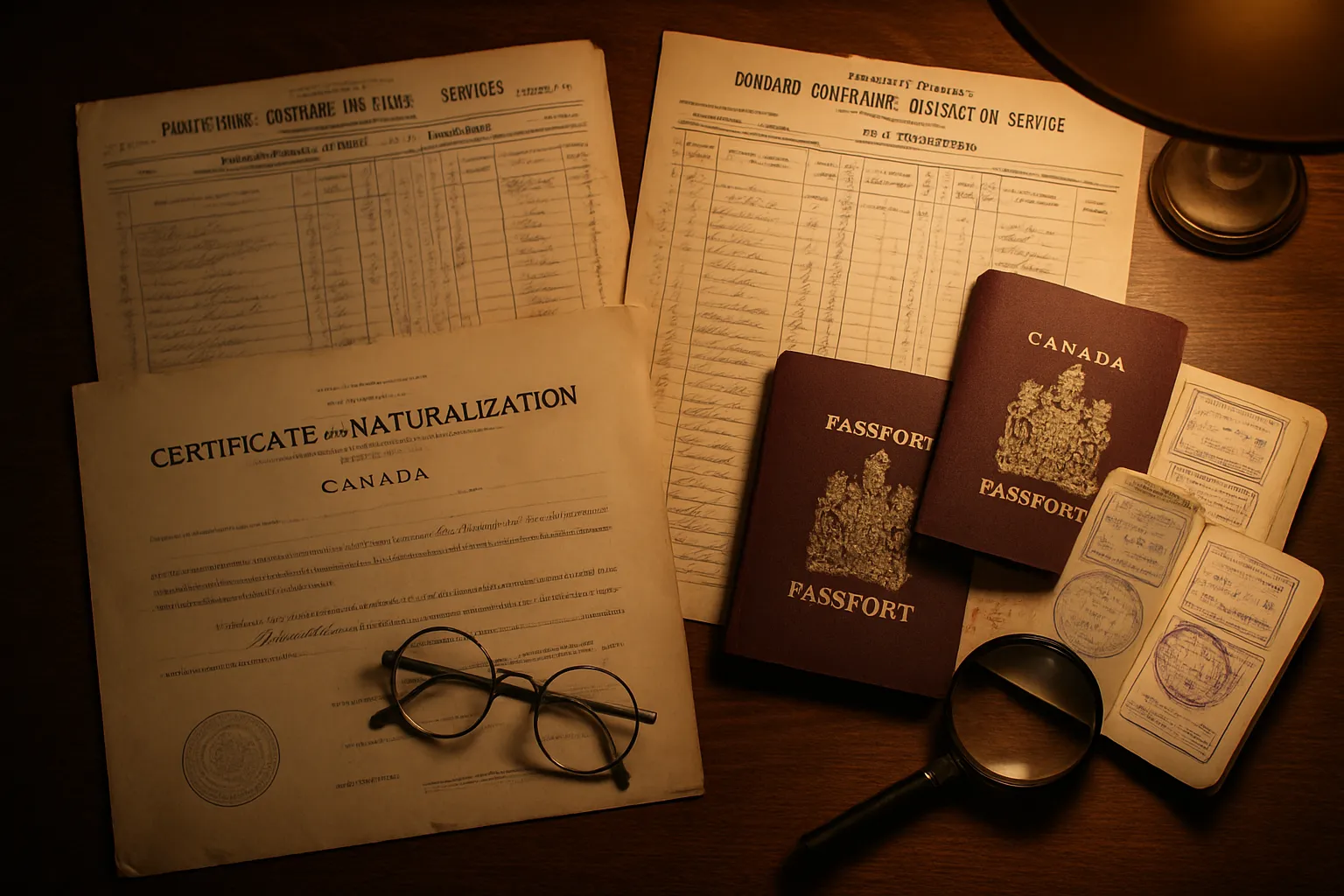
The census also captures a transitional moment. Many of the men were still listed as Austrian subjects because Galicia and Bukovyna remained part of the Austro-Hungarian Empire until 1918. The naturalization column shows whether a settler had applied for British (Canadian) citizenship — a process that typically took at least three years of continuous residence.
The 33 Columns Explained, Step by Step
The 1906 census schedule contains 33 separate columns of information. For Ukrainian genealogy, some columns are gold; others are usually blank or unhelpful. Here is what each column contains and how to interpret it.
Identifying Information (Columns 1-7)
- Column 1 — Number of dwelling. Sequential within the enumeration district. Useful for confirming that two families lived in the same house.
- Column 2 — Number of family. Each separate family unit gets its own number.
- Column 3 — Name of each person. The enumerator wrote names phonetically, often Anglicising or shortening them. Wasyl might appear as William, Mykhailo as Michael, and Hrytsko as Harry. Surnames were frequently misspelled — Hrynchyshyn could appear as Granchason, Krynchyshyn, or even Henchason.
- Column 4 — Sex.
- Column 5 — Colour or race. Almost always W for white; ethnic origin appears later.
- Column 6 — Age at last birthday. Beware: ages were often approximations, especially for adults. A discrepancy of two to three years between censuses is normal.
- Column 7 — Married, single, widowed, divorced.
Origin and Immigration (Columns 8-14)
This is where Ukrainian genealogy comes alive.
- Column 8 — Country or place of birth. Most Ukrainian settlers are recorded as Galicia, Bukowina, Austria, or Austria-Hungary. Some appear as Russia if they came from Volhynia or eastern Ukrainian lands under the Russian Empire.
- Column 9 — Year of immigration to Canada. One of the most important fields. This year usually marks the arrival at a Canadian port (Quebec City or Halifax). Cross-reference with the passenger list databases at LAC and Pier 21.
- Column 10 — Year of naturalization. If your ancestor naturalized as a British subject, the year is recorded here. Combined with column 9, this tells you how long they waited to take citizenship.
- Column 11 — Racial or tribal origin. Look for Galician, Ruthenian, Bukowinian, Polish, German, or Austrian. Inconsistency was the rule. The same family could be recorded as Galician in one census and Ruthenian in the next.
- Column 12 — Mother tongue. Ruthenian and Polish are the two most common entries for Ukrainian families.
Religion: The Strongest Ethnic Marker (Column 13)
In Canadian records of this period, religion is often a more reliable indicator of Ukrainian identity than the racial origin column. Ukrainian settlers were almost exclusively:
- Greek Catholic (Uniate, Byzantine Catholic) — the dominant church in Galicia
- Greek Orthodox (Eastern Orthodox) — the dominant church in Bukovyna and parts of eastern Galicia
- A small minority who converted to Roman Catholic, Presbyterian, or Methodist churches after arriving in Canada
If you see a settler from Austria with a Greek Catholic religion entry, you are almost certainly looking at an ethnic Ukrainian. The confusing surname spellings and inconsistent ethnic labels are erased by this single column.
Occupation, Land, and Livestock (Columns 14-33)
- Column 14 — Occupation, profession, or trade. Almost universally Farmer for Ukrainian settlers. Sons over fifteen are often recorded as Farmer’s son or Farmer’s labourer.
- Columns 15-22 — Earnings, employment, education. These are useful for context but are often blank for self-employed homesteaders.
- Columns 23-33 — Land, livestock, and crops. Number of horses, cattle, sheep, swine; acres improved; bushels of wheat. These columns are an underused goldmine for understanding the economic standing of your ancestors. A family with two horses and ten cattle in 1906 had been farming successfully for several years; a family with no livestock had probably arrived very recently.
| Column range | What it records | Genealogy value |
|---|---|---|
| 1-7 | Dwelling, family number, name, sex, colour, age, marital status | Confirms household grouping and basic identity |
| 8-12 | Birthplace, year of immigration, year of naturalization, racial origin, mother tongue | Highest genealogical value — links to passenger lists and ancestral village |
| 13 | Religion | Strongest single indicator of ethnic Ukrainian identity |
| 14-22 | Occupation, earnings, employment, education | Context only, often blank for homesteaders |
| 23-33 | Land, livestock, crops | Reveals how established the family was by 1906 |
Point important : the single most useful column pair for a Ukrainian researcher is 9 and 13 together — the year of immigration points to a passenger list, while the religion entry (Greek Catholic or Greek Orthodox) confirms the family was ethnically Ukrainian rather than Polish or Jewish, since the racial-origin labels themselves were applied inconsistently by enumerators.
How to Search the 1906 Census Step by Step
Method 1 — Library and Archives Canada (free, original images)
- Go to bac-lac.gc.ca and navigate to the Census section.
- Choose Census of the Northwest Provinces, 1906.
- Enter the surname and (optionally) the given name of your ancestor.
- Use wildcards generously. Searching for Hryn* will return Hrynchyshyn, Hryniuk, Hryniw, and similar variants. The enumerators were unfamiliar with Ukrainian phonetics and spellings vary widely.
- When a hit appears, click the entry, then follow the link to the microfilm reel to view the original page.
- Download the high-resolution image and save it with a descriptive filename (e.g.
1906_SK_Yorkton_HrynchyshynM.jpg).
Method 2 — FamilySearch (free, indexed)
FamilySearch volunteers have indexed much of the 1906 census. The search interface is more forgiving of phonetic spellings than LAC’s. You can search by location, age, or birth country independently. The links lead back to LAC images at no cost.
Method 3 — Ancestry (paid, advanced search)
Ancestry’s index includes additional search filters and integrates 1906 hits with later censuses, immigration lists, and family trees. If you already have an Ancestry subscription, this is the fastest way to assemble a research timeline from 1896 ship arrival to 1916 prairie census. If you do not, the LAC and FamilySearch routes are entirely sufficient.
Search Strategies That Actually Work for Ukrainian Names
Because Ukrainian surnames in 1906 were recorded by English-speaking enumerators with no knowledge of Cyrillic or Galician phonetics, direct surname searches often fail. The most experienced researchers use these strategies:
- Search by neighbours. Ukrainian settlers often arrived as a chain — the first families wrote home, more families came from the same village, and they settled within walking distance of each other. If you find any one family from your ancestral village, paging through the same enumeration district will often reveal the rest.
- Search by religion and origin together. Filter for Greek Catholic + Galician in a known settlement region, then scan the results.
- Use given-name variants. Ivan becomes John; Mykola becomes Nick or Nicholas; Petro becomes Peter; Wasyl becomes William or Bill; Dmytro becomes Dan or Denis.
- Try phonetic dropouts. Krynchyshyn may be indexed as Crinchason because the H sound was lost. Shymchuk may appear as Simchuk or Sinchuk. Speak the surname aloud in English and write down what you hear.
Combining the 1906 Census with Other Records
The 1906 census is best used as a pivot point between earlier and later records.
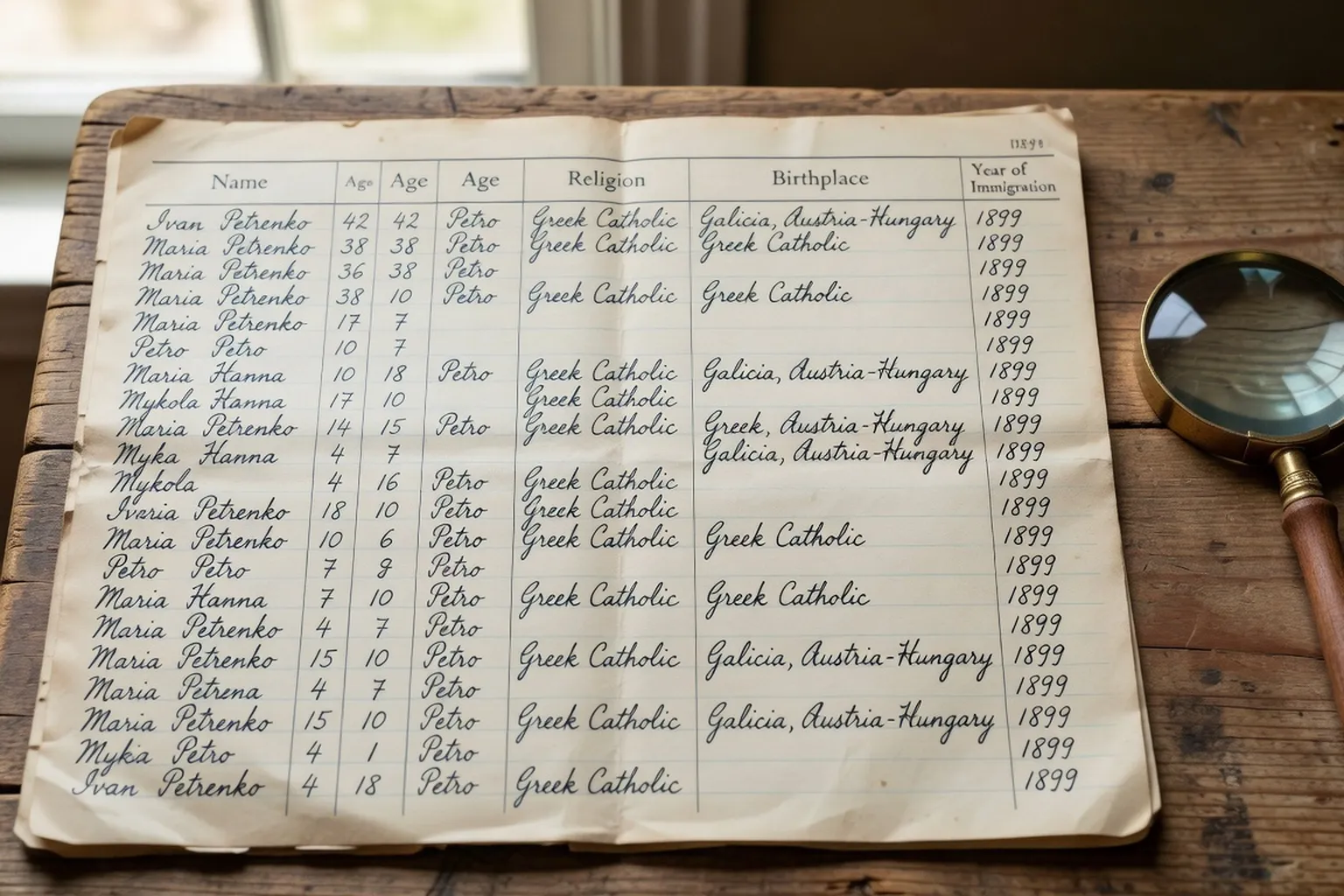
- Backwards in time — once you have the year of immigration (column 9), search the Canadian Immigration Records for Ukrainian Ancestors and the Pier 21 passenger lists. The ship manifest will give you the village of origin in Galicia or Bukovyna, which is the key to tracing your family in the Lviv State Archives.
- Forwards in time — the 1911 census, the 1916 Census of the Prairie Provinces, and the 1921 census let you watch the family grow. Children born in Canada appear; older relatives die or naturalize; brothers split off to new homesteads.
- Sideways — if a sibling or cousin lived in the same district, their 1906 entry may name additional family members. Ukrainian extended families often homesteaded as a unit.
| Pitfall | Why it happens | Safest check |
|---|---|---|
| Polish neighbour mistaken for relative | Galician villages were multi-ethnic | Religion column: Greek Catholic = Ukrainian, Roman Catholic = usually Polish |
| Year of immigration taken too literally | Many settlers returned home and re-emigrated | Check passenger lists for more than one crossing |
| Wrong head of household assumed | Eldest male present listed, not always the original immigrant | Compare with earlier and later censuses |
| Boarders overlooked | Single men boarded with established families | Check column 3 for unrelated names — often cousins or future spouses |
Common Pitfalls to Avoid
Mistaking a Polish neighbour for a Ukrainian relative. Galicia was multi-ethnic; Polish, Jewish, and Ukrainian families lived in the same villages. The religion column is your safest filter: Greek Catholic almost always means ethnic Ukrainian, while Roman Catholic in Galicia usually means ethnic Polish.
The census naturalization column is only the beginning of that story -- for the full research path, see our guide to naturalization and citizenship records for Ukrainian-Canadian ancestors.
Trusting the year of immigration too literally. Ukrainians often arrived in Canada, returned home temporarily, and came back two or three years later. The year recorded was usually the most recent arrival, not the first one. Check passenger lists for both possibilities.
Assuming the head of household is the patriarch. In Ukrainian families, the head was often the eldest male present, not necessarily the original immigrant. A widowed mother could be listed under her oldest son’s surname even when her own household was distinct.
Ignoring boarding workers. Single Ukrainian men often boarded with established families to save money. Check column 3 for non-relatives — they may turn out to be cousins, future spouses, or even the original immigrant ancestor before he sent for his wife.
Conseil : when name searches fail entirely, search by neighbours instead. Ukrainian settlers arrived in chains from the same village, so locating any one family in an enumeration district often reveals the rest of your ancestral community within a few pages.
Where the 1906 Census Will Take You Next
Once you have located your ancestor in the 1906 census, you have everything you need to push the research backwards into Ukraine. The year of immigration points you to a passenger list. The passenger list almost always names a village of origin. The village name lets you identify the parish and church where birth, marriage, and death records were kept. Those records, in turn, are now in the Lviv State Historical Archives or in microfilms at FamilySearch.
For most Ukrainian-Canadian researchers, the 1906 census is the single most important Canadian document standing between them and their ancestral villages. It is free, it is online, and the entire record set can be searched in a single afternoon. If you have not yet looked, start there.
If you are just beginning, our guide on how to start Ukrainian genealogy research walks through the full timeline from oral interview to ancestral village, and our map resources page explains how to convert a vaguely remembered village name into a precise location on a Galician map. Prairie land records complement census data: read our in-depth guide to the 1906 Prairie Census and Ukrainian land records for a step-by-step approach to connecting census entries with homestead files.
Frequently Asked Questions
The 1906 Census of the Northwest Provinces (Manitoba, Saskatchewan, Alberta) was a special interim census taken between the 1901 and 1911 nationwide enumerations. It captures Ukrainian settlers — recorded as Galician, Ruthenian, Bukowinian, or Austrian — at the height of the great migration wave of 1891-1914, often within five years of their arrival.
The full 1906 Census of the Northwest Provinces is available free of charge from Library and Archives Canada at bac-lac.gc.ca. The records are also indexed on FamilySearch and on Ancestry, but the original images are public domain and free at the LAC website. No subscription is required to view or download them.
Most Ukrainian settlers appear as Galician, Ruthenian, Bukowinian, Polish, or Austrian rather than Ukrainian — the term Ukrainian was rarely used in Canadian records before the 1920s. Religion (Greek Catholic, Greek Orthodox, or Roman Catholic) is often the strongest indicator of ethnic Ukrainian identity in this census.
Each line records name, age, sex, relationship to head of household, country of birth, year of immigration, year of naturalization, racial or tribal origin, religion, occupation, and a few livestock columns. There are 33 columns total, and the immigration and naturalization columns are particularly valuable for genealogy.
Possible reasons include: they had not yet immigrated by June 1906; they settled in Ontario, Quebec, or the Atlantic provinces (which were not enumerated in 1906); the surname was misspelled by the enumerator; or they were temporarily absent from the homestead. Search by neighbours and known village clusters when name searches fail.
On the Library and Archives Canada search page, click the entry, then click the linked microfilm reel reference. The original image opens in a viewer where you can zoom, save, and download a high-resolution copy. FamilySearch indexes also link to the original LAC images at no cost.
Yes, in the racial/tribal origin column the enumerator could write Galician, Bukowinian, Ruthenian, or Austrian. In practice, recording was inconsistent and depended on the enumerator. Always check both the origin column and the religion column together to confirm a Ukrainian (Greek Catholic or Greek Orthodox) household.