1. Introduction — Why Church Records Matter
For anyone tracing Ukrainian ancestry, church records are the single most important source of genealogical information. Before governments began keeping civil records, it was the parish priest who documented the milestones of every family’s life: the birth of a child, the union of two families in marriage, and the passing of a soul.
These records — known in Ukrainian as метричні книги (metrychni knyhy, or metrical books) — form an unbroken chain of family history stretching back centuries. For many Ukrainian families, they are the only written evidence of ancestors who lived in small villages across Galicia, Volhynia, Podilia, and Bukovyna.
If you are just beginning your journey into Ukrainian ancestry, our guide on how to start Ukrainian genealogy research will help you lay the groundwork before diving into church records.
2. What Are Metrical Books (Метричні Книги)?
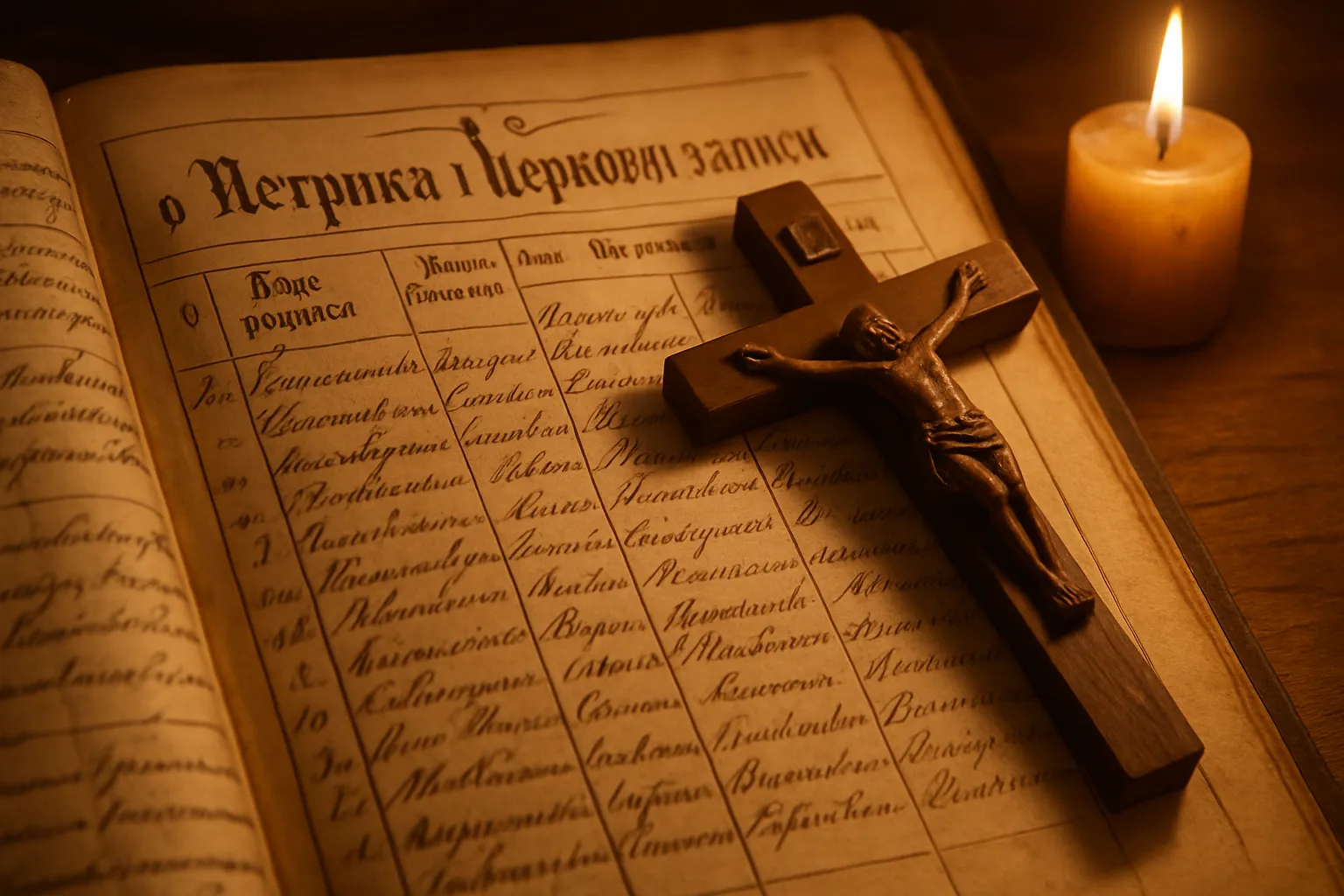
Metrical books are parish registers that recorded three fundamental types of vital events:
- Народження (Narodzhennia) — Births and Baptisms: The most detailed entries, recording the child’s name, date of birth and baptism, parents’ full names (including the mother’s maiden name), godparents, the father’s social class and occupation, and the village of residence.
- Шлюбу (Shliubu) — Marriages: These entries list the bride and groom, their ages, parents’ names, witnesses, and whether any dispensations were required (for example, if the couple was distantly related).
- Смерті (Smerti) — Deaths: Death records include the name and age of the deceased, cause of death, surviving spouse or family members, and the date and place of burial.
How They Were Organized
Most metrical books were organized chronologically within each category. A single volume might contain all three types of records for a given year, or a parish might maintain separate volumes for births, marriages, and deaths. In larger parishes, especially in towns, the volumes could be quite substantial, covering hundreds of entries per year.
Each entry was typically numbered sequentially within the year, making it easier to locate specific records once you know the approximate date of an event.
3. Where to Find Ukrainian Church Records
Finding the right archive is often the biggest challenge in Ukrainian genealogy. Church records from different regions ended up in different repositories due to the complex political history of Ukraine.
Central State Historical Archives of Ukraine in Lviv (TsDIAL)
The Центральний державний історичний архів України у Львові (TsDIAL) is the most important archive for researchers with roots in Galicia — the western Ukrainian lands that were part of the Austro-Hungarian Empire. TsDIAL holds millions of pages of Greek Catholic and Roman Catholic parish records, dating from the 1700s through the early 1900s.
The archive has been steadily digitizing its collections, and many records can now be accessed remotely. Researchers can also hire professional genealogists based in Lviv to conduct on-site searches. For a detailed guide to navigating this essential resource, see our Lviv archives guide.
FamilySearch.org
FamilySearch, operated by The Church of Jesus Christ of Latter-day Saints, has microfilmed and digitized an enormous number of Ukrainian church records. Their collection includes:
- Greek Catholic parish records from hundreds of Galician villages
- Orthodox church records from various Ukrainian regions
- Civil registration records from the Russian Empire period
- Records from Polish state archives that cover Ukrainian territories
Access is free, though some collections require viewing at a FamilySearch Center.
AGAD Warsaw (Archiwum Główne Akt Dawnych)
For ancestors from Galicia, the AGAD archives in Warsaw hold duplicate copies of many Greek Catholic parish records. Under Austro-Hungarian law, parishes were required to send copies of their metrical books to district authorities, and many of these duplicates ended up in Polish archives after World War I.
The Polish government has made significant progress in digitizing these records through the Szukajwarchiwach.gov.pl portal, which provides free online access to scanned images.
Regional Archives in Ukraine
For ancestors from areas outside Galicia, the relevant records are usually held in oblast (regional) state archives:
- Ternopil State Archive — covers parts of eastern Galicia and Podilia
- Ivano-Frankivsk State Archive — covers the Carpathian foothills and parts of southern Galicia
- Zhytomyr State Archive — important for Volhynia
- Kyiv State Archive — covers central Ukraine and has significant Orthodox records
- Chernivtsi State Archive — essential for ancestors from Bukovyna
To explore the diverse regions of Ukraine where your ancestors may have lived, Ukraine Zoom offers detailed geographic and cultural information. Understanding the geography of your ancestral homeland can provide valuable context for your research.
Each archive has its own cataloguing system and access policies. Some have begun digitizing their holdings, but many records still require in-person visits or the assistance of a local researcher.
4. Greek Catholic vs. Orthodox Records — Key Differences
Understanding which church your ancestors belonged to is essential, as it determines where to search and what language the records will be in.
Greek Catholic (Українська Греко-Католицька Церква)
Greek Catholic parishes dominated in Galicia and parts of Transcarpathia. Their records have several distinctive features:
- Language: Entries were often written in Latin (especially column headers and standardized phrases) with names and details in a mix of Latin script and Church Slavonic. After 1784, Austrian authorities required standardized Latin-format registers.
- Format: Galician Greek Catholic records typically followed a tabular format mandated by the Austrian government, with clearly labeled columns for each piece of information.
- Names: Given names often appear in their Latinized forms (e.g., “Joannes” for Ivan, “Maria” for Mariya, “Basilius” for Vasyl).
- Calendar: Greek Catholics used the Julian calendar until the early 20th century, meaning dates are 12-13 days behind the Gregorian calendar.
Orthodox (Православна Церква)
Orthodox parishes were predominant in central and eastern Ukraine, which was part of the Russian Empire. Their records differ significantly:
- Language: Entries were written in Church Slavonic or Russian, using the Cyrillic alphabet exclusively.
- Format: Russian Imperial authorities imposed their own standardized format, which differed from the Austrian model. Columns and categories were organized differently.
- Names: Names appear in their Church Slavonic or Russian forms (e.g., “Иоанн” for Ivan, “Василій” for Vasyl).
- Calendar: The Julian calendar was used throughout the Russian Empire until 1918.
Practical Implications
If your ancestors came from a village near the border between Austrian and Russian-controlled Ukraine, it is worth checking both Greek Catholic and Orthodox records, as some families changed religious affiliation over the generations, and parish boundaries did not always align with political borders.
5. How to Read Ukrainian Church Records
Reading old parish records requires patience and practice. Here are the key skills you will need.
Learning the Scripts
Cyrillic script is used in most Orthodox records and in many Greek Catholic records. The modern Ukrainian alphabet has 33 letters, but older records may use pre-reform characters that are no longer in standard use. Learning to recognize these characters is the essential first step.
Latin script appears in many Galician Greek Catholic records. The column headers are often in Latin, while personal names and place names may appear in Polish or Latinized Ukrainian forms.
Old Church Slavonic characters appear in the oldest records (pre-1800) and can be challenging even for native Ukrainian speakers. The letterforms are more ornate, and abbreviations were common.
Common Latin Terms in Registers
| Latin Term | English Meaning |
|---|---|
| Natus/Nata | Born (male/female) |
| Baptizatus/Baptizata | Baptized (male/female) |
| Parentes | Parents |
| Patrini | Godparents |
| Matrimonium | Marriage |
| Sponsus/Sponsa | Groom/Bride |
| Testes | Witnesses |
| Mortuus/Mortua | Deceased (male/female) |
| Sepultus/Sepulta | Buried (male/female) |
| Religio | Religion |
| Locus | Place |
| Aetas | Age |
| Causa mortis | Cause of death |
| Legitimus/Legitima | Legitimate (male/female) |
| Agricola | Farmer |
| Incola | Resident/Inhabitant |
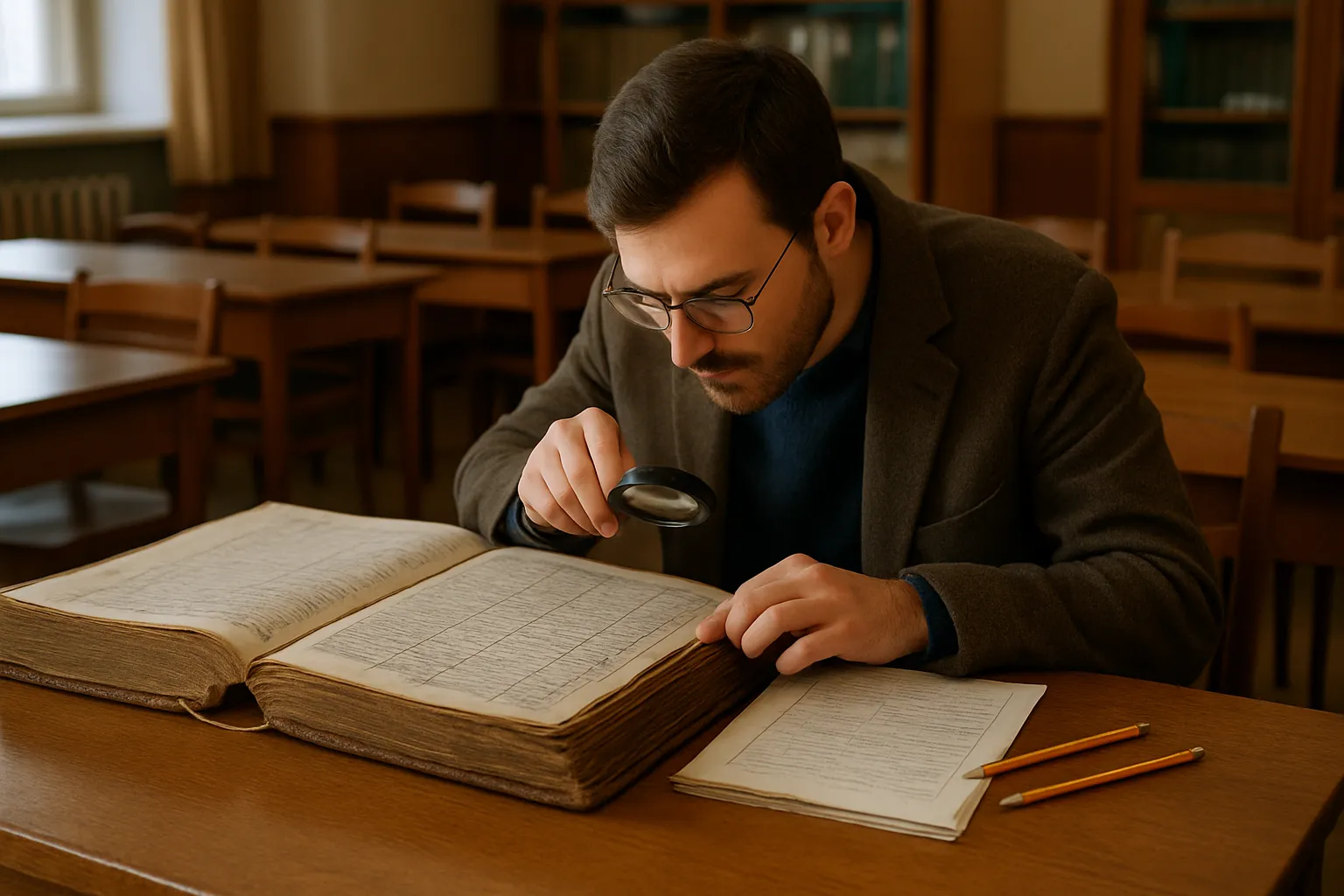
Tips for Deciphering Handwriting
Old handwriting — whether in Cyrillic or Latin script — presents its own challenges. Priests varied enormously in the legibility of their writing, and ink has often faded over the centuries. Here are practical strategies:
- Compare known letters: When you encounter an unfamiliar word, look for letters you can identify with certainty and use them as anchors to decode the rest.
- Use context clues: If you are reading a birth entry, you know certain words must appear (the child’s name, the parents’ names, the village name). This narrows down the possibilities.
- Cross-reference entries: The same names appear repeatedly in a parish register. If you cannot read a name in one entry, find another entry for the same family where the handwriting may be clearer.
- Study the priest’s style: Each priest had consistent handwriting habits. Spend time with multiple entries to learn the particular curves and abbreviations that priest favored.
- Consult paleography guides: Online resources and genealogy forums offer alphabet charts and examples of historical handwriting styles used in Ukrainian church records.
6. Understanding the Structure of a Metrical Book Entry
Birth and Baptism Entry (Typical Galician Format)
A standard birth entry in a Galician Greek Catholic metrical book contains these columns, usually in Latin:
- Numerus — Sequential entry number for the year
- Dies et Annus Nativitatis — Date and year of birth
- Dies et Annus Baptismi — Date and year of baptism
- Nomen Infantis — Name of the child
- Religio — Religion
- Sexus — Sex of the child
- Parentes (Pater/Mater) — Parents’ names, including the mother’s maiden name
- Conditio et Locus Patris — Father’s social status, occupation, and place of residence
- Patrini — Godparents’ names and residence
- Sacerdos Baptizans — Name of the baptizing priest
Marriage Entry
Marriage records typically include:
- Entry number and date of marriage
- Groom’s name, age, religion, status (bachelor or widower), occupation, and village
- Groom’s parents’ names
- Bride’s name, age, religion, and status (maiden or widow)
- Bride’s parents’ names
- Names of witnesses
- Whether banns were read (and any dispensations granted)
- Name of the officiating priest
Death Entry
Death records are often the simplest but can still yield valuable information:
- Entry number and date of death
- Name of the deceased
- Age at death
- Religion and status
- Cause of death
- Date of burial
- Name of surviving spouse (if applicable)
7. Navigating Common Challenges
Name Variations
Ukrainian names were recorded in many different forms depending on the language of the record and the preferences of the recording priest. The same person might appear as:
- Ivan / Joannes / Jan / Іоанъ — all versions of the name John
- Vasyl / Basilius / Bazyli / Василій — all versions of Basil
- Paraskeva / Parasceva / Paraska / Параскева — a common women’s name
Surnames also varied in spelling, and women’s surnames were feminized (e.g., a woman from the Kravchuk family would appear as Kravchukova or Kravchukówna for an unmarried woman).
Missing Records
Gaps in the record are unfortunately common. Wars, fires, floods, and deliberate destruction have all taken their toll. If records for your ancestral village are missing for a particular period, consider:
- Checking duplicate copies in other archives (AGAD Warsaw for Galician records, diocesan archives)
- Looking at neighboring parish records, as village residents sometimes attended a church in an adjacent parish
- Examining census records or other civil documents that may fill in the gaps
Jurisdictional Changes
Ukraine’s borders have shifted dramatically over the centuries. A village that was in Austria-Hungary in 1900 might have been in Poland in 1930, in the Soviet Union in 1945, and in independent Ukraine today. Each change of jurisdiction affected where records were kept and in what language. Using map resources for Ukrainian genealogy can help you track these changes and identify the correct archive for your time period.
8. Practical Steps to Get Started
If you are ready to begin working with Ukrainian church records, follow this approach:
-
Identify your ancestral village: This is the essential first step. Without a village name, finding the correct parish records is nearly impossible. Canadian immigration records, census entries, and family oral history are your best sources for this information.
-
Determine the parish: Once you know the village, identify which parish church served it. Not every village had its own church — many were served by a neighboring parish. Historical gazetteers and maps can help with this.
-
Locate the records: Use the archive guides above to determine where the metrical books for that parish are held. Check FamilySearch first, as their collections are free and accessible from anywhere.
-
Learn the basics of the script: Spend a few hours learning Cyrillic or reviewing Latin genealogical terms before diving into the records. This small investment of time will save you hours of frustration later.
-
Start with what you know: Begin by looking for events where you already know the date — a great-grandparent’s birth year, for example. Finding a known entry gives you practice reading the handwriting and confirms you have the right parish.
-
Work backward: Once you find one ancestor, use the parents’ names listed in their entry to search for the parents’ marriage record, then the grandparents’ birth records, and so on.
To understand the broader context of your ancestors’ journey, explore our article on Ukrainian community and family histories in Canada, which documents the settlements and communities they built in their new homeland.
9. Additional Resources
The following resources will support your work with Ukrainian church records:
- FamilySearch Wiki — Ukraine: Comprehensive guides to records by region and denomination
- Gesher Galicia: While focused on Jewish records, this organization has catalogued many Galician archive holdings that are useful for all researchers
- Ukraine SIG (Special Interest Group): An online community of researchers working with Ukrainian records, offering advice and translation assistance
- Matthew Bielawa’s “Ukrainian Genealogy” guide: A well-regarded introduction to the field with detailed information on archive collections
- Genealogy Indexer (genealogyindexer.org): Searchable indexes of some Ukrainian church record collections
Church records are the backbone of Ukrainian genealogy research. While they can be challenging to locate and read, the rewards are extraordinary — each entry connects you directly to an ancestor’s life, preserving their name and story for future generations. With patience, the right resources, and the growing availability of digitized records, tracing your Ukrainian family through parish registers has never been more accessible.
Frequently Asked Questions
Metrical books (метричні книги, metrychni knyhy) are parish registers maintained by Ukrainian churches — both Greek Catholic and Orthodox — that recorded vital events: births and baptisms (народження), marriages (шлюбу), and deaths (смерті). They are the primary source for Ukrainian genealogy research before civil registration began.
FamilySearch.org has digitized millions of Ukrainian parish records that are freely accessible. The Central State Historical Archives of Ukraine in Lviv (TsDIAL) has been digitizing its collections. Some records from Galicia are also available through the AGAD archives in Warsaw and the Szukajwarchiwach.gov.pl Polish portal.
Greek Catholic records from Galicia (western Ukraine) were often written in Latin or a mix of Latin and Church Slavonic, following formats similar to Roman Catholic parishes. Orthodox records from central and eastern Ukraine were typically written entirely in Church Slavonic or Russian, with different column layouts and terminology.
The oldest surviving Ukrainian parish records date to the late 1600s, but most available records begin in the mid-1700s. Coverage varies significantly by region and parish. Many records were destroyed during wars, fires, and political upheavals. For Galicia, continuous records from the 1770s onward are relatively common.
Start by learning the Cyrillic alphabet — it can be mastered in a few hours. Many Galician records use Latin script, which is more accessible. Use online paleography guides, join genealogy forums where experienced researchers can help with difficult entries, and familiarize yourself with common terms and abbreviations used in registers.
Birth records typically include the child's name, date of birth and baptism, parents' names with the mother's maiden name, godparents' names, the father's occupation and social status, and the village or town. Marriage records list both spouses, their ages, parents, and witnesses. Death records include the deceased's name, age, cause of death, and surviving family members.