# Ukrainian Genealogy Glossary: 50 Essential Terms in Ukrainian, Polish, Russian and Latin Learn more about reading old Cyrillic church records.
How to Use This Genealogy Glossary
This glossary is designed to assist genealogists navigating Ukrainian, Polish, Russian, and Latin records—languages commonly encountered in Eastern European church and civil archives. Ukrainian genealogy often involves cross-referencing multiple languages due to historical political divisions and the shifting borders of empires (Polish-Lithuanian Commonwealth, Austrian Empire, Russian Empire). Many vital records were kept by the Greek Catholic (Uniate), Orthodox, or Roman Catholic churches before the establishment of civil registration in the 19th century. Terms like metrychna knyha (metrical book) or sprava (case/file) refer to specific types of documents, while place names may appear in regional languages depending on the time period and location. Understanding these terms helps researchers interpret records accurately and locate ancestral information in archives across Ukraine and neighboring regions.
Key takeaway: The same genealogical concept can appear in four different languages depending on which empire administered the region and when — always check the Ukrainian, Polish, Russian, and Latin equivalents before concluding a term is unfamiliar.
This glossary is organized into five sections:
- Vital records terms (metrical books, baptisms, marriages, burials)
- Church and religious terms (parishes, dioceses, denominations)
- Archive and document terms (fonds, inventories)
- Place name and geography terms (administrative divisions)
- Calendar and date terms (Julian vs. Gregorian conversions)
Section 1: Vital Records Terms
| Ukrainian Term | Polish | Russian | Latin | Meaning |
|---|---|---|---|---|
| Метрична книга (Metrychna knyha) | Księga metrykalna | Метрическая книга | Liber Matrimoniorum/Matricula | Parish register of vital events |
| Хрещення (Khreshchennia) | Chrzest | Крещение | Baptisma | Baptism |
| Шлюб / Вінчання (Shliub / Venchannia) | Małżeństwo / Wesele | Бракосочетание / Венчание | Matrimonium | Marriage ceremony |
| Поховання (Pohrebennia) | Pogrzeb | Похороны | Sepultura | Burial record |
| Народження (Narodzhennia) | Urodzenie | Рождение | Nativitas | Birth record |
1. Метрична книга (Metrychna knyha) | Księga metrykalna | Метрическая книга (Metricheskaya kniga) | Liber Matrimoniorum/Matricula
A bound volume maintained by a parish or church to record vital events such as baptisms, marriages, and burials. These books, often dating from the 17th to early 20th centuries, are the cornerstone of Ukrainian genealogical research. Entries are typically chronological and include names, dates, witnesses, and locations. For example, a metrychna knyha from a Greek Catholic parish in Galicia might list a birth entry as: 1785, 10 July – Baptized Maria, daughter of Ivan and Anna Hrytsiv, with godparents Vasyl Melnyk and Oksana Koval.
2. Хрещення (Khreshchennia) | Chrzest | Крещение (Kreshchenie) | Baptisma
The sacrament of baptism, recorded in church registers. These entries often include the date of baptism (sometimes different from birth), the child’s name, parents’ names, godparents (pokhresny bat’ko), and witnesses. In Polish records, this may appear as Chrzest or Baptisma. Example: 1823, 15 March – Baptized Petro, son of Mykhailo Synytsia and Hanna Dmytriv, godfather: Teodor Hrytsiv.
**3. Шлюб / Вінчання (Shliub / Venchannia) | Małżeństwo / Wesele | Бракосочетание (Brakosochetanie) / Венчание (Venchanie) | Matrimonium*
The record of a marriage ceremony, often called venchannia in Ukrainian and wesele in Polish. Entries typically include the marriage date, names of the bride and groom, their ages, places of origin, witnesses (svidky), and sometimes the parents' names. Example: 1810, 20 November – Married Ivan Kovalchuk and Maria Petrenko, both of the village of Tyshkiv, witnesses: Petro Bohach and Hanna Shostak.
**4. Поховання (Pohrebennia) | Pogrzeb | Похороны (Pokhorony) | Sepultura*
The burial record, which often includes the date of death and burial, the deceased’s name, age, and sometimes cause of death. In older Latin records, Sepultura may be abbreviated as Sep.. Example: 1842, 3 October – Buried Hanna, widow of Semen Lysiuk, aged 78, from Velyki Mosty.
**5. Народження (Narodzhennia) | Urodzenie | Рождение (Rozhdenie) | Nativitas*
A birth record, though less common than baptismal entries. When present, it may include the child’s name, date of birth, parents’ names, and sometimes the midwife or witnesses. Example: 1850, 5 June – Born Petro, son of Ivan and Maria Hryhorovych, village of Rohatyn.
**6. Похресний батько (Pokhresny bat’ko) | Ojciec chrzestny | Крестный отец (Krestnyy otec) | Patrinus*
The godfather in a baptismal record. Godfathers were often relatives or respected community members and are frequently named in khreshchennia entries. Example: Pokhresny bat’ko: Ivan Sydorenko, uncle of the child.
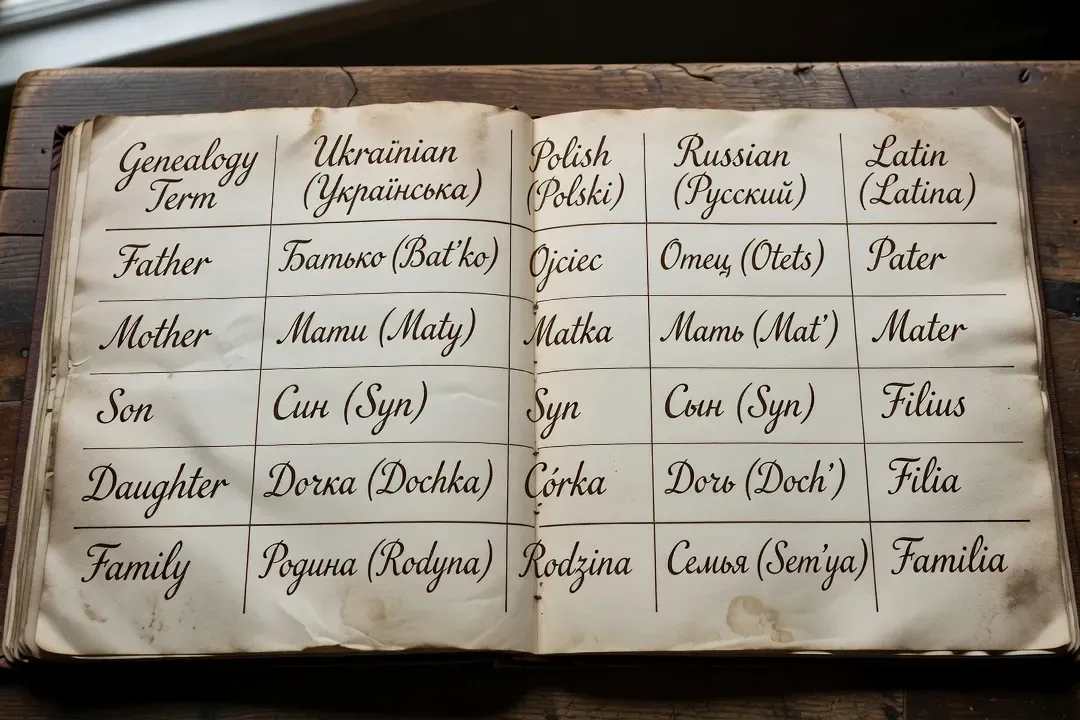
Comparison table showing Ukrainian, Polish, Russian and Latin genealogy terms side by side.
**7. Свідки (Svidky) | Świadkowie | Свидетели (Svideteli) | Testes*
Witnesses to a vital event, such as baptism, marriage, or burial. Their names and sometimes social status (e.g., selianyn—peasant) are recorded. Example: Svidky: Mykhailo Korol and Hanna Vasyliv, neighbors. Learn more about Ukrainian church records and metrical books.
**8. Незаконнонароджений (Nezakonnonarodzhenyi) | Nieślubny | Незаконнорожденный (Nezakonnorozhdennyy) | Illegitimus*
A term used in historical records to denote a child born out of wedlock. Such entries may include the mother’s name and the child’s baptism details, sometimes with additional notes. Example: 1798, 25 December – Baptized Yurii, illegitimate son of Hanna Koval, godmother: Oksana Shevchuk. For further reading, see Ukrainian place names and their historical spelling variations.
**9. Вдівець / Вдова (Vdovets / Vdova) | Wdowiec / Wdowa | Вдовец / Вдова (Vdovets / Vdova) | Vidua / Viduus*
A widower (vdovets) or widow (vdova), terms often included in marriage records to indicate the marital status of the bride or groom. Example: 1830, 10 October – Married Ivan Vdovets, widower of Hanna Petrenko, to Maria Kovalchuk, maiden.
**10. Другий шлюб (Druhyi shliub) | Drugie małżeństwo | Второй брак (Vtoroy brak) | Secundae nuptiae*
A second marriage, recorded when a widowed or divorced individual remarries. These entries often include the deceased spouse’s name and the date of their death. Example: 1860, 5 March – Second marriage of Petro Hrytsiv, widower of Hanna Khomyn, to Maria Dmytriv.
Section 2: Church and Religious Terms
**11. Грамота (Hramota) | Pismo | Грамота (Gramota) | Litterae / Charta*
A charter, decree, or official document issued by a church or secular authority. In genealogical context, hramoty may include land grants, nobility confirmations, or clerical appointments. Example: A 1745 hramota from the Uniate Metropolitan confirmed the appointment of a priest to the parish of Zhovkva.
**12. Церковний прихід (Tserkovnyi prykhid) | Parafia | Церковный приход (Tserkovnyy prikhod) | Parochia*
A parish, the administrative unit of a church where vital records were kept. Parishes could be Greek Catholic, Orthodox, Roman Catholic, or Jewish, depending on the region. Example: Records from the Tserkovnyi prykhid of Zboriv (Galicia) document births from 1820–1850. Learn more about Ukrainian village name history and research.
**13. Єпархія (Eparkhiia) | Diecezja | Епархия (Eparkhiya) | Dioecesis*
A diocese or eparchy, a larger ecclesiastical jurisdiction overseeing multiple parishes. In Ukrainian Greek Catholic records, this may appear as eparkhiia under the authority of a metropolitan. Example: The records of the Eparkhiia of Peremyshl (Przemyśl) include registers from parishes in Lemko and Boyko regions.
**14. Священник / Парах (Svyashchenyk / Parókh) | Ksiądz / Pleban | Священник (Sviashchennik) / Приходский священник (Prikhodskiy sviashchennik) | Sacerdos / Parochus*
A priest (svyashchenyk in Ukrainian, ksiądz in Polish), responsible for maintaining parish records. In Greek Catholic and Orthodox traditions, priests were often married (odruzhennyi), a detail that may appear in records. Example: Father Ivan Hrytsiv, parish priest of Rohatyn, recorded 25 baptisms in 1845.
**15. Греко-Католицька Церква (Hreko-Katolytska Tserkva) | Kościół Greckokatolicki | Греко-Католическая Церковь (Greko-Katolicheskaya Tserkov’) | Ecclesia Graeco-Catholica*
The Ukrainian Greek Catholic Church, historically dominant in Galicia and part of western Ukraine. Uniate in doctrine but Eastern in rite, it was suppressed in 1946 under Soviet rule but revived in 1989. Example: Vital records from a Hreko-Katolytska Tserkva in Lviv mention the use of both Ukrainian and Church Slavonic in entries. See also: our full list of free Ukrainian genealogy websites.
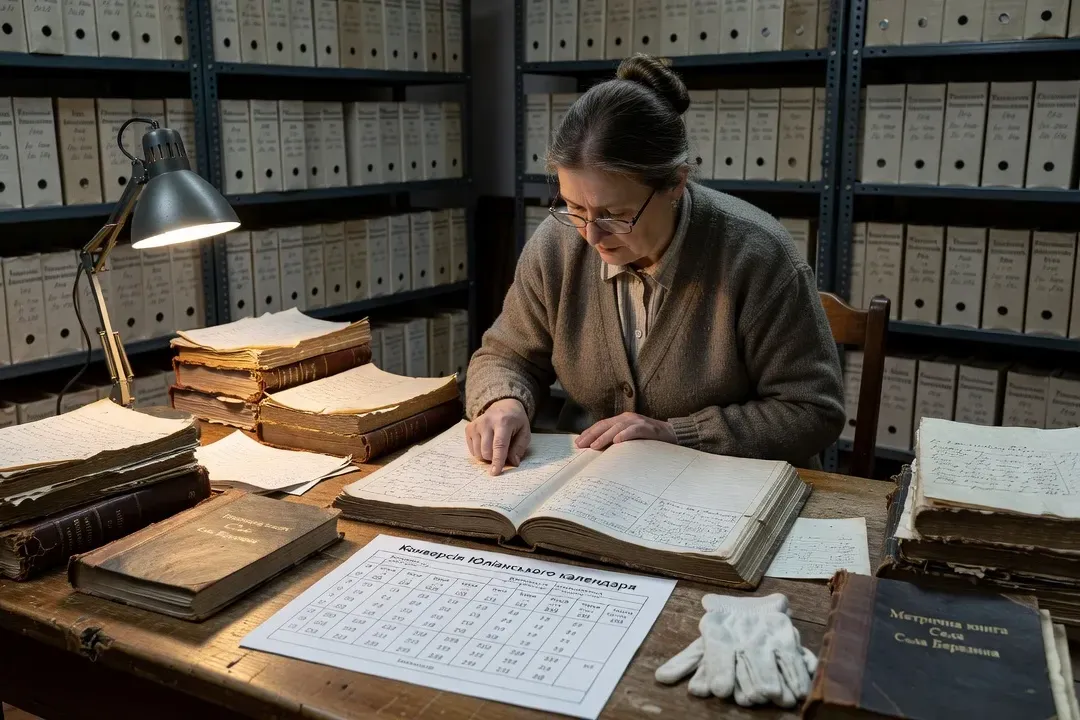
Ukrainian archivist pointing to Julian calendar conversion chart next to Cyrillic date entries in old church register.
**16. Православна Церква (Pravoslavna Tserkva) | Cerkiew prawosławna | Православная Церковь (Pravoslavnaya Tserkov’) | Ecclesia Orthodoxa*
The Orthodox Church, which split from the Roman Catholic Church in 1054 and had a strong presence in central and eastern Ukraine. Example: Orthodox parish records in Chernihiv gubernia (governorate) often used Old Church Slavonic before switching to Russian.
**17. Уніатська Церква (Uniiatska Tserkva) | Kościół unicki | Униатская Церковь (Uniatskaya Tserkov’) | Ecclesia Unita*
The term Uniate refers to the Greek Catholic Church during the period of its union with Rome (formalized in 1596 at the Union of Brest). Records may use Uniiatska Tserkva to distinguish from Orthodox or Roman Catholic parishes. Example: A uniiatska tserkva in Kamianets-Podilskyi recorded marriages in Polish and Church Slavonic until the late 18th century.
**18. Ікона (Ikona) | Ikona | Икона (Ikona) | Icona*
An icon, often mentioned in church inventories or as part of a priest’s estate. Icons were central to Orthodox and Greek Catholic worship and sometimes included dedicatory inscriptions. Example: In the 1790 inventory of St. George’s Church in Drohobych, an ikona of the Virgin Mary is listed among parish property.
**19. Престол (Prestol) | Ołtarz | Престол (Prestol) | Altare*
The altar in a church, where sacraments were performed. In inventories, prestol may refer to the altar’s furnishings or relics. Example: The 1812 inventory of the Ternopil parish church lists the prestol, cross, and Gospel books as parish assets.
**20. Храм (Khram) | Kościół | Храм (Khram) | Templum / Ecclesia*
A church building, as opposed to a chapel or home shrine. The term khram is used in both Orthodox and Greek Catholic contexts. Example: Records from the khram of St. Michael in Kyiv mention a fire in 1715 and subsequent rebuilding.
Section 3: Archive and Document Terms
**21. Архів (Arkhiv) | Archiwum | Архив (Arkhiv) | Archivum*
An archive, where historical documents are preserved. Ukrainian archives (e.g., Central State Historical Archive of Ukraine in Lviv (CDIAL)) hold vital records, land deeds, and nobility papers. Example: The Central State Historical Archive in Kyiv holds fond 123, containing noble estate records from Volhynia.
**22. Фонд (Fond) | Zespół archiwalny | Фонд (Fond) | Fundus*
An archival fond, or collection of records from a single institution or family. Fond numbers (e.g., Fond 201, opis 1) help researchers locate specific documents. Example: Fond 166, opis 1, sprava 45 in the Lviv archive contains Greek Catholic parish records from Rohatyn.
Common pitfall: Confusing "fond," "opis," and "sprava" — a fond is the top-level collection, an opis is the inventory within it, and a sprava is the individual case/file. Citing a document without all three reference numbers makes it very difficult to relocate later.
**23. Опис (Opys) | Inwentarz | Опис (Opis) | Inventarium*
An inventory or catalog of archival materials, often called a finding aid. Opysy list fond contents by sprava (case/file) and arkush (folio). Example: The opys for Fond 228 describes 15 opis and 234 spravy, including census records from 1811.
Section 4: Place Name and Geography Terms
Selo (village)
Ukrainian Cyrillic: Село Romanized: selo Polish equivalent: wieś Russian equivalent: село (selo)
In Ukrainian genealogy records, selo refers to a rural settlement, smaller than a town (misto). These villages were often the primary unit of local administration in Cossack Hetmanate and later Russian Imperial records. For example, a church record might list a birth as occurring "в селі Іванівка" (v seli Ivanivka, "in the village of Ivanivka").
Misto (town/city)
Ukrainian Cyrillic: Місто Romanized: misto Polish equivalent: miasto Russian equivalent: город (gorod)
Misto denotes an urban settlement, ranging from small towns to large cities. In Polish partitions, miasto often indicated a legally incorporated town with certain rights. Russian records might use gorod or posad (trading settlement). A typical entry could read: "у місті Львів" (u misti L’viv, "in the city of Lviv").
Povit (district, Austrian era)
Ukrainian Cyrillic: Повіт Romanized: povit German/Polish equivalents: Kreis / powiat
During the Habsburg period, povit was an administrative district within a krai (region), equivalent to a Polish powiat or German Kreis. These divisions appeared in Galician church and civil records. For instance, a birth might be recorded as "у повіті Золочівському" (u poviti Zoločivs’komu, "in the Zoločiv district").
Hromada (commune/community)
Ukrainian Cyrillic: Громада Romanized: hromada Polish equivalent: gmina Russian equivalent: община (obshchina)
Originally signifying a rural community with shared responsibilities, hromada became a formal administrative unit in the late 19th century. In Polish partitions, it aligned with gmina, while in Russian records, it often referred to peasant communes. Church books might note: "громадою села..." (hromadoiu sela..., "the commune of the village...").
Huberniya (governorate, Russian era)
Ukrainian Cyrillic: Губернія Romanized: huberniya Russian equivalent: губерния (guberniya) Polish equivalent: gubernia
A huberniya was a major administrative division in the Russian Empire, equivalent to a province. Records from these regions often include terms like guberniya or gubernatorstvo. For example: "Київська губернія" (Kyïvs’ka huberniya, "Kyiv Governorate").
Halyshchyna (Galicia)
Ukrainian Cyrillic: Галичина Romanized: Halyščyna Polish equivalent: Galicja German equivalent: Galizien
Halyshchyna refers to the historical region of Galicia, encompassing western Ukraine and southeastern Poland. Austrian records often used Galizien, while Polish sources might say Galicja. A typical record could list a birthplace as "Галичина, повіт Львів" (Halyščyna, povit L’viv, "Galicia, Lviv District").
Bukovyna (Bukovyna)
Ukrainian Cyrillic: Буковина Romanized: Bukovyna Romanian equivalent: Bucovina German equivalent: Bukowina
Bukovyna is a historical region straddling modern Ukraine and Romania. Austrian records used Bukowina, while Romanian sources called it Bucovina. A church entry might read: "у Буковині, місто Чернівці" (u Bukovyni, misto Černivci, "in Bukovyna, the city of Chernivtsi").
Volyn (Volhynia)
Ukrainian Cyrillic: Волинь Romanized: Volyn’ Polish equivalent: Wołyń Russian equivalent: Волынь (Volyn’)
Volyn’ is a historical region in northwestern Ukraine. Polish partitions called it Wołyń, while Russian records used Volyn’. A typical entry could be: "Волинська губернія" (Volyns’ka huberniya, "Volhynia Governorate").
Podillia (Podillia)
Ukrainian Cyrillic: Поділля Romanized: Podillia Polish equivalent: Podole Russian equivalent: Подолия (Podoliya)
Podillia refers to the central-southern historical region now split between Ukraine and Moldova. Polish records used Podole, while Russian sources said Podoliya. A church book might note: "Подільська губернія" (Podil’s’ka huberniya, "Podolia Governorate").
Sloboda (free settlement)
Ukrainian Cyrillic: Слобода Romanized: sloboda Russian equivalent: слобода (sloboda)
Originally denoting a settlement exempt from certain taxes, sloboda became a common term for villages or suburban areas. Russian records often used it to describe settlements near fortresses or monasteries. An example entry: "слобода Іванівка" (sloboda Ivanivka, "the settlement of Ivanivka").
Section 5: Calendar and Date Terms
| Term | Ukrainian Cyrillic | Meaning |
|---|---|---|
| Staroho styliu | Старого стилю | Old Style / Julian calendar, used until 1918 |
| Novoho styliu | Нового стилю | New Style / Gregorian calendar |
| Richne chyslo | Річне число | Year number in a date |
| Misyats | Місяць | Month |
| Den | День | Day of the month |
| Rizdvo | Різдво | Christmas/Nativity feast day |
| Velykden | Великдень | Easter, a movable feast |
Practical steps for handling Julian-to-Gregorian conversions in records:
- Add 13 days to Julian dates for events after 1900
- Add 12 days for events between 1800 and 1900
- Add 11 days for events between 1700 and 1800
- Always note in your research log which calendar style the original record used
Staroho styliu (Old Style / Julian calendar)
Ukrainian Cyrillic: Старого стилю Romanized: staroho styliu
The staroho styliu was the Julian calendar used in the Russian Empire and Orthodox churches until 1918. Dates were 13 days behind the Gregorian calendar (novoho styliu). Genealogists must convert these dates—for example, a birth recorded as "1 січня 1850 року" (1 sichnia 1850 roku) under the Old Style corresponds to January 13, 1850, in the New Style.
Novoho styliu (New Style / Gregorian calendar)
Ukrainian Cyrillic: Нового стилю Romanized: novoho styliu
The novoho styliu refers to the Gregorian calendar adopted in Western Europe in 1582 and later in Austria-Hungary (1587) and Russia (1918). Records from these regions after their respective adoption dates use the Gregorian calendar. For instance, a Polish civil record might list "1918 r., 15 października" (October 15, 1918), using the Gregorian style.
Richne chyslo (year number)
Ukrainian Cyrillic: Річне число Romanized: richne chyslo
Richne chyslo indicates the year in a date, often abbreviated as "р." (r., for rik). In church records, years might be written in Roman numerals or spelled out. For example: "1850 року" (1850 roku, "the year 1850") or "MDCCCL" (Roman numerals for 1850).
Misyats (month)
Ukrainian Cyrillic: Місяць Romanized: misiats
Misiats denotes the month in a date. Ukrainian records often use the genitive case for months, e.g., "січня" (sichnia, "of January") in "1 січня" (1 sichnia, "January 1"). Polish records might use "stycznia" for January, while Russian records use "января" (yanvarya).
Den (day)
Ukrainian Cyrillic: День Romanized: den
Den’ refers to the day of the month in a date. Ukrainian records typically list the day first, followed by the month and year, e.g., "1 січня 1850 року" (1 sichnia 1850 roku, "January 1, 1850"). Polish and Russian records follow similar conventions but use their respective month forms.
Yuliianskyi kalendar (Julian calendar)
Ukrainian Cyrillic: Юліанський календар Romanized: Yuliianskyi kalendar
The Yuliianskyi kalendar is the Julian calendar, named after Julius Caesar. It was the standard in Orthodox and Eastern Catholic churches. Genealogists must account for the 13-day discrepancy when comparing records from regions using the Julian and Gregorian calendars.
Hryhorianskyi kalendar (Gregorian calendar)
Ukrainian Cyrillic: Григоріанський календар Romanized: Hryhorians’kyi kalendar
The Hryhorians’kyi kalendar is the Gregorian calendar, introduced by Pope Gregory XIII in 1582. It was adopted in Catholic and Protestant regions earlier than in Orthodox areas. Records from these regions use the Gregorian calendar exclusively after their adoption dates.
Rizdvo (Christmas/Nativity)
Ukrainian Cyrillic: Різдво Romanized: Rizdvo
Rizdvo signifies Christmas, celebrated on January 7 in the Julian calendar (Old Style) and December 25 in the Gregorian calendar (New Style). Church records often include feast days, such as "Різдво Христове" (Rizdvo Khrystove, "Nativity of Christ"), which can help date events.
Velykden (Easter)
Ukrainian Cyrillic: Великдень Romanized: Velykden’
Velykden’ is Easter, a movable feast calculated differently in the Julian and Gregorian calendars. Records might note "Великдень 1850 року" (Velykden’ 1850 roku, "Easter 1850"), which occurred on April 14 in the Julian calendar and April 26 in the Gregorian.
Pist/Pisna (fast/Lent)
Ukrainian Cyrillic: Піст Romanized: pist
Pist refers to a fasting period, most notably Great Lent (Великий піст, Velykyi pist), leading to Easter. Church records may mention deaths or events occurring during Lent, such as "помер під час посту" (pomer pid chas postu, "died during the fast").
Conclusion
Understanding Ukrainian archival terminology is essential for accurate genealogical research. Place names like selo or misto reveal administrative divisions, while calendar terms like staroho styliu or Velykden’ clarify date discrepancies. Researchers must cross-reference regional practices—whether Polish gmina or Russian guberniya—and convert Old Style dates to New Style for consistency. By mastering these terms, genealogists can navigate church, civil, and census records with precision, uncovering ancestral stories hidden in the nuances of Ukrainian archival language. Always verify local conventions, as administrative and calendar systems evolved over time and varied by region.
Frequently Asked Questions
Ukrainian church records were written in multiple languages depending on the era and church denomination. Pre-1918 Orthodox and Greek Catholic records used Church Slavonic (written in Cyrillic) or Latin for formal entries, with Ukrainian-language annotations becoming more common from the 1870s onward. Under Polish administration (1918-1939), records were often kept in Polish. After Soviet occupation, records shifted to Ukrainian or Russian. Canadian Ukrainian parish records are mostly in Ukrainian Cyrillic until the 1930s-1950s, then increasingly in English.
Metrychna knyha (Ukrainian: метрична книга, plural: metrychni knyhy) literally means metrical book or register. It refers to the official parish registers maintained by Ukrainian churches to record vital events: births/baptisms, marriages, and deaths/burials. These are the Ukrainian equivalent of civil vital records for communities where the church rather than the state recorded life events. Metrical books are the primary genealogical source for Ukrainian ancestors who lived before civil registration became widespread.
Julian calendar dates in Ukrainian records need 13 days added for events after 1900, 12 days for events 1800-1900, and 11 days for events 1700-1800 to convert to Gregorian dates. For example, a baptism recorded as January 6 (Julian) in 1895 would be January 18 (Gregorian). The Julian calendar runs behind the Gregorian calendar and the gap increases by one day per century. This is important for matching Ukrainian church record dates with Canadian civil registration dates.
A revizka skazka (Russian: ревизская сказка) is a household census or revision list conducted by the Russian Imperial government in territories it controlled, including parts of eastern Ukraine. These surveys, conducted roughly every 20-30 years from the 1720s to 1850s, recorded all peasant and state households with names, ages, and relationships. They are invaluable for pre-civil registration genealogy research in right-bank Ukraine, Podillia, Volhynia, and regions under Russian rather than Austrian administration.
Metrikant (from Latin metrica) refers to the record of a specific type of vital event in a church register — a birth/baptism entry, marriage entry, or death/burial entry. In older Ukrainian church records you may encounter phrases like 'vnesen do metryky' (entered into the registry) or 'metrikant' used as a heading for individual entries. Understanding this term helps researchers navigate Latin-language headers in Ukrainian Greek Catholic records, which often used Latin administrative terminology even when the main record text was in Ukrainian or Church Slavonic.