Why Online Research Has Changed Ukrainian Genealogy
Genealogy research has undergone a remarkable transformation in recent years, particularly for those tracing Ukrainian-Canadian ancestry. The digitization of historical records, the rise of DNA testing, and the growth of online communities have made it possible for researchers—whether in Canada, Ukraine, or elsewhere—to uncover family connections that were once nearly impossible to find. For Canadian researchers, this digital revolution is invaluable. Many Ukrainian immigrants arrived in Canada between 1891 and 1914, settling in the prairies and establishing tight-knit communities. Their descendants often seek church records, immigration manifests, homestead files, and naturalization documents to piece together their family histories. Learn more about how to start Ukrainian genealogy research. This connects to cultural immersion programs for Ukrainian-Canadians tracing their roots.
Thanks to free online databases, genealogy enthusiasts can now access records from Ukraine, Canada, and beyond without leaving their homes. Websites like FamilySearch and the Library and Archives Canada (LAC) portal provide digitized church books, census records, and immigration files, while DNA platforms like MyHeritage and GEDmatch help connect distant relatives across continents. Ukrainian-specific resources such as Genea-Ukraina and DAMU/TsDIAU offer transcribed metrical books and archival documents that are critical for tracing ancestors in Galicia, Volhynia, or Bukovyna. Meanwhile, community-driven platforms like the Ukrainian Genealogy Society Canada Facebook Group provide mentorship and collaborative problem-solving.
The following list highlights the 15 best free Ukrainian genealogy websites and databases in 2026, carefully selected for their relevance to Canadian researchers. Whether you're just beginning your search or looking to break through brick walls, these resources will help you uncover your Ukrainian roots.
Key takeaway: No single resource covers every record type. Canadian researchers get the best results by starting with FamilySearch and Library and Archives Canada for the Canadian side of the story, then turning to Genea-Ukraina, DAMU/TsDIAU, or JRI-Poland once a specific Ukrainian village or region has been identified.
| # | Resource | Type | Best For |
|---|---|---|---|
| 1 | FamilySearch.org | Free database | Ukrainian church records, Canadian censuses |
| 2 | Library and Archives Canada | Free archive | Immigration, census, homestead records |
| 3 | Ancestry.ca | Freemium | Church records, land grants, DNA matching |
| 4 | Genea-Ukraina | Free transcription project | Metrical books from Galicia, Volhynia, Podolia |
| 5 | GenealogyIndexer.org | Free search engine | Newspapers, obituaries, Yizkor books |
| 6 | MyHeritage.com | Freemium DNA/trees | SmartMatching, SuperSearch database |
| 7 | JRI-Poland | Mixed free/paid | Galician Jewish vital records |
| 8 | DAMU/TsDIAU | Archive (fee for copies) | Central Ukrainian regions (Kyiv, Chernihiv) |
| 9 | UGSC Facebook Group | Free community | Mentorship, brick-wall troubleshooting |
| 10 | AllMormons.com | Free supplementary site | Backup for uncommon parish records |
| 11 | Ellis Island Foundation | Free database | Ship manifests, first US arrivals |
| 12 | Fold3 | Freemium | Military service and casualty records |
| 13 | UkrGenealogy.ca | Free Canadian portal | Prairie settler research guides |
| 14 | GEDmatch Genesis | Free DNA tool | Cross-company DNA comparison |
| 15 | BAC-LAC Archives Online Portal | Free archive | Naturalization and border crossing files |
The 15 Best Free Ukrainian Genealogy Websites in 2026
1. FamilySearch.org
FamilySearch remains the gold standard for free genealogy research, offering millions of digitized records worldwide. For Ukrainian-Canadian researchers, it provides access to Ukrainian church records (metrical books), Canadian censuses (1851–1921), and immigration documents. Many of these records are indexed and searchable, though some require browsing microfilm images. A key advantage is its partnership with Ukrainian archives, making records from Galicia and other regions more accessible. Canadian researchers should start here, as FamilySearch often links to Library and Archives Canada (LAC) collections. Limitations include inconsistent indexing for older Ukrainian records and occasional access restrictions due to privacy laws.
2. Library and Archives Canada (BAC-LAC.gc.ca)
Canada’s national archives, BAC-LAC, is an essential resource for Ukrainian-Canadian genealogy. It holds immigration records (1865–1935), census data (1851–1921), and homestead files—critical for those whose ancestors settled on the prairies. The "Immigrants to Canada" database is particularly useful for finding arrival records, while the census collections help track family movements. The naturalization records (1915–1951) are another hidden gem. While not all records are digitized, the site provides detailed finding aids to help locate physical documents. Researchers should cross-reference LAC records with Ukrainian church books to confirm details like birth dates and family names.
3. Ancestry.ca
Though Ancestry operates on a freemium model, its free trial periods (often 14 days) make it a powerful tool for Ukrainian-Canadian research. Ancestry’s Canadian collections include church records, passenger lists, and land grants, while its global databases feature Galician and Bukovynian records from partner archives. The DNA matching feature can also connect you with distant relatives in Ukraine or Canada. A key limitation is cost—full access requires a subscription—but many public libraries offer free remote access to Ancestry Library Edition. For best results, combine Ancestry’s records with FamilySearch’s free collections to maximize coverage.
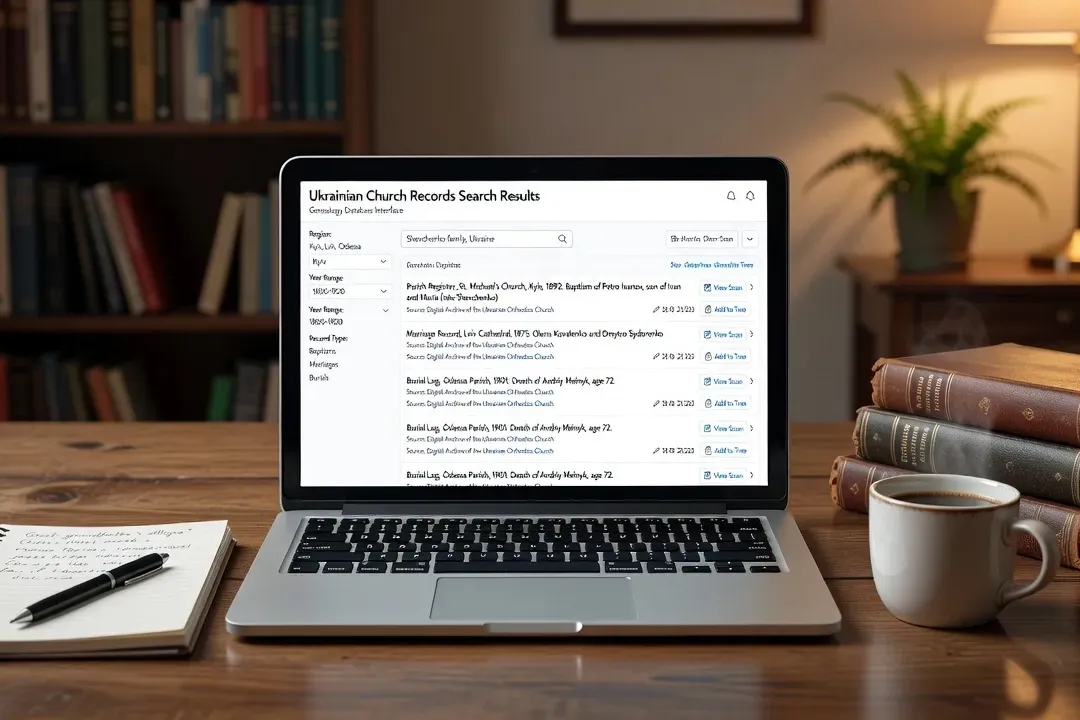
FamilySearch website on laptop screen showing Ukrainian church records search results.
4. Genea-Ukraina (Genea-Ukraina.com.ua)
Genea-Ukraina is a Ukrainian-run transcription project that digitizes and indexes metrical books (birth, marriage, death records) from Ukrainian churches. Many of these records date back to the 18th and 19th centuries, covering regions like Galicia, Volhynia, and Podolia—key areas for Ukrainian migration to Canada. The site is fully free and searchable, though some records are still being added. Canadian researchers should use this resource to verify details found in Canadian immigration records. A tip: learn Cyrillic script to improve search accuracy, as many records were handwritten in pre-Latinized Ukrainian. Learn more about our earlier guide to 20 Ukrainian genealogy resources.
5. GenealogyIndexer.org
GenealogyIndexer is a search engine for historical documents, including newspaper announcements, obituaries, and vital records. For Ukrainian-Canadian researchers, it scans German, Polish, and Ukrainian newspapers published in Galicia and Bukovyna, which often mention emigrations to Canada. The site also includes Yizkor books (Holocaust memorial books), which sometimes contain biographical sketches of pre-WWI emigrants. While not all records are indexed, it’s a powerful tool for finding obscure mentions of your ancestors. Pair searches with Ukrainian village names and phonetic spellings to improve results.
6. MyHeritage.com
MyHeritage offers free DNA testing and family tree building, making it a valuable supplementary tool for Ukrainian-Canadian research. Its SmartMatching technology automatically connects your family tree with others, potentially uncovering distant cousins in Ukraine or Canada. The SuperSearch database includes millions of Ukrainian records, including census data, military records, and naturalization files. While the core features are free, advanced tools like record matches require a subscription. For best results, upload your FamilySearch or GEDCOM file to maximize matches. Many Ukrainian-Canadians have found lost branches of their family through MyHeritage’s DNA circles. Learn more about Ukrainian DNA testing services.
7. JRI-Poland (JRI-Poland.org)
JRI-Poland focuses on Jewish genealogical records, making it invaluable for researchers with Galician Jewish ancestry. Many Ukrainian Jews emigrated to Canada in the late 19th and early 20th centuries, settling in cities like Montreal and Winnipeg. The site hosts indexed Jewish vital records from former Polish-Lithuanian territories, including Galicia. While not free for all records (some require a small fee), many basic searches are free. Canadian researchers should cross-reference JRI-Poland’s records with Canadian Jewish archives (e.g., CJA) for a fuller picture.
8. DAMU/TsDIAU (Central State Historical Archive of Ukraine)
The DAMU (TsDIAU) is Ukraine’s central state archive, holding millions of historical documents, including noble records, land surveys, and church books. While not all records are digitized, the site provides finding aids and digitized microfilms for some collections. Canadian researchers can request digital copies of records (for a fee) if they know their ancestor’s village or county. The archive covers Kyiv, Chernihiv, and other central Ukrainian regions—useful for those whose families originated outside Galicia. Tip: contact Ukrainian genealogists via Facebook groups to assist with record requests.
9. Ukrainian Genealogy Society Canada Facebook Group
The Ukrainian Genealogy Society Canada (UGSC) Facebook group is a vital community resource with over 5,000 members. It’s a place to ask questions, share research tips, and collaborate on brick walls. Many members are experienced researchers who can help interpret Ukrainian handwriting, decipher village names, or locate obscure records. The group also organizes transcription projects and virtual meetups. For Canadian researchers, it’s an invaluable first step before diving into archives. Tip: post specific questions with as much detail as possible (village, approximate years, family names).
10. AllMormons.com
AllMormons is a supplementary LDS genealogy site that hosts digitized church records, including Ukrainian Orthodox and Greek Catholic baptismal records. While not as comprehensive as FamilySearch, it sometimes contains records not yet indexed elsewhere. Canadian researchers should check here if they’re missing key sacramental records from Ukrainian parishes in Canada. The site also includes Canadian parish registers for some prairie communities. Limitations include inconsistent coverage and no advanced search tools, so it’s best used as a backup resource.
Collection of genealogy database website logos arranged as research toolkit concept.
11. Ellis Island Foundation (LibertyEllisFoundation.org)
Though focused on US immigration, the Ellis Island Foundation website is useful for Canadian researchers because many Ukrainian immigrants first arrived in New York before traveling to Canada. The "Ellis Island Records" database contains ship manifests (1820–1957), which can reveal departure ports, next-of-kin in Ukraine, and final destinations. Some Canadian border crossing records (1908–1935) are also available. Tip: Search using phonetic spellings (e.g., "Petrowsky" instead of "Petrovsky") and village names to improve results. Learn more about Galician village maps and directories.
12. Fold3
Fold3 specializes in military records, making it essential for researchers with ancestors who served in World War I or World War II. Many Ukrainian-Canadians enlisted in the Canadian Expeditionary Force (CEF) or the Polish Army (if from former Galicia). The site includes service records, casualty lists, and draft registration cards. While free access is limited, many public libraries and universities provide free remote access. For best results, combine Fold3 records with Canadian War Museum databases and Ukrainian veterans’ associations (e.g., UCC in Canada).
13. UkrGenealogy.ca
UkrGenealogy.ca is a Canadian-focused portal for Ukrainian genealogy, curated by the Ukrainian Canadian Archives & Museum of Alberta (UCAMA). It aggregates free resources, including transcribed records, research guides, and links to Ukrainian archives. The site is particularly useful for prairie settlers, with church histories, cemetery transcriptions, and immigration stories. While not as extensive as FamilySearch, it’s a great starting point for Canadian-specific records. Tip: Check the "Research Tips" section for advice on Ukrainian paleography and naming customs.
14. GEDmatch Genesis
GEDmatch Genesis is a free, open-source DNA comparison tool that allows you to compare autosomal DNA with others across different testing companies (Ancestry, 23andMe, MyHeritage). For Ukrainian-Canadian researchers, it’s a way to find distant cousins who may share Galician, Volhynian, or Bukovynian ancestry. The site also offers ethnicity calculators and chromosome browsers to visualize shared DNA segments. Tip: Upload your raw DNA data from any company and use the "Admixture (heritage)" tool to estimate Ukrainian ancestry percentages.
15. BAC-LAC Archives Online Portal (Naturalization & Border Crossings)
The BAC-LAC Archives Online Portal (link) includes naturalization records (1915–1951) and border crossing documents (1908–1935), which are crucial for Ukrainian-Canadian research. Naturalization records often list place of birth, occupation, and arrival date, while border crossing files reveal travel patterns between the US and Canada. These records are less commonly used than census or immigration files but can provide key details when other sources fail. Tip: Search using maiden names and alternate spellings—many Ukrainian names were anglicized upon arrival.
How to Get the Most from These Online Resources
Combining these 15 free resources strategically will maximize your chances of uncovering your Ukrainian-Canadian ancestry. Start with FamilySearch, as it offers the broadest collection of free records, including Ukrainian metrical books and Canadian censuses. Cross-reference findings with Library and Archives Canada (BAC-LAC) to verify immigration details and prairie homestead records. If you hit a brick wall, turn to Genea-Ukraina for transcribed Ukrainian church books or JRI-Poland if your family had Jewish roots in Galicia.
- Step 1: Search FamilySearch and Library and Archives Canada for Canadian-side records (census, immigration, homestead files).
- Step 2: Identify your ancestral village or region, then turn to Genea-Ukraina, DAMU/TsDIAU, or JRI-Poland for the Ukrainian side.
- Step 3: Upload DNA results to MyHeritage and GEDmatch Genesis to connect with distant cousins in Canada or Ukraine.
- Step 4: Join the Ukrainian Genealogy Society Canada Facebook Group to get help reading handwriting and village names.
- Step 5: Check military (Fold3), naturalization (BAC-LAC), and newspaper (GenealogyIndexer.org) records for details missing elsewhere.
For DNA research, MyHeritage and GEDmatch Genesis can connect you with distant relatives, while **Facebook groups like the Ukrainian Gene
Common pitfall: Relying on a single resource because it feels the most polished. Ancestry's freemium model and MyHeritage's paid tiers make them look "more complete," but FamilySearch, Genea-Ukraina, and the BAC-LAC portal remain completely free and often hold records the paid platforms don't index at all.
Frequently Asked Questions
Yes, FamilySearch.org is completely free for all users. It holds millions of digitized Ukrainian church records, Canadian parish registers, and immigration records. Create a free account to access indexed records and browse image-only collections. Some collections from Ukraine are still being digitized and added regularly.
Genea-Ukraina is a Ukrainian genealogy volunteer project that has transcribed and indexed thousands of metrical books and revision lists from specific Ukrainian regions. Access it at genea-ukraina.com.ua. Search by surname and region. Results include transcribed entries with source citations pointing to archive collections where the originals are held.
Library and Archives Canada (bac-lac.gc.ca) provides free access to ship manifests, naturalization records, and census microfilm order lists online. Some records are indexed and searchable by name; others require browsing microfilm images. The border crossing records (1908-1953) held at BAC-LAC are particularly valuable for Ukrainian-Canadian researchers.
AncestryDNA currently has the largest overall database and the most Ukrainian-Canadian matches for researchers with prairie heritage. MyHeritage DNA has a strong Eastern European presence and is popular in Ukraine itself, making it valuable for connecting with relatives who tested in Ukraine. GEDmatch allows cross-platform chromosome comparison for users who have tested with multiple services.
Alberta Genealogical Society (abgensoc.ca) and Saskatchewan Genealogical Society (sgsi.sk.ca) maintain provincial databases and online indexes that include Ukrainian-Canadian records not available in national databases. Both organizations also have research libraries open to visitors. The Shevchenko Scientific Society of Canada maintains a Ukrainian-language library catalogue accessible online.