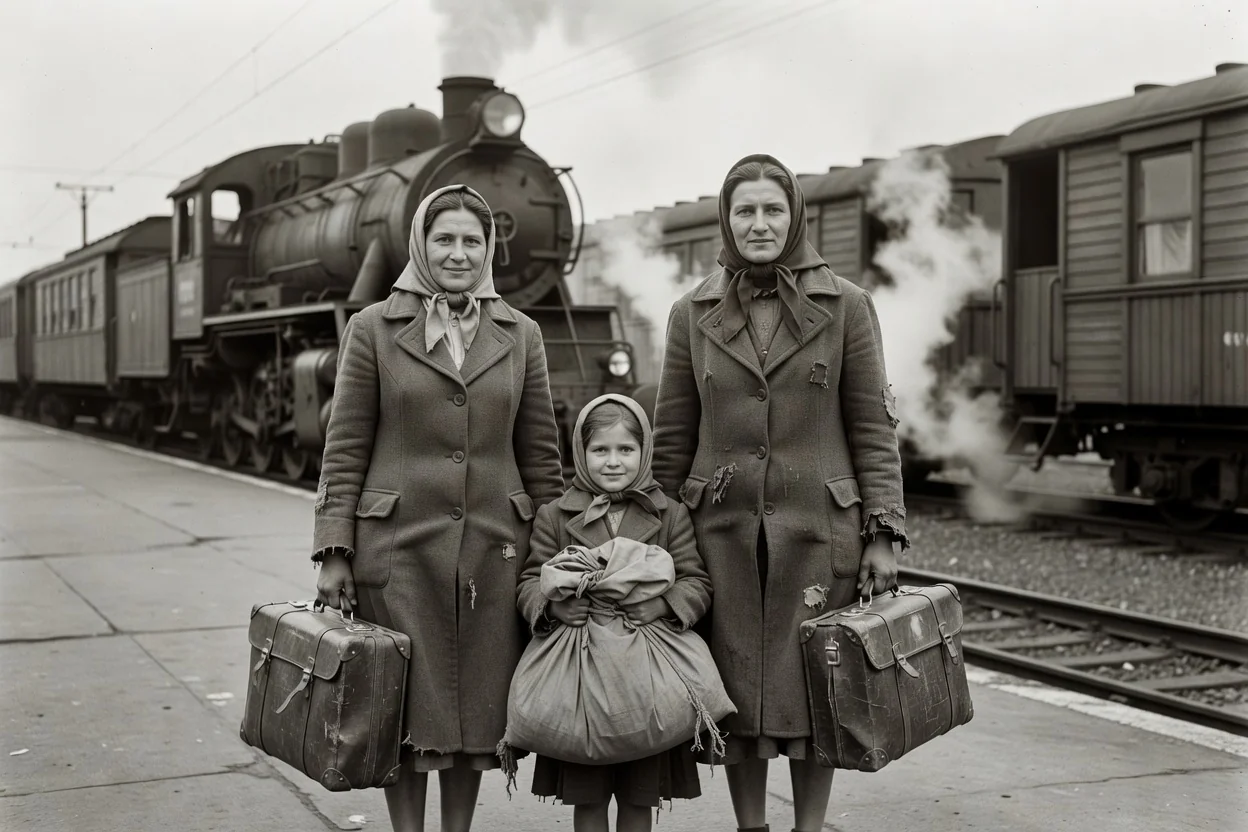
If your family story includes a grandmother who arrived in Canada "after the war" with a single suitcase, a sponsor she barely knew, and a name that seems to change spelling depending on which document you read, you are probably descended from one of the more than 33,000 Ukrainian displaced persons — DPs, in the language of the time — who came to Canada between 1947 and 1952. They were the third great wave of Ukrainian immigration, after the prairie settlers of 1891–1914 and the smaller interwar flows, and their history is the missing chapter in many family trees.
This guide explains who the DPs were, how Canada's post-war bulk labour program selected and transported them, and — most usefully for researchers — what records the whole process created and where those records survive today. It is written for descendants, and it assumes no prior knowledge of refugee archives.
Who Were the Displaced Persons?
At the end of the Second World War, somewhere between seven and eleven million people were stranded in Germany, Austria and Italy — concentration camp survivors, former forced labourers, prisoners of war, and civilians who had fled west ahead of the Soviet advance. Among them, historians of the refugee experience estimate that roughly 250,000 were Ukrainians. Some had been deported to Germany as Ostarbeiter, forced labourers shipped west by the Nazi occupation regime; others were soldiers' families, villagers who had escaped conscription or collectivization, or survivors of the camps themselves.
What defined a DP in the administrative sense was refusal or inability to go home. For Ukrainians, going home often meant returning to territory the Red Army now controlled, and repatriation to the Soviet Union carried well-founded fears of arrest, deportation to the Gulag, or execution. When the Western Allies agreed at Yalta to hand over Soviet citizens, many Ukrainians took pains not to be Soviet citizens on paper — they declared themselves Polish (on the strength of their pre-1939 status in Galicia, Volhynia or Bukovyna) or simply stateless. That single act of self-protection is the reason DP records are so genealogically confusing, and we return to it below.
By 1947 most Ukrainian DPs were living in organized camps — mostly in the British and American zones of occupied Germany and Austria, with significant communities in Italy — administered first by UNRRA (the United Nations Relief and Rehabilitation Administration) and then by its successor, the International Refugee Organization (IRO). Life in the camps was waiting: rations, barracks, work assignments, and endless queues in front of national selection teams from countries like Canada, which came to the camps to choose workers.
The DP era sits at a pivot point in the community's longer story, which our timeline of Ukrainian immigration to Canada traces from the first Galician homesteaders of 1891 through every later wave. What made the DPs different from those earlier immigrants was not only why they left, but the documentary machinery that processed them: the pre-war settler bought a ticket and appeared on a ship manifest, while the DP was registered, screened, carded, contracted and tracked at every step — leaving records at each one.
How Canada Opened Its Doors, 1946–1947
Canada entered the post-war refugee question cautiously. Public opinion in 1945 was wary of mass immigration, and the government of William Lyon Mackenzie King moved slowly. But two pressures mounted: the British and American occupation governments wanted the camps emptied, and Canadian employers — above all prairie farmers, lumber companies and urban households desperate for domestic servants — wanted workers. In May 1946 the King government signalled it would relax restrictions, and through 1947 the machinery was built for what became one of the largest organized immigration movements in Canadian history.
Between 1947 and 1953, Canada admitted roughly 165,000 displaced persons, and Ukrainians were among the largest national groups in the flow. The program was run through an unusual partnership: the Canadian government set the rules and sent selection teams to the camps, while a coalition of churches, service organizations and ethnic community bodies located sponsors, guaranteed jobs and housing, and met the newcomers at the dock. The Canadian Christian Council for the Resettlement of Refugees (CCCRR), founded in 1948, coordinated much of this work, chartering its own ships and mobilizing congregations across the country.
Within the Ukrainian-Canadian community, the existing institutions of the pre-war immigration stepped in on an impressive scale. The Ukrainian Canadian Committee and its affiliated organizations raised funds, found placements and lobbied Ottawa for a larger Ukrainian quota; the Ukrainian Canadian Relief Fund helped refugees settle once they arrived. Established families sponsored distant relatives and total strangers alike — the "close relatives" and sponsorship schemes channelled thousands of DPs to specific Canadian towns and farms. The community's full institutional response, wave by wave, is summarized in the detailed history of Ukrainian immigration to Canada compiled by the Ukrainian community in Toronto.
The Bulk Labour Program and Selection in the Camps
The heart of the DP immigration was the bulk labour program, and its logic was strictly economic. Canada wanted young, healthy, single workers for jobs Canadians were leaving: men for agriculture, logging, mining and railway construction, women for domestic service in cities and rural households. Selection teams from the Department of Immigration and Citizenship toured the camps with medical officers, conducting interviews, X-rays and security screening, and signing up applicants to one- or two-year employment contracts with a named employer.
The contract system mattered enormously, and it left records. A DP did not simply emigrate; they signed a labour contract — often without fully understanding the geography of the country or the nature of the work — and their file followed the contract. A woman who agreed to domestic service in Ontario might find herself on a farm outside Neepawa, Manitoba; a man signed to railway gangs might spend two years in the bush before he was free to seek other work. That two-year indenture explains a recurring pattern in family stories: the first address in Canada is almost never the address where the family put down roots.
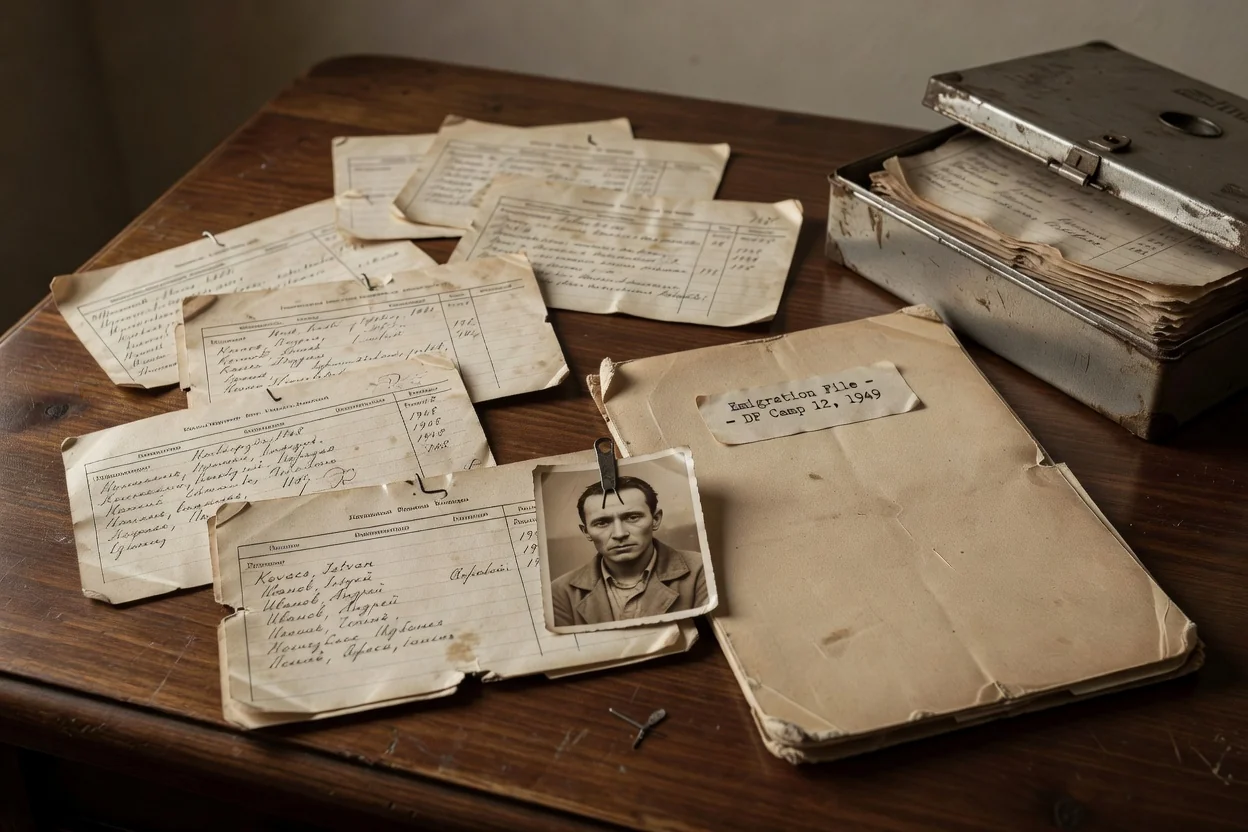
For the researcher, the selection process generated three kinds of paper: the IRO or camp registration records (name, birth date and place, family members, camp and barrack number); the Canadian selection file (interview notes, medical results, occupation declared, employer named); and the transport booking that followed. Not all of it survives intact, but enough exists — in Ottawa, in Bad Arolsen, and on microfilm — to reconstruct most DP journeys step by step.
Ships, Trains and Reception in Canada
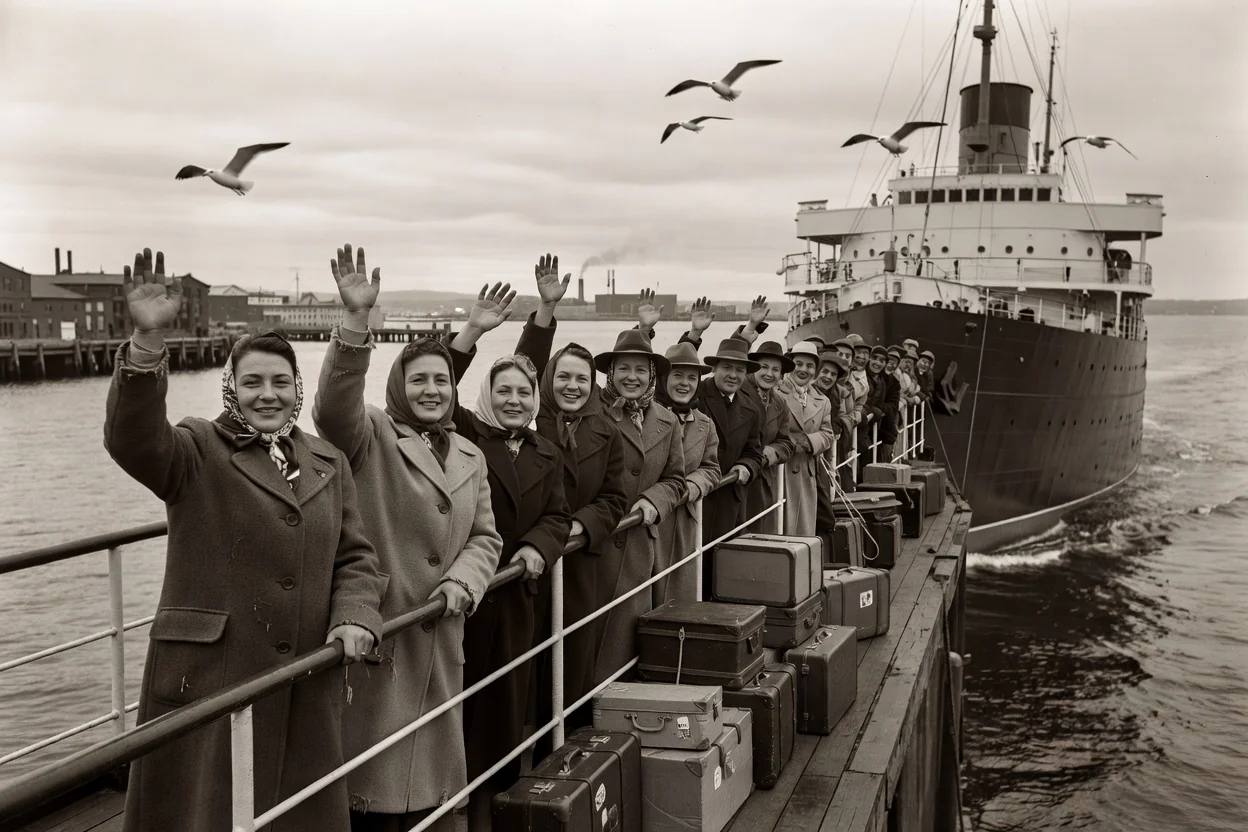
Most Ukrainian DPs reached Canada by sea. The iconic vessel of the movement was the Beaverbrae, a ship chartered by the CCCRR that completed 52 voyages from Bremen, Rotterdam and Antwerp, carrying more than 33,000 passengers of many nationalities to Canadian ports. DPs also crossed on chartered and scheduled liners — the Samaria, the Scythia, the Sobieski and others — arriving at Halifax's Pier 21 or into the port of Quebec, and, later in the program, by charter flights into Dorval airport at Montreal.
Arrival was a processing event, not a welcome. Newcomers were examined again, their documents checked against the manifests, and then they were put on trains — often in sealed or closely shepherded parties for contract workers — to reception points across the country. The ocean arrival records and the inland travel records are therefore separate files, and a complete reconstruction usually needs both. The wider context of what it took for Ukrainians to reach and enter Canada — from the pre-war steamship agencies to the post-war selection missions — is covered in our guide to Canadian immigration records for Ukrainian ancestors, which remains the best starting point for the border-crossing documents themselves.
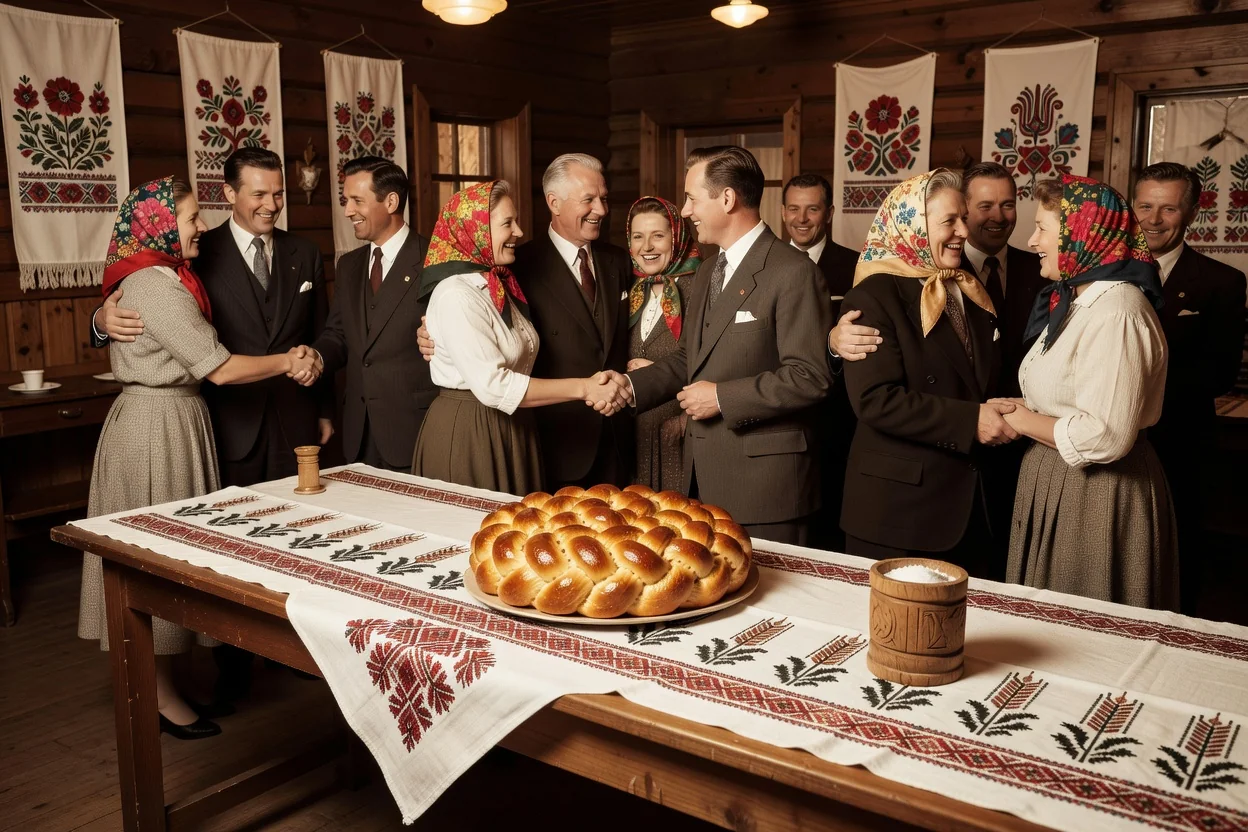
Sponsors and reception committees were waiting at the other end. Church halls, community organizations and individual families met trains, found rooms, explained Canadian money and snow, and translated the first incomprehensible letters from employers. For many DPs the Ukrainian-Canadian community — established for fifty years by then — was the difference between a bare contract and a new life; it is no accident that so many DP-era families remember their sponsors' names with the same reverence they give their ancestors' villages.
What the DP-Era Records Look Like
The table below maps the main record families, what each one contains, and where the surviving files are held. Most DP research uses at least three of the five rows.
| Record family | What it typically contains | Where it survives |
|---|---|---|
| DP registration cards (camp intake) | Name, birth date and place, parents or spouse, nationality claimed, religion, occupation, camp and barrack number — filled out when the person registered with UNRRA/IRO | The Arolsen Archives (former International Tracing Service), Bad Arolsen, Germany — searchable online, inquiries free |
| Canadian selection and immigration files | Interview notes, medical and security screening, declared occupation, employment contract, named employer, sponsor guarantees | Library and Archives Canada (Immigration Branch, RG 76); much of it access-restricted and obtainable through formal access requests |
| Ship passenger manifests | Voyage, port and date of arrival, manifest line per passenger, sometimes physical description and final destination | LAC microfilms and published indexes; many arrivals at Halifax and Quebec City also documented by the Canadian Museum of Immigration at Pier 21 |
| Census and civil registration | DP families in the 1951 and 1956 Canadian censuses (arrival year, birthplace, citizenship status); provincial marriage, birth and death registrations | Library and Archives Canada (census), provincial vital statistics offices |
| Community and press records | Arrival notices, wedding and obituary announcements (nekrologi) naming home villages, mutual-benefit and parish membership lists | Ukrainian-language newspapers and parish archives across Canada; detailed in our guide to the Ukrainian-Canadian community press |
One column of that table deserves emphasis: the Arolsen Archives (the former International Tracing Service) in Bad Arolsen, Germany. Because the camps were run by international organizations rather than by the countries the DPs came from, the single largest cache of Ukrainian DP records sits not in Kyiv, Warsaw or Ottawa but in a small German town. Its online collections include the registrations and files of displaced persons, children and missing persons — the very cards on which a grandmother's pre-war address or a father's camp number may be sitting, uncatalogued by any family member who never knew to look.
A Step-by-Step Research Guide
A practical order of operations for researching a DP-era ancestor, from the known to the unknown:
- Anchor the family in Canada. Find the household in the 1951 or 1956 census, which gives arrival year, birthplace and citizenship status. Pull every available civil record — marriage, children's births, death registration — each of which usually restates the birthplace and parents' names.
- Mine the obituaries. The Ukrainian-language press printed nekrologi that routinely name the oblast, raion and village of origin, the arrival year, and surviving family in both countries. These notices solve more DP origin problems than any archive.
- Request the immigration file. With an arrival year in hand, apply for the person's immigration records from Library and Archives Canada. Files routinely reproduce the DP registration card completed in Europe — camp, family group, claimed pre-war address.
- Search Arolsen. Run the name (in all its spellings) through the Arolsen Archives online collections, and file a free inquiry if nothing surfaces — many records are not yet digitized and staff searches are part of the archive's mandate.
- Identify the ship. Match the arrival date and port to passenger manifests and Pier 21 records; the manifest line often confirms the group the person travelled with, which can identify relatives and fellow-villagers who emigrated together.
- Trace the contract. If the file names an employer or sponsoring agency, follow the paper locally — railway, lumber and farm-labour records, parish books and town directories from the first Canadian address frequently bridge the gap between arrival and the family's settled life.
Two cautions frame the whole exercise. First, Canadian passenger lists after 1935 are not as freely accessible as the famous pre-war series, and immigration files on living or recently deceased persons are subject to access restrictions — expect requests, fees and waiting times, and build them into your plan. Second, keep a name-variant ledger from day one: the same person may appear under four or five spellings across the record families, and the links between them are the actual research.
Names, Spellings and the Identity Traps
Every immigration wave produces spelling chaos, but the DP wave industrialized it. Names passed from Cyrillic to Latin script in at least two official transliterations, were then respelled phonetically by German, English or Polish-speaking clerks, and were sometimes deliberately altered by the migrants themselves — a handier first name, a more Canadian-looking surname, a "Polish" spelling chosen at camp registration to ward off repatriation. Add the Ukrainian practice of gendered surnames (a wife and daughter carry the feminine form: Kowalchuk becomes Kowalchukiwna in some records), and a single family can scatter across indexes like light through a prism.
The nationality field is the deepest trap. A man recorded as a Polish national on his IRO card may appear as Ukrainian on his ship manifest, Ruthenian in a parish book, and stateless in his naturalization papers — with no contradiction, because each clerk wrote down what served the person at that desk. Researchers who insist on one fixed identity miss the trail; researchers who treat nationality as a fluid, self-declared attribute follow it. Our dedicated guide to Ukrainian surname spelling variants in Canadian records maps the most common transformations and the search strategies that defeat them.
The same flexibility applies to dates. Birth dates drift by a year or two between DP cards, manifests and censuses — older DPs sometimes shaved years to qualify for selection programs, and clerks routinely approximated. Treat the earliest European record (usually the camp registration card, written in the person's own script) as the most authoritative, and record discrepancies rather than resolving them silently.
How the DP Wave Changed the Community
The third wave permanently changed Ukrainian Canada. The pre-war community was largely rural, prairie-based, and divided between Catholic and Orthodox church traditions; the DPs were more urban, more secular, more politically engaged, and often better educated — among them were professionals, former officers, artists and intellectuals who had no intention of milking cows for long. Friction was real: established communities sometimes found the newcomers too nationalist, too political, or insufficiently grateful, while DPs found the old-country village culture of the prairies charming but frozen in 1913. The debates of the 1950s — over homeland politics, church jurisdiction, and what "Ukrainian-Canadian" meant — were largely the DPs asserting a different answer.
Within two decades the influence ran the other way. DP-founded institutions — credit unions, scholarship foundations, Saturday schools, professional associations, new churches and halls — revitalized the community's organizational life, and DP families moved decisively into Canadian public life. The demographic picture today, in which the community counts roughly 1.4 million people and stretches from Victoria to Charlottetown, is the product of all three waves together, a layered history we sketch in our guide to the Ukrainian-Canadian population and its communities.
For the family historian, the deepest legacy of the DP wave is attitudinal. A community that arrived as refugees — processed by international organizations, sponsored by strangers, grateful and watchful at once — generated an unusual volume of testimony: memoirs, anniversary interviews, recorded oral histories, and above all family letters carried across the camps. If your family has a "war story" that was never told straight, the DP records described here are often where the straight version has been waiting all along.
Sources consulted: Library and Archives Canada, Ukrainian Canadians: A Brief History and the genealogy research guide on immigration records; Momryk, "Ukrainian Canadians, 100 Years Later" (LLT Journal, 1993); Cameron, Religion and Refugees: The Evolution of Resettlement in Canada (University of Toronto, 2018); Canadian Immigration Historical Society, The Resettlement of European Refugees in Canada, 1947–1960; Canadian Lutheran World Relief, Our Refugee History (the Beaverbrae voyages); Lituanus, Contract Hiring of Displaced Persons in Canadian Domestic Employment; Isajiw and others, The Refugee Experience: Ukrainian Displaced Persons after World War II (as summarized in this University of Waterloo study); FamilySearch Wiki, Ukraine Emigration and Immigration; usctoronto.ca, History of Ukrainian Immigration to Canada.
Frequently Asked Questions
Displaced persons were civilians uprooted by the Second World War who could not or would not return home when the fighting ended. Ukrainian DPs included survivors of forced labour and concentration camps, refugees from the advancing Soviet army, and people who had fled west ahead of the front. Historians estimate that some 250,000 Ukrainians were living in displacement in Europe at the end of the war; most ended up in camps in the British and American zones of occupied Germany and Austria, and in Italy.
Between 1947 and 1952, more than 33,000 Ukrainians came to Canada, the great majority of them displaced persons. They arrived under the bulk labour program and related schemes that matched single men to farm, forestry and mine work and women to domestic service. Ukrainians formed one of the largest national groups within the roughly 165,000 displaced persons Canada admitted between 1947 and 1953.
Three record families matter most. First, DP registration and care files created in the European camps by UNRRA and its successor the International Refugee Organization, including the intake cards filled out when a person registered in a camp — many of these survive at the Arolsen Archives in Germany. Second, Canadian immigration and selection files, including medical and security screening documents created by Canadian teams in the camps, held by Library and Archives Canada (much of it restricted and obtainable through access requests). Third, ship passenger manifests and arrival records for the ocean liners that brought DPs to Halifax and Quebec City, some of which are indexed on commercial genealogy sites.
DP records are full of deliberate inconsistencies. To avoid forced repatriation to the Soviet Union, many Ukrainians described themselves as Polish citizens (by virtue of their pre-1939 status in Galicia or Volhynia) or as stateless, and camp registrars wrote down whatever the person declared. Transliteration between Cyrillic and Latin alphabets produced many spelling variants, and officials frequently recorded names phonetically. A single ancestor may appear as a Ukrainian national on one card, a Pole on another, and under two or three different spellings on ship lists.
Start on the Canadian side, where the trail is newest and easiest to document: find the family in the 1951 or 1956 Canadian census, in naturalization records, or in an obituary in the Ukrainian-language press, all of which usually give an arrival year and a birth village. With that anchor, request the person's immigration file from Library and Archives Canada, which typically reproduces the DP registration card completed in Europe — a document that often names the camp, the family members registered together, and the claimed pre-war address.