Why Ukrainian Names Were Misspelled in Canada
Between 1891 and 1914, more than 170,000 Ukrainian immigrants arrived in Canada, most of them from the Austro-Hungarian provinces of Galicia and Bukovyna. Almost none of the officials who processed these newcomers — port clerks in Halifax and Quebec City, railway agents, homestead inspectors, or census enumerators on the prairies — had any training in Ukrainian phonetics, let alone the Cyrillic alphabet in which most of these families' names had been recorded back home. Names were transcribed by ear, under time pressure, from speakers whose English was often minimal and whose accents reflected regional dialects of Galician or Bukovynian Ukrainian.
The consequence for genealogists today is that a single ancestor's surname may have been spelled correctly exactly once — on the original parish record in the old country — and never again in the same way on this side of the Atlantic. A ship manifest clerk might write one approximation, a homestead registrar another, a census enumerator a third, and a tombstone carver a fourth. None of these people were wrong in a meaningful sense; they were doing their best with an unfamiliar sound system. But the cumulative effect is that researchers who search only for the "correct" modern spelling of a surname will miss the majority of the paper trail.
Understanding why the errors happened is the first step toward predicting how they happened, which in turn makes it possible to reverse-engineer the original name from its anglicized descendants. This article walks through the mechanics of that reversal, with practical tables and search strategies you can apply directly to Library and Archives Canada, FamilySearch, and Ancestry indexes.
Key insight: Canadian clerks transcribed Ukrainian names using English spelling conventions, which do not map cleanly onto Ukrainian consonant clusters or vowel sounds. Treat every historical record as a phonetic guess, not an authoritative spelling — and search accordingly.
Common Suffix Transformations: -enko, -uk, -chuk, -sky
Ukrainian surnames are built from a relatively small number of productive suffixes, and each one had its own characteristic mangling pattern in Canadian records. Recognizing the suffix family of your ancestor's surname is often more useful than trying to match the whole name letter for letter, because clerks tended to preserve the general "shape" of a name while garbling specific consonants.
The table below summarizes the four most common suffix groups and the anglicized forms you should expect to encounter across ship manifests, homestead files, and census returns.
| Ukrainian Suffix | Meaning / Origin | Original Example | Common Canadian Misspellings |
|---|---|---|---|
| -enko | Patronymic, "son of" (very common in central/eastern Ukraine and among some Galician families) | Kovalenko | Koval, Kowalenko, Kovalinko, Kovalenco, Kowal |
| -uk / -iuk | Patronymic diminutive, extremely common in Galicia and Bukovyna | Petryshyn, Ivanyuk | Petrishin, Petryshen, Ivaniuk, Ivanuk, Evanuk |
| -chuk | "Little son of," widespread in western Ukraine | Kovalchuk, Panchuk | Kowalchuk, Kovalchuck, Panchuck, Pantschuk, Kowalczuk (Polish-influenced spelling) |
| -sky / -ska | Adjectival surname denoting place or family origin | Wasylyshyn, Zaharchuk | Washylyshyn (male) — feminine forms frequently dropped entirely and replaced with the masculine form for the whole family |
| -yshyn / -ishin | Common Galician patronymic ending | Hrynchyshyn, Baranyshyn | Hrynchishin, Hrynshyn, Baranishin, Baranshen |
Note that Polish-influenced spellings appear frequently in records from the Austro-Hungarian era because many local administrators in Galicia used Polish orthography (for example, "cz" instead of "ch," or "sz" instead of "sh"). If your ancestor's original documents came through Polish-administered offices before emigration, expect the Canadian clerk to inherit some of that spelling as well, compounding the transcription drift.
Which Records Are Most Affected by Spelling Errors
Not all record types suffer equally from name distortion. Some sources were created under time pressure with minimal verification, while others benefited from repeated contact with the same family over years, allowing spellings to stabilize (even if that stable spelling was itself incorrect). Knowing which records to treat with suspicion — and which to trust as anchors — helps prioritize your research time.
| Record Type / Decade | Typical Reliability | Why |
|---|---|---|
| Ship manifests, 1896-1914 | Low | Written in transit by pursers or port officials on a single hearing, no follow-up verification |
| 1901 & 1906 census | Low-Medium | Enumerators visited once, wrote phonetically, no standardized transliteration guide existed |
| Homestead application files, 1896-1930 | Medium | Signed or marked by the applicant, but clerks often "corrected" the spelling to their own approximation on subsequent forms |
| 1911 & 1916 census | Medium | Some families had been in Canada long enough to establish a consistent anglicized spelling that enumerators simply copied |
| Parish / church metrical books | High | Ukrainian-speaking clergy recorded names in Cyrillic or careful transliteration, closest to the original form |
| 1921 & later census, civil registration | Medium-High | Families had usually settled on one "official" anglicized spelling used consistently for legal purposes |
For deeper background on the census sources themselves, see our companion guide to the 1906 Prairie Census and its land records, which explains how to locate the district-level microfilm reels referenced above.
Building a Spelling-Variant List for Your Surname
Before searching any database, take fifteen minutes to build a written list of plausible spelling variants for your target surname. This single step will save hours of frustrated, unproductive searching later. Work outward from the known modern spelling using these steps:
- Identify the suffix family (see the table above) and note its typical Canadian mutations.
- Swap vowels systematically. Ukrainian "o" often becomes English "a" or "u" in transcription (Kovalenko/Kavalenko); "y" is frequently rendered as "i" or "e."
- Test consonant substitutions. "V" and "W" are interchangeable in most transcriptions (Wasyl/Vasyl); "ch" may appear as "tch," "cz," or simply "c"; "shch" (щ) is almost always simplified to "sch" or "sh."
- Check for truncation. Long Ukrainian surnames were frequently shortened by clerks who ran out of space on a form or simply gave up (Hrynchyshyn becoming just "Hryn" or "Grin").
- Search for a completely different surname. Some families adopted an entirely new, unrelated English surname after arrival (a phenomenon distinct from spelling drift, but equally important — see the section on church records below for how to detect it).
Write this list down and keep it beside you during every search session. Cross off variants once you have tested them and note which databases you searched, so you avoid repeating fruitless queries months later.
Common mistake: Assuming that because a name is not found under its "correct" modern Ukrainian spelling, the ancestor did not emigrate or the record does not exist. In the vast majority of cases, the record exists — it is simply indexed under a misspelling that a rigid, single-spelling search will never surface.
Wildcard and Soundex Search Techniques
Most major genealogy platforms — Ancestry, FamilySearch, and Library and Archives Canada's own search tools — support wildcard characters and, in some cases, Soundex or phonetic matching. Learning to use these tools deliberately, rather than relying on the default "exact match" search box, dramatically increases the chance of finding a misspelled ancestor.
- Asterisk wildcards (*): Replace an uncertain string of letters. Searching "Kowal*" will surface Kowalchuk, Kowalenko, Kowalyshyn, and dozens of other variants in a single query.
- Question mark wildcards (?): Replace a single uncertain letter. "Petr?shyn" will catch both Petryshyn and Petrishyn without over-broadening the search the way a full asterisk would.
- Soundex and phonetic search: Many databases offer a "sounds like" toggle. This is especially useful for names where the vowel is the uncertain element, since Soundex algorithms group phonetically similar consonant skeletons together regardless of vowels.
- Reverse searches by first name and location: When surname variants become too numerous to test individually, search instead by a distinctive first name combined with the known township, parish, or ship — then scan all results for a plausible surname match by eye.
Our guide to the top free Ukrainian genealogy databases lists which platforms support each of these techniques, so you are not guessing which search box actually has wildcard support.
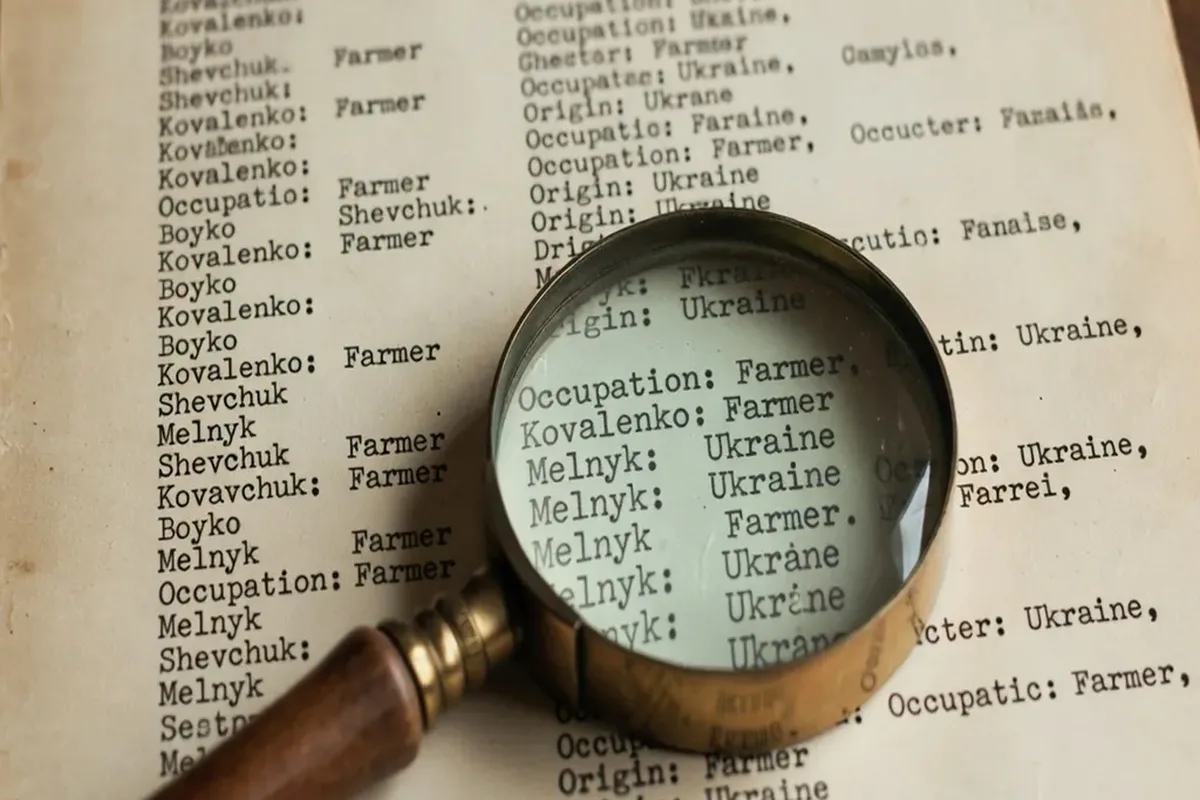
Handwritten ship manifest page from early 1900s showing phonetically spelled Ukrainian surnames.
First Names Changed Too: Anglicization Patterns
Surname research cannot be separated from first-name research, because Canadian clerks routinely anglicized given names alongside family names, and a rigid search on both fields at once will fail twice as often as a flexible one. The most common substitutions follow predictable patterns rooted in perceived English equivalents rather than true translation.
Mykola became Nicholas or Nick; Ivan became John; Vasyl became William, Wasyl, or Basil; Petro became Peter; Fedir became Fred or Theodore; Hryhorii became George or Gregory; Oleksandr became Alexander or Alex. For women, Paraskeviia became Pauline or Paraska; Kateryna became Catherine or Katie; Yevdokiia became Eudokia or simply Eva; Anastasiia became Anastasia or Stacy.
When searching census or immigration indexes, try both the Ukrainian original and its English equivalent as separate queries, and if the database allows it, search the surname alone with the first name left blank or wildcarded. This is often the fastest way to locate an ancestor whose given name was translated rather than transliterated.
Cross-Referencing Multiple Records to Confirm Identity
Because no single Canadian record can be trusted to preserve an accurate spelling, identity confirmation depends on triangulating several independent sources that agree on enough non-name details — age, birthplace, arrival year, religion, township — to establish that "Kowalchuck" on one document and "Kovalchuk" on another are the same person.
A reliable confirmation strategy checks at minimum three of the following data points across two or more records:
- Approximate birth year (allow a two- to three-year margin, since ages were frequently estimated or rounded)
- Birthplace as recorded ("Austria," "Galicia," or a named village)
- Religion (Greek Catholic vs. Greek Orthodox, which can also shift over time and is not by itself conclusive)
- Legal land description (township, range, meridian) if a homestead file exists
- Names and approximate ages of spouse and children, which tend to remain more stable across records than the surname itself
For guidance specifically on connecting homestead files to family names, see our detailed guide to Ukrainian homestead records and the Dominion Lands system, which explains how legal land descriptions provide an anchor point independent of spelling.
Practical tip: Build a simple spreadsheet with one row per record found and columns for spelling variant, source, date, age, birthplace, and township. Sorting this spreadsheet by birthplace and approximate age — rather than by surname spelling — often reveals which "different" surnames actually belong to the same family.
Why Church Records Often Preserve the Original Spelling
Ukrainian Catholic and Ukrainian Orthodox parish clergy in Canada were, unlike census enumerators and immigration clerks, usually native or fluent speakers of Ukrainian, and many kept their metrical books (registers of baptisms, marriages, and burials) in Cyrillic script or in a careful, consistent Latin transliteration. Because of this, church records are frequently the single best source for recovering the "true" original spelling of a surname that has been badly garbled elsewhere.
When a family's Canadian civil records show a heavily anglicized surname, it is worth locating the nearest Ukrainian Catholic or Orthodox parish active in their settlement district during the relevant years and requesting a search of the baptismal and marriage registers. These records also frequently list the family's village of origin in Galicia or Bukovyna, information almost never present in civil records. Our full guide to Ukrainian church records and metrical books explains how to locate and request access to these registers, and our companion guide to Ukrainian Orthodox church records in Canada covers parishes that followed the Orthodox rather than Catholic tradition.
If you are attempting to trace a surname back across the ocean to its Galician or Bukovynian origin, reading the original Cyrillic entries is often unavoidable. For a practical primer, see our guide to reading old Cyrillic church records.
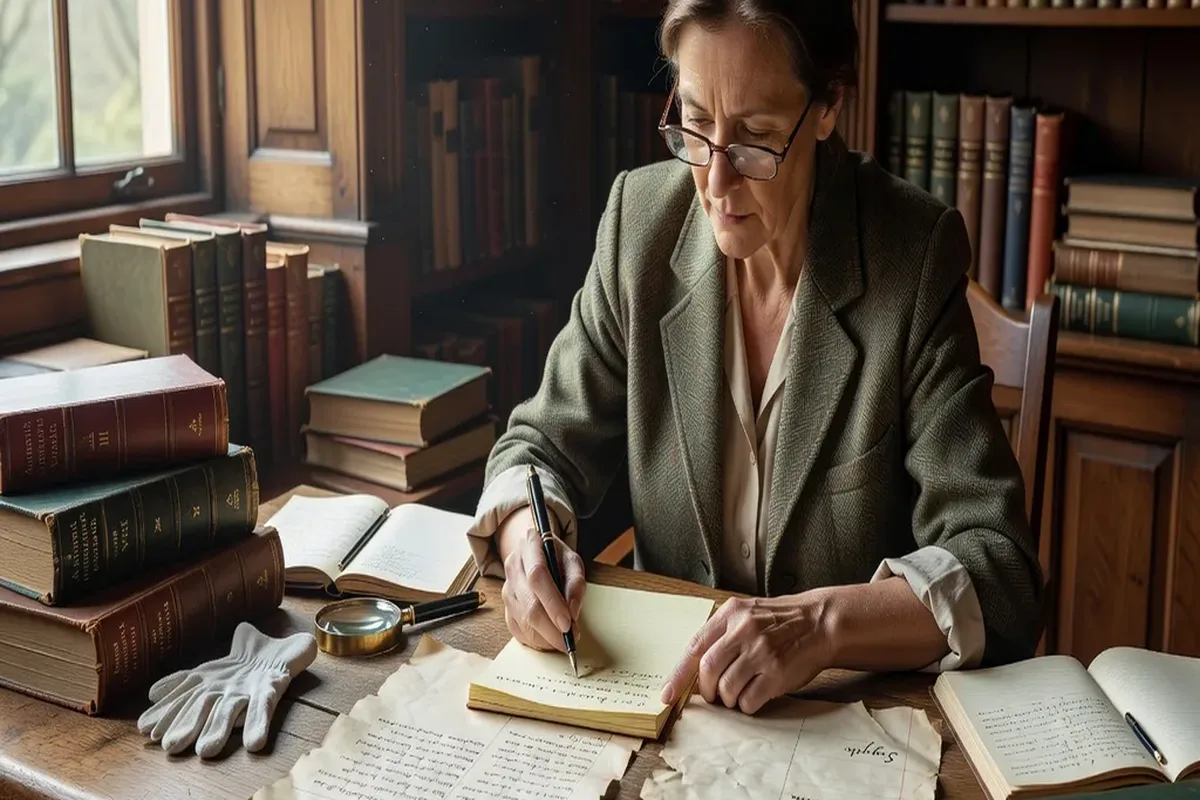
Comparison of a Cyrillic parish register entry beside its anglicized Canadian civil record counterpart.
Case Study: One Family, Six Spellings Across Fifty Years
Consider the case of a family whose original Galician surname, recorded in the parish register of a village near Ternopil, was Гринчишин — transliterated correctly as Hrynchyshyn. Tracking this single family through the Canadian record set reveals just how far a name can drift while still referring to exactly one household.
Name drift shows up especially strongly in military records -- see our guide to CEF service records for Ukrainian-Canadian soldiers for a specific example.
The 1899 ship manifest, filled out by a purser in Hamburg who spoke neither Ukrainian nor much English, recorded the head of household as "Grinchishin." The 1901 Canadian census enumerator, working from oral testimony in a prairie sod house, wrote "Hrynchishen." The 1904 homestead application, filed at the local Dominion Lands office, listed the applicant as "Harry Grinshen" — the given name itself replaced with an anglicized approximation, and the surname truncated further. The 1911 census, taken by a different enumerator, recorded "Grynshyn." A 1918 land patent used yet another spelling, "Hrinshin." Only the family's Ukrainian Catholic parish register, in which the priest recorded baptisms in careful transliterated form throughout this entire period, consistently preserved something close to the original: "Hrynchyshyn."
This case is documented in more detail, including the archival citations for each record, in our related profile of a Prince Edward Island descendant tracing his family back to Galicia, whose research encountered nearly identical spelling drift while working through Canadian civil records.
The lesson is not that any single record was "wrong." Each clerk made a reasonable phonetic approximation given the tools and training available. The lesson is that a researcher who searches only for "Hrynchyshyn" in every database will miss five out of six of this family's Canadian records entirely.
Practical Checklist for Surname Variant Research
Use the checklist below at the start of any new surname research project to make sure you are not relying on a single, rigid spelling before you begin searching.
- Write out the surname's suffix family and its known Canadian mutation patterns.
- Build a list of at least six to eight plausible spelling variants before opening any database.
- Search using wildcards or Soundex rather than exact-match fields wherever the platform allows it.
- Search first names in both their Ukrainian and anglicized forms as separate queries.
- Cross-reference at least three non-name data points (age, birthplace, township, religion) across every candidate record.
- Locate the nearest Ukrainian Catholic or Orthodox parish register as an anchor for the "true" original spelling.
- Keep a running spreadsheet of every variant tested, the database searched, and the result, to avoid duplicating work.
For readers just beginning this kind of research, our foundational guide on how to start Ukrainian genealogy research covers the broader research framework into which surname-variant searching fits. And if your family's migration story extends beyond Canadian records into the broader Ukrainian diaspora, the historical overview at Ukraine Trips offers useful cultural and regional context for the villages many of these families left behind.
Frequently Asked Questions
Canadian immigration officials, ship pursers, and census enumerators generally did not speak Ukrainian and had no standardized system for transliterating Cyrillic names into English. They wrote down names phonetically, based on what they heard, which meant the same surname could be transcribed differently by every official who recorded it. Regional dialects from Galicia and Bukovyna, along with Polish-influenced spelling conventions used in Austro-Hungarian administrative records, added further variation.
Ukrainian Catholic and Orthodox parish metrical books are generally the most reliable source, because they were often kept by Ukrainian-speaking clergy who recorded names in Cyrillic script or careful, consistent transliteration. Civil records such as ship manifests, census returns, and early homestead files are far less reliable, since they were created by English-speaking officials working from oral testimony under time pressure.
Use wildcard characters (an asterisk for multiple uncertain letters, a question mark for a single uncertain letter) if the database supports them, or enable a Soundex/phonetic search option. Build a written list of plausible variants first, based on known suffix mutation patterns (such as -enko, -uk, -chuk, and -sky endings), and test each one systematically rather than relying on a single exact-match query.
Yes. Given names were routinely anglicized in Canadian records: Ivan became John, Mykola became Nicholas or Nick, Vasyl became William or Basil, and Paraskeviia became Pauline, among many other substitutions. When searching for an ancestor, try both the Ukrainian original and its common English equivalent as separate search terms.
Cross-reference non-name details that are less likely to have been altered: approximate birth year, recorded birthplace, religion, the legal land description of a homestead, and the names and ages of a spouse and children. If at least three of these details align across two records with different surname spellings, it is very likely the same individual or family.
Yes, this happened in a meaningful minority of cases, distinct from simple spelling drift. Some families adopted an entirely new English surname after settling in Canada, sometimes to ease integration or to distance themselves from a name that was constantly mispronounced. Parish records and oral family history are usually the only way to detect this kind of full surname change, since civil records after the change will show no trace of the original name.