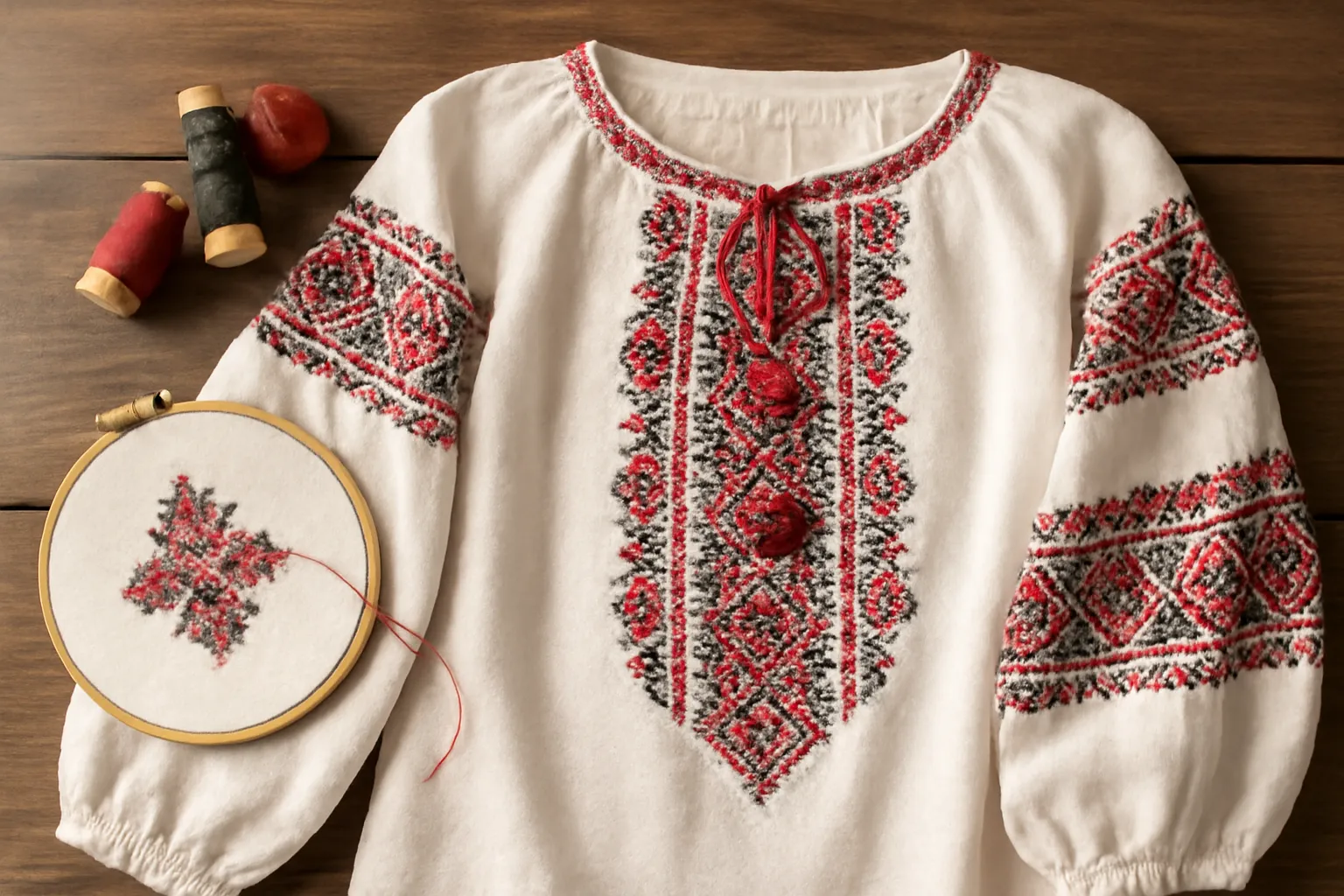
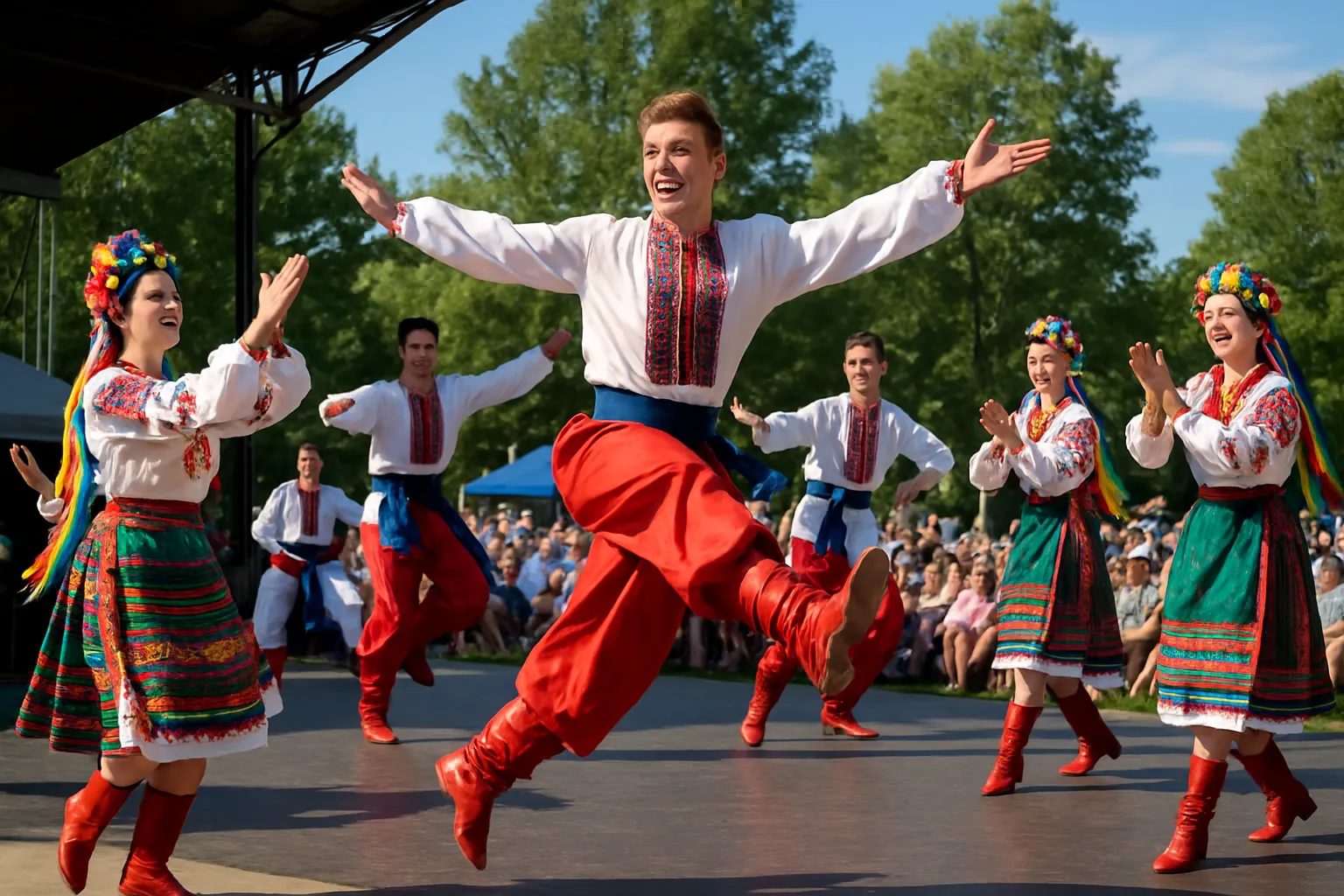
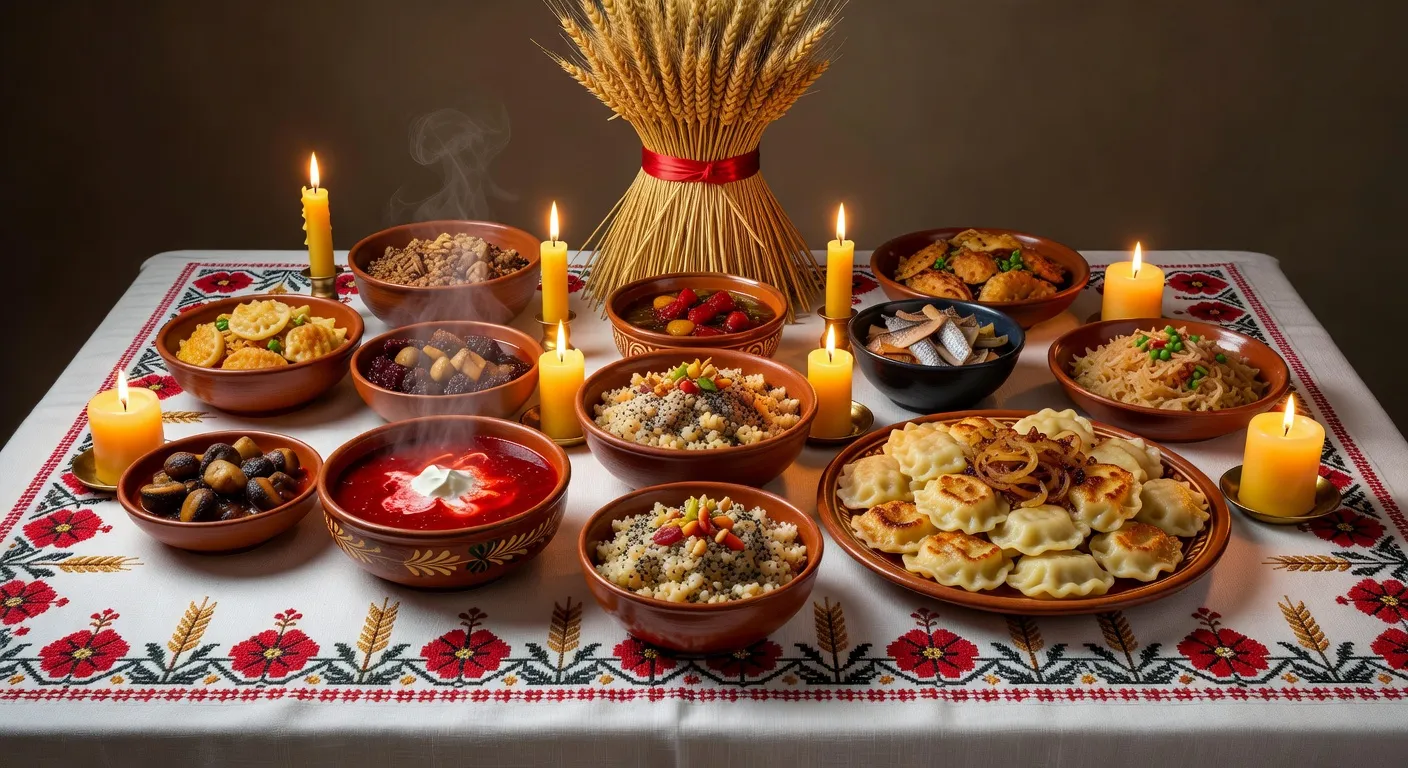
In the Ukrainian-Canadian community, no craft is more immediately recognized as a marker of identity than vyshyvanka — the traditional embroidered textile that has adorned Ukrainian garments for centuries. But vyshyvanka is not one thing. It is an entire visual language, with regional dialects as distinct as spoken ones, encoding information about place, season, family, and status in threads of red, black, blue, and white.
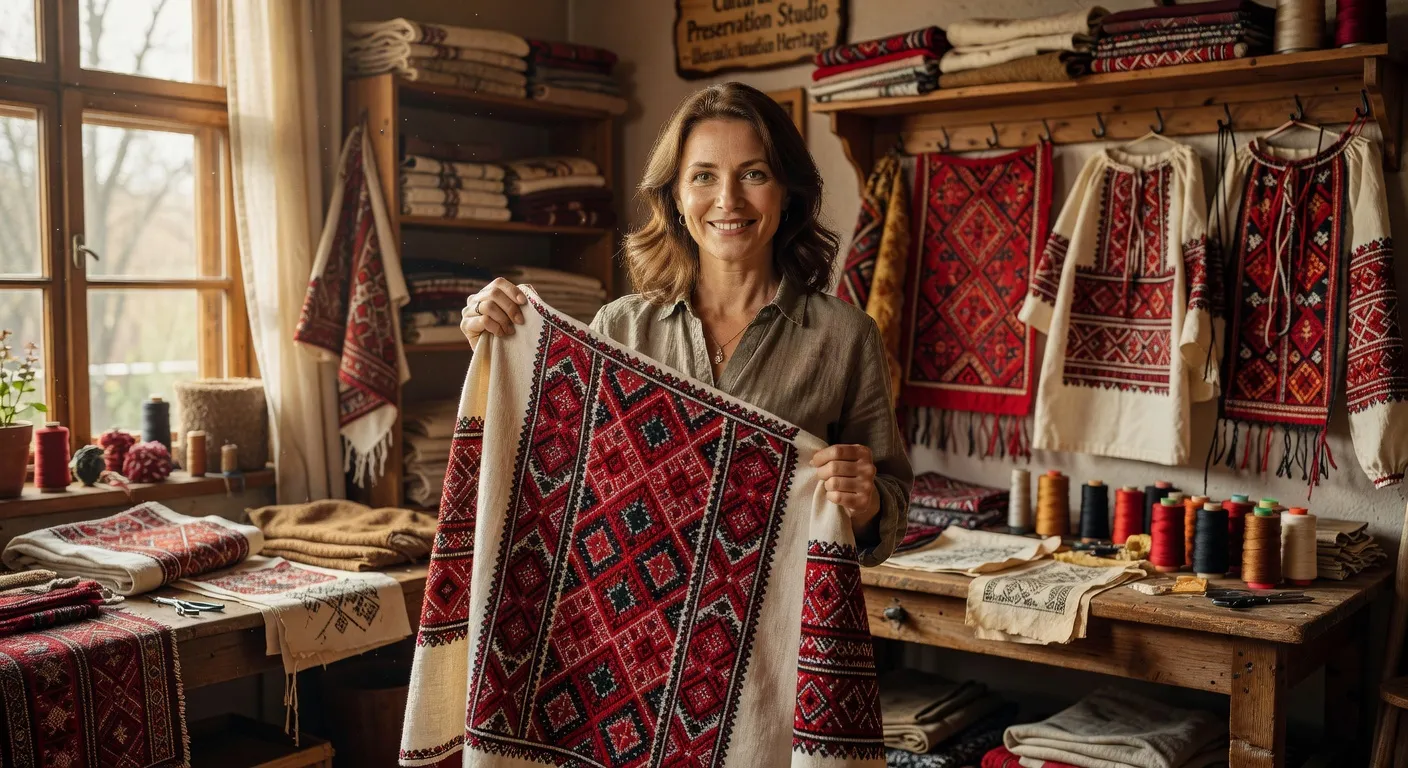
Lesia Moroz has spent 22 years learning to read that language. Based in Fredericton, New Brunswick, she has assembled one of the most comprehensive private collections of regional Ukrainian embroidery pattern samples in Eastern Canada — spanning Galicia, Podillia, Poltava, Volyn, and the Hutsul Carpathians — and she teaches both the craft and its cultural context in workshops across Atlantic Canada. For genealogists and descendants of Ukrainian immigrants, her work at the intersection of Ukrainian folk traditions and family history offers a tool for regional identification that goes beyond the documentary record.
This interview is presented as an editorial portrait: a synthesis of textile expertise and documented regional scholarship, written in question-and-answer form to make the knowledge accessible to first-time researchers and craft learners. The expert depicted is a fictional composite; her answers reflect the actual documented characteristics of Ukrainian regional embroidery traditions. Photo credit: editorial portrait.
What Makes Vyshyvanka Different from Generic Slavic Embroidery
The second distinguishing feature is how encoding works in Ukrainian embroidery. The patterns aren’t decorative in a casual sense. They are a visual vocabulary — specific geometric forms carry specific meanings related to fertility, protection, the cosmos, the cycle of seasons. A woman preparing her daughter’s wedding garments would choose patterns that were protective and auspicious, not simply beautiful. That intentionality runs through the craft at every level.
The third thing is the regional specificity, which is remarkable even within Ukraine itself. I can often tell, with reasonable confidence, whether a piece comes from Galicia, Podillia, or the Hutsul region just by looking at it. That’s not a skill — it’s the result of an entire regional culture encoding itself over generations into a textile tradition.
How to Identify Your Ancestral Region by Embroidery Pattern
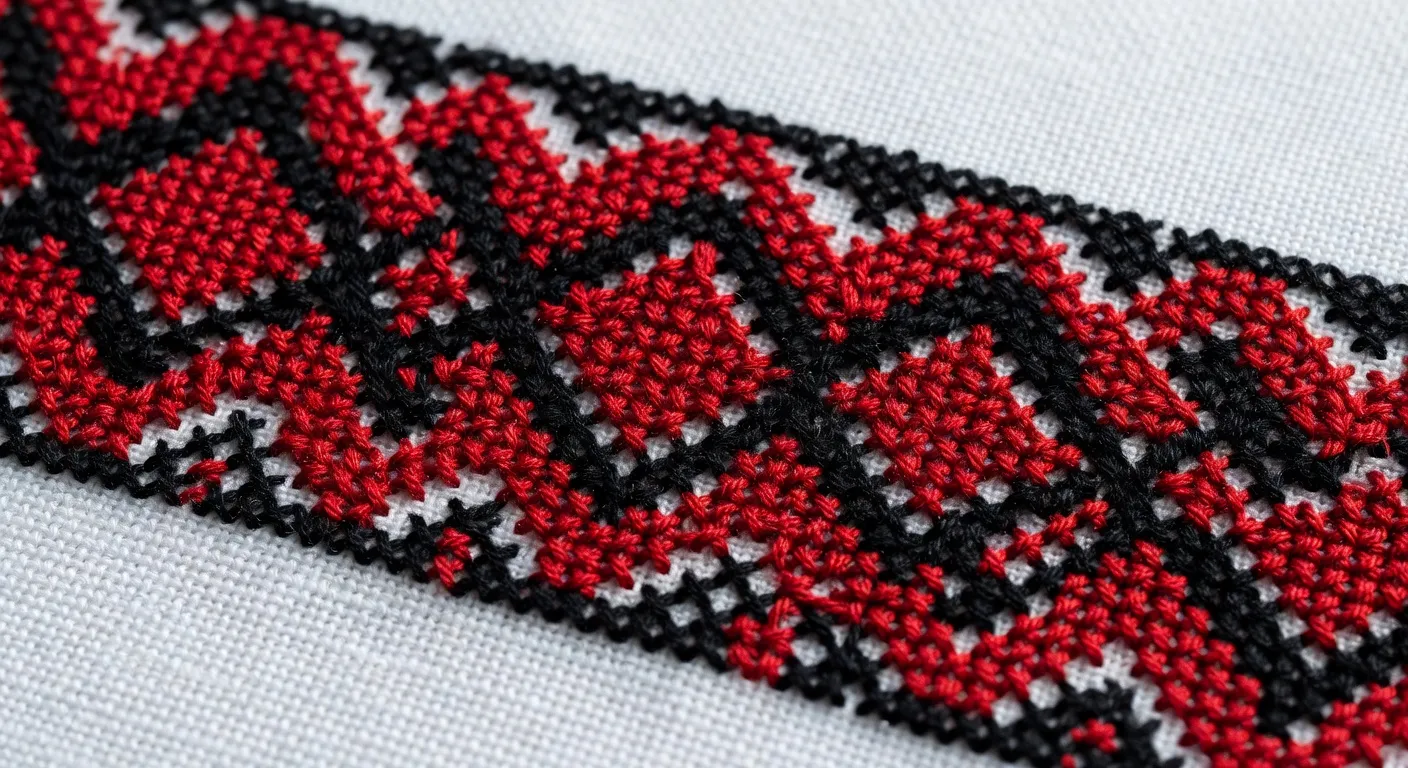
Galician sleeves typically have geometric patterns in red and black, often with the motif running vertically along the sleeve seam. Poltavan pieces often show the characteristic white-on-white cross-stitch with botanical motifs — wheat ears, oak leaves, viburnum clusters. Hutsul pieces from the Carpathian region have completely different aesthetics: bolder, more colorful, often incorporating wool thread alongside cotton, with diamond and chevron patterns that echo the mountain environment.
The challenge is that the Ukrainian embroidery tradition was already adapting in the diaspora by the 1920s. A photograph from a PEI Ukrainian family taken in 1930 might show a garment made in Canada with patterns simplified by necessity or adapted to available materials. That garment is still evidence — but it’s evidence of what the family remembered of the original tradition, not the tradition itself.
What I always tell researchers is that embroidery evidence is not a replacement for documentary genealogy. It’s a complement to it. If you already know your ancestor came from somewhere in Galicia but you don’t know which part, and a family photograph shows a piece with characteristics strongly associated with the Ivano-Frankivsk district, that’s a clue worth following up with archival research. It narrows the search; it doesn’t conclude it.
Galician vs. Podillian vs. Poltavan Regional Styles
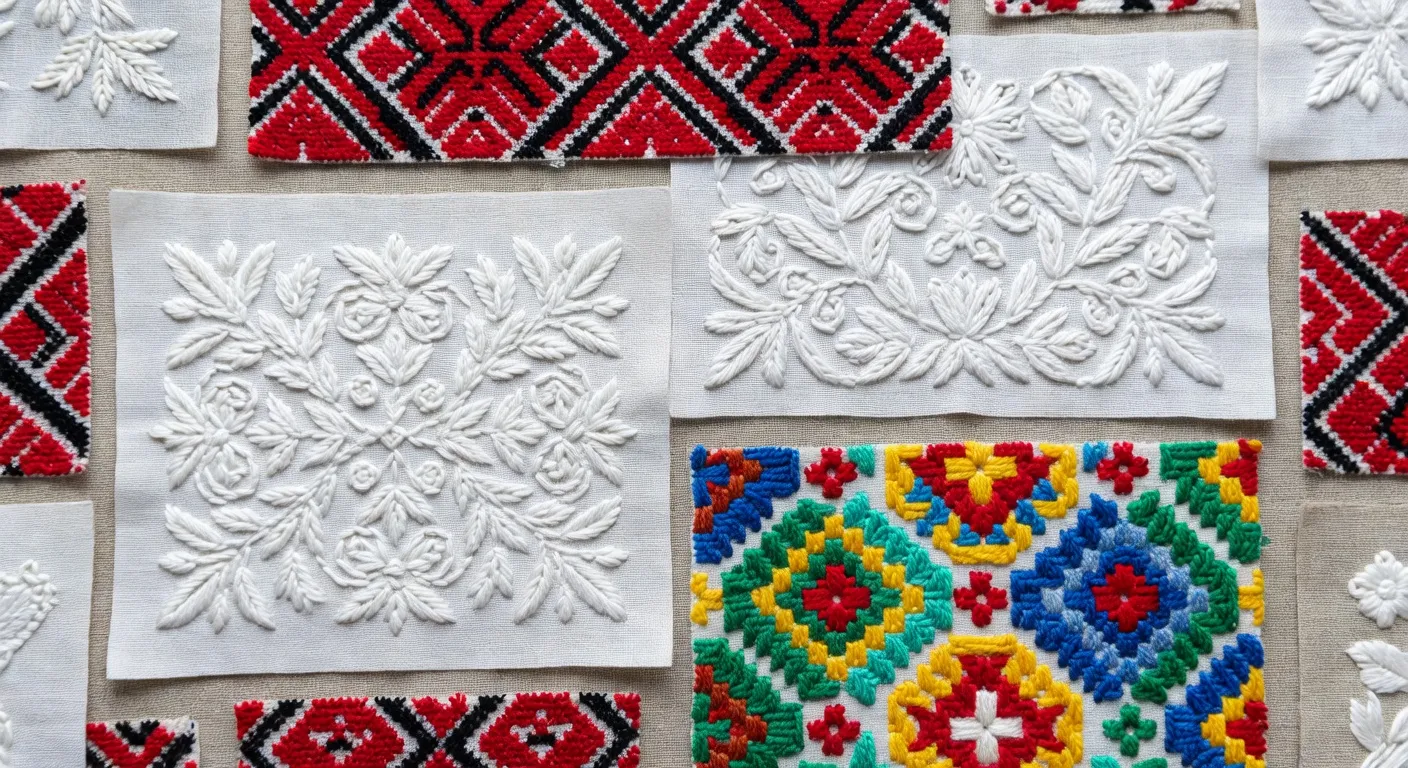
Galicia — the dominant tradition among Ukrainian Canadians in PEI and on the prairies — uses geometric patterns in red and black on white linen as a baseline, though blues and yellows appear in more northerly districts. The stitch technique is usually cross-stitch or schidne running stitch. Patterns are organized in horizontal bands and often feature interlocking geometric forms — diamonds, rhombuses, stars, crosses — rather than realistic representations.
Podillia (central Ukraine) is more polychromatic — you see complex multi-colored geometric designs with more use of blues, greens, and yellows alongside the red. The scale is often larger and bolder than Galician work, and the designs are sometimes more floral in character while remaining geometric at the core.
Poltava region is famous for its white-on-white cross-stitch, which is demanding and subtle. The botanical motifs — oak leaves, sunflowers, wheat ears, viburnum — are so finely worked in white thread on white linen that the pattern is visible only through shadow and texture. It’s technically extraordinary but unfamiliar to most people who associate Ukrainian embroidery with the red-black palette.
Hutsul (Carpathian mountain region) is the most visually dramatic. The Hutsul tradition incorporates wool as well as cotton thread, creates bold diamond and chevron patterns in very strong color combinations, and is associated with the mountain environment — geometric forms that echo the angles of the landscape. The Ukrainian Easter traditions of the Hutsul region — including their distinctive pysanka egg patterns — mirror the embroidery geometric vocabulary in a fascinating way.
| Region | Base palette | Technique |
|---|---|---|
| Galicia | Red and black on white linen | Cross-stitch or schidne running stitch, horizontal bands |
| Podillia | Polychrome — red, blue, green, yellow | Larger, bolder, more floral within a geometric core |
| Poltava | White-on-white | Pulled-thread and satin stitch, botanical motifs |
| Hutsul | Vivid multicolour, wool and cotton | Bold diamond and chevron patterns |
The Symbolism of Specific Motifs
The viburnum (kalyna) — a red-berried shrub — is one of the most universal symbols in Ukrainian folk art, associated with the homeland, beauty, and blood. When it appears in embroidery, it almost always carries patriotic or protective meaning.
The wheat sheaf or wheat stalk appears in regions where agriculture was central — which is most of them — and represents the harvest, prosperity, and the cycle of life and death. You’ll see it in Poltavan white embroidery especially.
Geometric diamonds and rhombuses are associated with female fertility and the earth in the scholarly literature on Ukrainian folk art. The four-pointed star (svarha) is associated with the sun.
Oak leaves represent strength and male energy. The sunflower — which appears especially in central Ukrainian traditions — is associated with the solar cycle and is perhaps the most internationally recognized Ukrainian folk motif.
The cross appears in many contexts and can have both Christian and pre-Christian associations. In Christian contexts it is straightforwardly devotional; in older geometric arrangements it may be a continuation of an ancient solar symbol.
How Ukrainian Diaspora in Canada Adapted Traditional Patterns
Materials changed first. In Galicia, the base fabric was hand-woven linen — coarse, durable, with a specific tooth that held the thread in a particular way. In Canada, machine-woven cotton and wool were what was available. The hand feel and visual character of the embroidery changed with the fabric, even when the pattern was copied exactly.
Pattern simplification was the second major adaptation. A master embroider in a Galician village might spend six months on a single garment, working patterns that had been refined over generations. An immigrant woman managing a farm, raising children, and maintaining household work had less time. Patterns were simplified — not corrupted, but adapted to the time available.
Syncretism happened gradually across generations. By the second and third generations, Ukrainian-Canadian embroidery often blended elements from different regional traditions, because the embroidery teacher at the Saturday school might be from Galicia while her students’ families came from Podillia or Volhynia. A unified “Ukrainian-Canadian” style emerged that is itself a diaspora cultural form — distinct from any single regional origin.
Revival movements countered this drift from the 1970s onward. The Ukrainian cultural revival of the 1970s and 1980s, which coincided with Canadian multiculturalism policies, brought a renewed interest in regional specificity. Organizations began collecting pattern samples, publishing pattern books, and teaching regional styles alongside the syncretized Canadian versions. For Ukrainian settlers in PEI and across Atlantic Canada, these revival movements were often the first time young people had encountered the idea that their grandparents’ embroidery could be geographically located.
Atlantic Canada’s Ukrainian Embroidery Community
I run workshops at Ukrainian cultural centres in Fredericton and Charlottetown, and occasionally at community colleges that have expressed interest. The participants are a mix: some are Ukrainians who arrived after 2022 and who grew up with the craft; some are third- or fourth-generation descendants reconnecting with a practice their grandparents knew; some are non-Ukrainians attracted by the craft itself.
The most moving sessions are always the ones where a newcomer shows a photograph from their phone — a garment their mother or grandmother made in Ukraine — and an older Canadian-born participant recognizes the pattern from the region their great-grandmother came from. That moment of connection across generations and across the diaspora experience is what the work is actually about.
For those wanting to experience Ukrainian folk traditions in their original geographic context, Ukraine travel resources like ukrainetrips.com document the regions where these textile traditions originated — the Lviv markets, the Poltava museum, the Hutsul villages — which remain important for diaspora researchers seeking to understand the original context of the patterns they’ve inherited.
DNA and Embroidery: Connecting Textile Traditions to Genealogy
That assessment becomes a research lead. If I say “this looks like Ivano-Frankivsk Oblast work, possibly the Kolomyia district,” the researcher now has a narrowed geographic target for their archival work. They can contact the East European and Genealogical Society (eigs.ca) with that specific district in mind, or they can submit targeted requests to the Lviv or Ivano-Frankivsk regional archives.
It’s not infallible — as I said, diaspora adaptations make precise identification difficult from Canadian-made garments — but it adds a layer of evidence that purely documentary genealogy can’t provide. It treats the family’s material culture as a document in its own right, which I think is the right approach.
The combination of DNA evidence, documentary records, and material culture evidence — including embroidery analysis — is more powerful than any single approach alone. I’ve been part of research collaborations where all three converged on the same Galician district, and those convergences are genuinely exciting.
Quick Questions: Myths and Misconceptions
Myth: All Ukrainian embroidery uses red and black. Not true. Red-black-white is characteristic of Galicia and is the most internationally familiar Ukrainian embroidery palette, but Podillia uses greens and blues extensively, Poltava uses white-on-white cross-stitch, and Bukovyna features multicolored floral motifs with metallic thread.
Myth: The vyshyvanka is a garment worn only for festivals. Not true historically. The embroidered shirt was everyday wear for Ukrainian peasants — different garments for work, for church, for celebration, each with patterns appropriate to the occasion. The vyshyvanka as a “special occasion” garment is a diaspora and urban adaptation.
Myth: Embroidery patterns have fixed meanings that can be looked up in a reference. Oversimplification. While some symbols have broadly documented meanings (kalyna = homeland, wheat = harvest), the symbolic vocabulary was not uniform across regions or periods. Modern symbolic interpretations sometimes reflect 20th-century nationalist romanticism rather than historical practice. Treat symbolic claims with scholarly skepticism.
Myth: You need Ukrainian ancestry to learn and practice vyshyvanka. Absolutely not. Ukrainian embroidery is a craft tradition that anyone can learn and practice respectfully. The requirement is acknowledgment of origin — giving credit to the culture and community that developed the tradition — not Ukrainian heritage.
Resources for Learning Ukrainian Embroidery in Canada Today
For a historical overview of the vyshyvanka tradition before exploring the learning resources below, see our comprehensive guide to Ukrainian embroidery history and regional styles.
Key resources for learning and researching Ukrainian embroidery in Canada:
- Ukrainian Cultural Centres in major cities run embroidery workshops, often at multiple skill levels
- Ukrainian Women’s Association of Canada (UWAC) — publishes pattern books and maintains embroidery collections at the national level
- East European and Genealogical Society — holds a pattern reference library useful for regional identification research
- FamilySearch Catalog — digitized Ukrainian ethnographic photographs and textile museum records accessible for free
- Provincial Ukrainian cultural organizations — in Atlantic Canada, contact the Ukrainian Cultural Association of New Brunswick or the Ukrainian community in Charlottetown
3 Things to Remember
1. Regional specificity is real and usable. Ukrainian embroidery is not a single tradition but a family of regional traditions. If you have a family garment or a clear photograph, a textile specialist can often identify the regional origin — which becomes a genealogical research lead.
2. The diaspora tradition is its own cultural form. Canadian-made Ukrainian embroidery is not a degraded copy of the original. It is a living record of how a community adapted a tradition to new circumstances while maintaining its core meaning. Treat diaspora textiles as evidence of cultural resilience, not cultural loss.
3. Material culture is genealogical evidence. Photographs, garments, embroidered household textiles — these are primary sources just as census records and ship manifests are. If you are researching Ukrainian folk traditions and family history, document, photograph, and preserve every textile artifact in the family collection. Future researchers will thank you. For community context on how Ukrainian-Canadian heritage organizations have preserved these traditions across generations, see our guide to the Ukrainian diaspora in Canada.
Frequently Asked Questions
A vyshyvanka (вишиванка) is a traditional Ukrainian embroidered garment — typically a shirt or blouse — decorated with elaborate needlework. The term comes from the Ukrainian word 'vyshyvaty' (to embroider). In contemporary usage, vyshyvanka often refers broadly to any Ukrainian embroidered textile, though strictly speaking it means the embroidered garment. Wearing a vyshyvanka has become a powerful expression of Ukrainian cultural identity, particularly since 2014 and more intensely since 2022.
Ukrainian embroidery patterns are highly regional. Before the 20th century, each village or district developed distinctive patterns over generations, encoded in specific color combinations, geometric motifs, and stitch techniques. A researcher who can identify the embroidery pattern on a family garment or photograph can sometimes narrow down the ancestral region to a specific area of Galicia, Podillia, Poltava, Volyn, or other regions. This works because patterns were transmitted within communities and often did not travel across regional boundaries.
Major regional styles include: Galician (characterized by geometric patterns, red-and-black color combinations on white linen); Podillian (complex geometric designs with multiple colors including blues and yellows); Poltavan (fine white-on-white cross-stitch with complex botanical motifs); Volyn (bolder geometric shapes with red dominance); Bukovynian (richly colored with floral elements and some metallic thread); and Hutsul (from the Carpathian mountains, with complex geometric patterns and vibrant color combinations). Each style has sub-regional variations within it.
The best resources are: Ukrainian ethnographic museums in Kyiv and Lviv (some have digitized their collections); the Rushnyk Pattern Database compiled by Ukrainian folk art organizations; published pattern collections from diaspora cultural organizations; and the collection holdings of the East European and Genealogical Society in Canada. Knowing your ancestral village or district from genealogical research is essential — it tells you which regional archive or museum to consult for historically accurate patterns from that specific area.
Yes, in a fascinating way. Photographs of ancestors wearing embroidered garments can sometimes confirm regional origin when documentary records are ambiguous. An ancestor recorded in a Canadian census as 'Austrian' might be identified as specifically Galician or Bukovynian by the embroidery pattern visible in a wedding photograph. Additionally, embroidered family textiles — if preserved — sometimes include the maker's name or a dedication that provides genealogical data unavailable elsewhere.