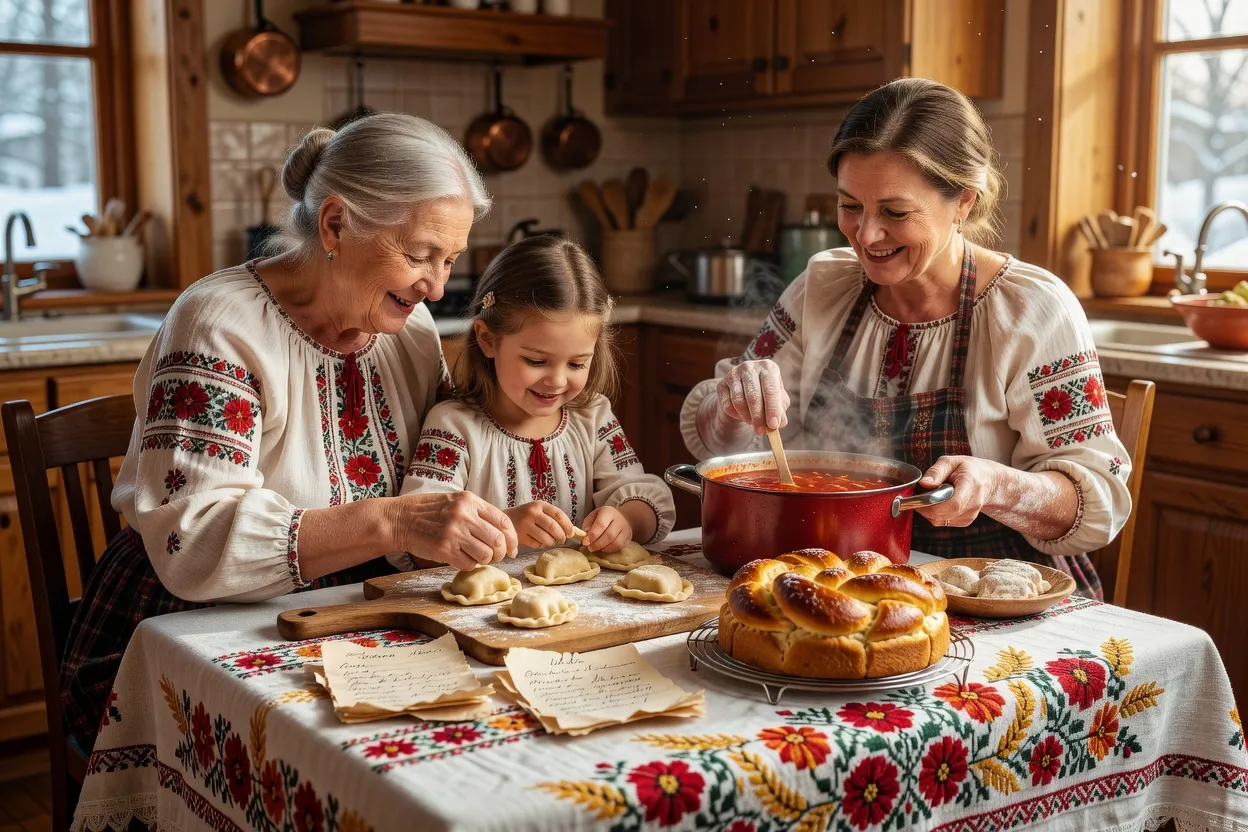
For a Ukrainian-Canadian family, the smell of borscht simmering on a Sunday afternoon is rarely just about dinner. It is a quiet conversation with the past. The same could be said of a tray of pierogi being sealed by hand at the kitchen table, or of a braided kolach cooling on a rack before a parish supper. These recipes arrived in Canada tucked inside memory rather than luggage, carried by women and men who left Galician villages, Bukovynian hamlets, Volhynian towns, and Poltava districts between the 1890s and the Second World War. The dishes they made became a kind of edible archive: a record of where a family came from, what they valued, and how they survived in a new country without forgetting the old one.
Food history is family history. In the Ukrainian-Canadian context, it is also village history. A single recipe card can preserve a dialect word, a regional technique, or an ingredient substitution that points back to a specific landscape. This article explores how the meals Ukrainian-Canadians still cook today function as living genealogical documents, connecting descendants to the regions, communities, and women who shaped the diaspora. If you are tracing your own Ukrainian roots, the recipes in your family kitchen may be one of the most personal sources you will ever find.
From Village Kitchens to Prairie Tables
The first wave of Ukrainian immigration to Canada began in 1891 and accelerated rapidly after 1896, when the Canadian government advertised free homestead land on the prairies. Most of these early settlers came from the Austro-Hungarian province of Galicia and the neighbouring Duchy of Bukovyna, regions that are now part of western Ukraine. They were followed by smaller but significant streams from Volhynia, Poltava, and other central Ukrainian districts. Many left because farmland at home was scarce and partitioned, and because Canadian agents promised 160 acres for a ten-dollar registration fee.
What they brought with them was not much in terms of material goods, but it was rich in practice. They knew how to bake with sourdough, how to ferment cabbage, how to stretch a small amount of meat into a nourishing soup, and how to turn root vegetables and grains into meals that could feed a family through a Prairie winter. Their foodways were shaped by the agrarian calendar of eastern Europe: heavy autumn preservation, meatless fast days, Easter baking, and the twelve-dish Christmas Eve Svyata Vechera that marked the turning of the year.
On the Canadian prairies, these rhythms were both disrupted and reinforced. The climate was colder and drier, but the soil was extraordinarily fertile for hard red spring wheat. Ukrainian women quickly discovered that the wheat they had grown in small Galician plots now grew in golden waves outside their sod houses. Churches were built first, then community halls, and around both institutions food became the primary language of cultural survival. The journey from village kitchen to prairie table is one of the great unwritten chapters of Ukrainian-Canadian history, and it began with the decision to keep cooking as if home were still within reach.
The Dishes That Define Ukrainian-Canadian Tables
Every diaspora community carries a short list of dishes that function as edible flags: foods so closely identified with the group that preparing them becomes a statement of identity. For Ukrainian-Canadians, that list is both long and lovingly preserved. It includes soups and dumplings, cabbage and bread, sweets and savoury pastries that have travelled remarkably well from the old country to the new.
The following dishes appear again and again in family recipe boxes, parish cookbooks, and festival menus. They are not museum pieces; they are working recipes, adapted dozens of times over by grandmothers, mothers, and now grandchildren who want to taste what their ancestors tasted.
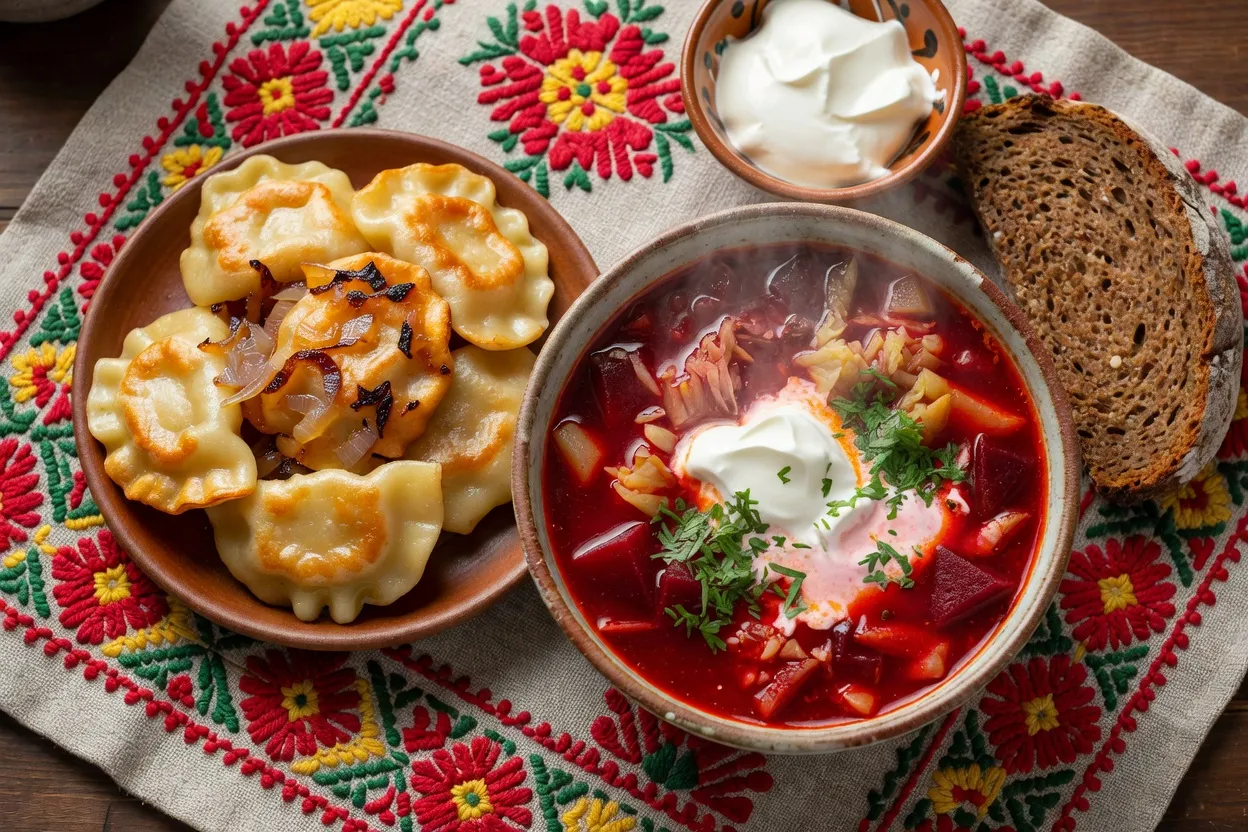
- Borscht — A beet-based soup that can be served hot or cold, meatless or enriched with pork or beef. It is the most internationally recognised Ukrainian dish and the one most likely to vary from one family to the next.
- Varenyky / Pierogi — Boiled dumplings with fillings ranging from potato and cheese to sauerkraut, mushroom, cherry, or prune. The name varenyky is Ukrainian; pierogi is the Polish-derived term many English-speaking Canadians use.
- Holubtsi — Cabbage rolls, typically filled with rice, buckwheat, or meat, slow-baked in a tomato or sour-cream sauce.
- Kapusniak — A hearty sauerkraut soup, often made with pork or sausage, sharp and restorative in winter.
- Nalysnyky — Thin crepes filled with cottage cheese, herbs, or fruit, then baked or pan-fried.
- Kolach — A braided, slightly sweet bread with deep ritual meaning, especially at Christmas and Easter. Its circular shape represents eternity and the Trinity. Learn more in our guide to Ukrainian Christmas kolach traditions.
- Kyiv Cake / Torte — A layered meringue and nut cake created in Kyiv in 1956 at the Karl Marx Confectionery Factory. It became a festive favourite in Ukrainian-Canadian communities after the Second World War.
These seven dishes do not exhaust Ukrainian-Canadian cuisine, but they form its backbone. Each one is connected to specific seasons, religious observances, and family memories. Borscht on a Friday, varenyky on a Saturday, holubtsi after church, and kolach at Christmas: this rhythm once defined the weekly and yearly calendar of countless prairie households.
| Dish | Core ingredients | Typical occasion | Genealogical clue |
|---|---|---|---|
| Borscht | Beets, cabbage, potato, carrots, dill, sometimes meat or beans | Weekly family meals, Svyata Vechera | Bean-thickened versions may point to Podillia or Poltava; mushroom-based versions suggest Galicia. |
| Varenyky / Pierogi | Flour dough with potato, cheese, sauerkraut, mushroom, or fruit filling | Sundays, holidays, parish suppers | Filling choices and dough thickness often reflect regional origin and Canadian adaptation. |
| Holubtsi | Cabbage leaves, rice, buckwheat, meat, tomato or sour-cream sauce | Family dinners, festivals | Buckwheat-heavy fillings are common in Transcarpathian and Bukovynian recipes. |
| Kapusniak | Sauerkraut, pork, potatoes, onions, caraway | Winter weekdays | Strong sauerkraut and caraway presence may indicate Bukovynian or Galician roots. |
| Nalysnyky | Thin crepe batter, cottage cheese, herbs, fruit | Brunch, light suppers, Lent | Fresh-cheese versions are typical of central and western Ukraine. |
| Kolach | Flour, eggs, sugar, yeast, often raisins or poppy seed | Christmas, Easter, weddings, funerals | Braided circular form and timing connect to both Christmas cuisine customs and Easter ritual. |
| Kyiv Cake | Meringue, hazelnuts or cashews, buttercream, chocolate | Weddings, birthdays, New Year | Post-1956 Soviet-era recipe; its presence signals a mid-20th-century or later connection to urban Ukraine. |
Regional Roots: Reading Recipes for Ancestral Geography
Ukrainian cuisine is not uniform. The country stretches from the Carpathian Mountains to the Black Sea steppe, and each region developed its own larder. For genealogists, this regional diversity is valuable. A family recipe can sometimes suggest where an ancestor lived before emigrating, especially when the recipe preserves an ingredient or technique that was specific to a particular province.
Galicia — Today part of western Ukraine, historical Galicia was under Austro-Hungarian rule until 1918. Its cuisine is rich in dairy, mushrooms, and caraway. Galician borscht often relies on a mushroom base for the fasting version and is served with vushka, tiny ear-shaped dumplings. Cream and butter appear generously in everyday cooking, and the region produced many of the Christmas and Easter breads still made in Canada.
Bukovyna — Situated in the Carpathian foothills, Bukovyna has strong Romanian, Hungarian, and Jewish culinary influences. Sauerkraut, smoked meats, and paprika-flavoured dishes are common. Bukovynian holubtsi might be made with cornmeal or buckwheat rather than rice, and kapusniak tends to be sharper and smokier than in other regions.
Volhynia — In northwestern Ukraine, Volhynian cooking is lighter and more reliant on freshwater fish, forest berries, and fresh dairy. Borscht here is often thinner and more vegetable-forward, and pancakes and crepes feature prominently. Families from Volhynia who settled in Canada sometimes kept a preference for simpler, less heavily spiced dishes.
Poltava — Central Ukrainian Poltava is famous for its own borscht tradition, often thickened with beans or served with halushky, small dumplings dropped directly into the soup. The cuisine is hearty and grain-centred, reflecting the region's rich black-earth agriculture. Poltava families brought with them a love of buckwheat, millet, and bean-based dishes that adapted easily to prairie life.
When a Ukrainian-Canadian recipe card specifies "add beans to the borscht," "use buckwheat in the holubtsi," or "serve with halushky," it may be signalling a regional origin. Comparing these clues with known Ukrainian village names and historical regions can help a researcher narrow down a parish or district to explore in Austrian, Hungarian, Polish, or Russian Empire records.
Prairie Substitutions and Canadian Inventions
Ukrainian immigrants did not simply reproduce old-country recipes in Canada. They adapted, sometimes out of necessity and sometimes because Canadian ingredients were surprisingly similar. The result was a cuisine that remained recognisably Ukrainian while becoming quietly Canadian.
The most important substitution was grain. Hard red spring wheat flourished on the prairies and became the foundation of Ukrainian-Canadian bread, dumpling dough, and pasta. Settlers from Galicia and Volhynia, who had known wheat at home, now had it in abundance. Those from more forested or mountainous regions learned to use prairie wheat as a substitute for the mixed grains they had once relied upon.
Pork and cabbage, two pillars of Ukrainian cooking, were also available in Canada. Ukrainian settlers often raised their own pigs and made their own sauerkraut in ceramic crocks, continuing a preservation tradition that had sustained them through Eastern European winters. Sour cream and fresh cheese were easier to obtain in dairy-rich Canada than in the often impoverished old-country countryside, so creamy varenyky and rich borscht became even more common.
Some substitutions were more inventive:
- Cranberries occasionally replaced sour cherries in fruit compotes and sauces, especially in Ontario and Quebec where cranberries were locally grown.
- Maple syrup appears in a few family recipes as a Canadian alternative to honey in sweets and glazes, though it never fully replaced honey in traditional baking.
- Prairie wild mushrooms substituted for European forest mushrooms in dried-mushroom soups and sauces, with each family developing its own preferred foraging spots.
- Cheddar cheese became a common filling for varenyky after Ukrainian-Canadian dairies began producing it locally, creating the now-classic "cheddar and potato" pierogi.
- Canola oil and margarine gradually replaced lard and butter in some households during the mid-20th century, altering texture but preserving form.
These changes were not failures of tradition. They were the tradition in action. Each substitution told a story about what was available, what was affordable, and what a family decided to keep sacred. A recipe that calls for cheddar rather than dry cottage cheese is not inauthentic; it is a document of Canadian life in the 1930s or 1940s, when a Ukrainian dairy farmer's wife first tried the local cheese and discovered it melted beautifully inside a dumpling.
Handwritten Recipes as Family Archives
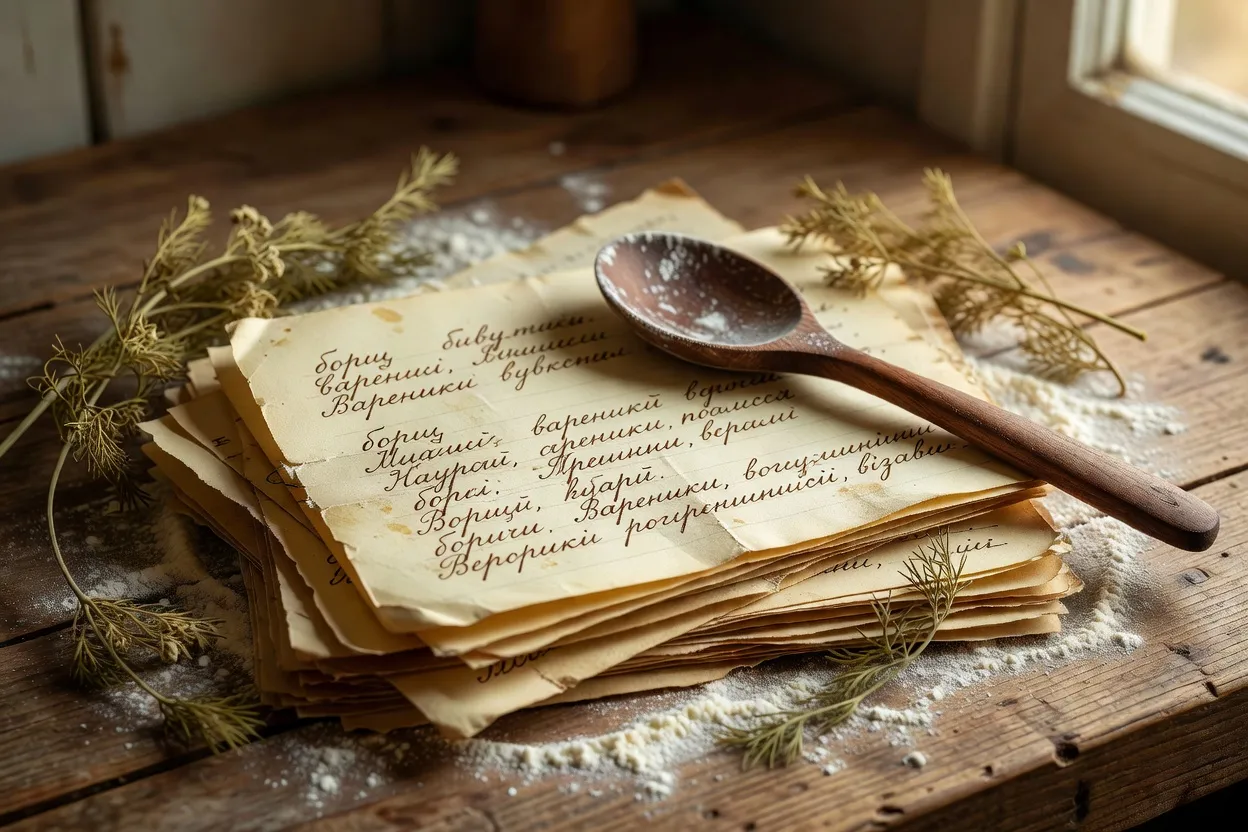
For Ukrainian-Canadian genealogists, the most precious documents are sometimes not in archives at all. They are in kitchen drawers: index cards written in a shaky hand, notebook pages stained with bacon grease, and mimeographed church cookbook pages annotated with "from Baba" or "Teta's way." These objects are family archives, and they preserve information that rarely appears in official records.
A handwritten recipe can contain clues to a woman's literacy, her language use, and her social network. Cards written in Ukrainian rather than English often indicate a first-generation immigrant. Cards that switch between languages, using English words for Canadian ingredients and Ukrainian words for techniques, capture the linguistic code-switching of the second generation. Marginal notes — "like Mother made," "for Christmas only," "do not skip the caraway" — preserve judgments and memories that would otherwise be lost.
Recipe cards also preserve names and relationships. A card marked "Annie Kowal's borscht" or "Mrs. Hnatiuk's varenyky" names a real person, often a neighbour or relative whose full name may not appear elsewhere in the family papers. For a genealogist trying to reconstruct a community, these names are gold. They connect households, parishes, and villages in ways that census records cannot.
Even the physical form of a recipe card matters. A card written on the back of a funeral notice, a prayer card, or a church bulletin is anchored in a specific date and place. A recipe copied into a school notebook may have been written by a daughter learning to cook under her mother's supervision. These material details give recipes a context that printed cookbooks cannot match.
Parish Kitchens, Community Suppers, and Keeping Tradition Warm
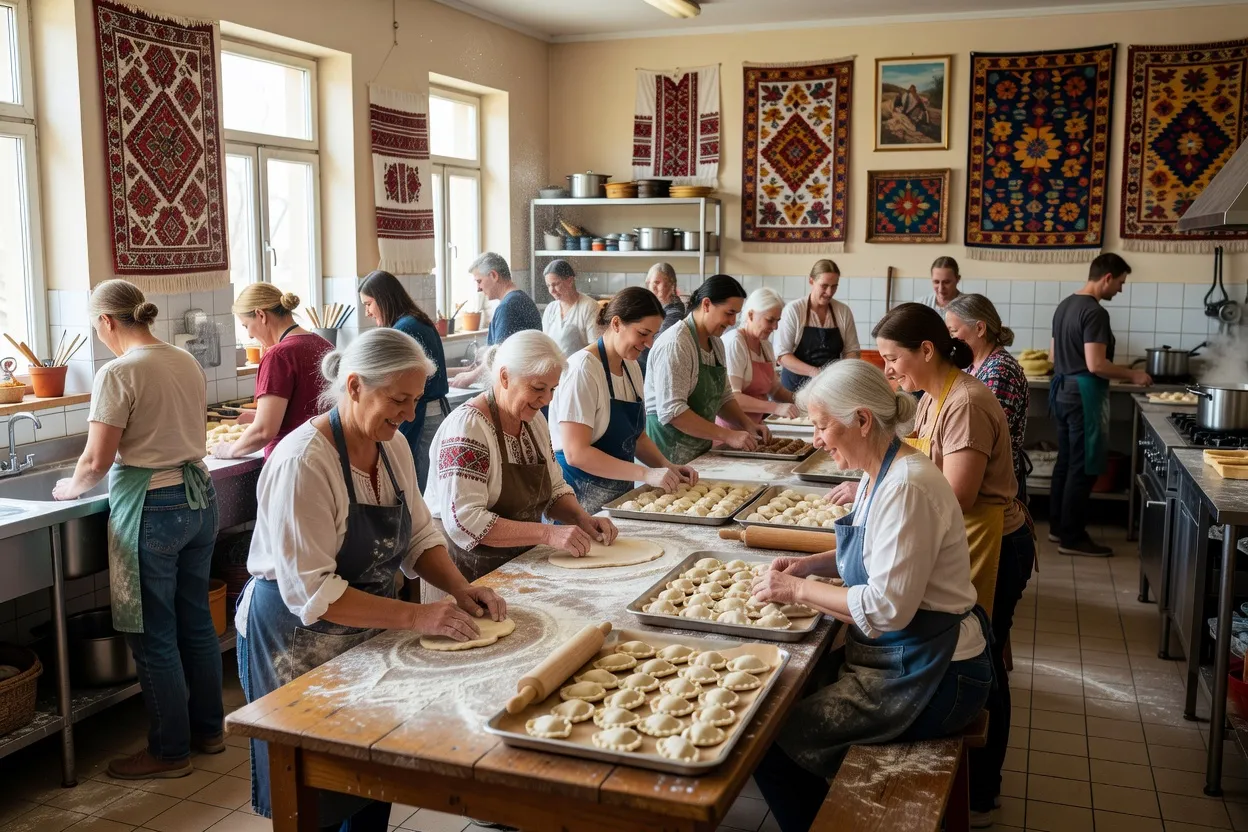
If the family kitchen was where Ukrainian-Canadian foodways were preserved, the parish hall was where they were shared. Ukrainian Catholic and Orthodox churches across Canada became the institutional heart of the diaspora, and their kitchens became schools of tradition. Women organised perogy-making bees, baked bread for festivals, and compiled cookbooks to raise money for church renovations, refugee relief, and youth programs.
Community cookbooks produced by Ukrainian women's groups are among the most underused sources in family history research. A 1965 cookbook published by a Ukrainian women's group might contain not only recipes but also contributor names, parish affiliations, and advertisements from local Ukrainian-owned businesses. The University of Alberta's Culinaria exhibition includes a Ukrainian ladies' cookbook with a special section on the twelve dishes of Christmas Eve Svyata Vechera, demonstrating how closely food and faith were intertwined.
Parish suppers and cultural festivals kept these dishes in public view. From small-town Alberta to urban Ontario, Ukrainian halls hosted Friday night perogy suppers, fall borscht dinners, and summer festival booths. These events did more than raise funds. They gave young people a reason to learn the recipes, gave newcomers a place to belong, and gave the broader Canadian public a taste of Ukrainian hospitality. In many prairie towns, the Ukrainian church supper was one of the first places where Ukrainian-Canadian identity was performed and celebrated openly.
The women who organised these events rarely appear in history books, but their labour built the diaspora. They were the translators between old-country tradition and new-country reality, the ones who decided which recipe would be made with lard and which with shortening, which festival would feature kolach and which would sell torte. Their names, recorded in parish cookbooks and hall rental logs, deserve to be remembered as founders of the community every bit as much as the male church elders who signed the charters.
Today, Ukrainian-Canadian food traditions are experiencing a revival. Younger generations are asking grandparents for recipes, filming perogy-making tutorials, and posting regional variations online. Restaurants and food trucks from Vancouver Island to Montreal serve modern takes on borscht and varenyky. At the same time, parish kitchens still fill with volunteers before Christmas and Easter, proving that the old ways have not been replaced — they have simply found new carriers.
For anyone researching Ukrainian-Canadian ancestry, the food on the family table is a starting point, not an afterthought. Ask which dishes your grandparents considered essential. Ask whether the recipe came from a specific village or region. Ask who wrote the recipe card and in what language. The answers may lead you not only to a better borscht, but to a clearer picture of where your family came from and how they made Canada home while never fully leaving Ukraine behind.
Sources consulted: Internet Encyclopedia of Ukraine, "Traditional foods" (encyclopediaofukraine.com); Veselka, "8 Classic Ukrainian Foods: A Taste of Tradition" (veselka.com); Discover Ukraine, "The most delicious dishes of Ukrainian cuisine" (discover.kr.ua); The Canadian Table, "Ukrainian" (canadiantable.com); Canadian Food Focus, "The History Of Perogies In Canada" (canadianfoodfocus.org); M. Epp, "Eating Across Borders: Reading Immigrant Cookbooks," Historical Studies in Education (hssh.journals.yorku.ca); University of Alberta Bruce Peel Special Collections, Culinaria exhibition, Ukrainian Ladies' Good Will Organization cookbook (omeka.library.ualberta.ca); Chef's Pencil, "Kyiv Cake (Iconic Ukrainian Meringue Cake) Recipe" (chefspencil.com); Authentic Ukraine, "Kyiv cake" (authenticukraine.com.ua).
Frequently Asked Questions
The most common Ukrainian-Canadian dishes include borscht (beet soup), pierogi or varenyky (dumplings), holubtsi (cabbage rolls), kapusniak (sauerkraut soup), nalysnyky (thin crepes), kolach (braided bread), and Kyiv cake or torte. These dishes appear at family tables, church suppers, and cultural festivals from the prairies to Prince Edward Island.
Yes. Regional cooking styles can offer clues. A family borscht recipe thickened with beans and served with halushky may point toward Poltava; mushroom-forward fillings and caraway accents suggest Galicia; sauerkraut and pork combinations echo Bukovyna; and lighter, fresh-cream dishes are more typical of Volhynia. Handwritten recipe cards sometimes name a village or include a regional ingredient that helps narrow the search.
Start with parish archives, Ukrainian Catholic and Orthodox church basements, local historical societies, university special collections such as the University of Alberta's Culinaria exhibition, and interlibrary loan. Many community cookbooks were sold as fundraisers by Ukrainian women's groups between the 1920s and 1980s and list contributor names alongside recipes.
Recipes vary because immigrants arrived from different regions of Ukraine at different times, settled in distinct Canadian climates, and adapted to locally available ingredients. Oral transmission, memory, and the need to substitute prairie wheat, Canadian pork, wild mushrooms, cranberries, or maple syrup all produced gentle but lasting differences between family versions.
Settlers on the Canadian prairies found that hard red spring wheat replaced Ukrainian grains, while pork and sauerkraut remained accessible. Cranberries sometimes replaced sour cherries in compotes, and a few families experimented with maple syrup in place of honey. Dairy and sour cream were often easier to obtain in Canada than in the old country, leading to richer varenyky and creamier borscht.