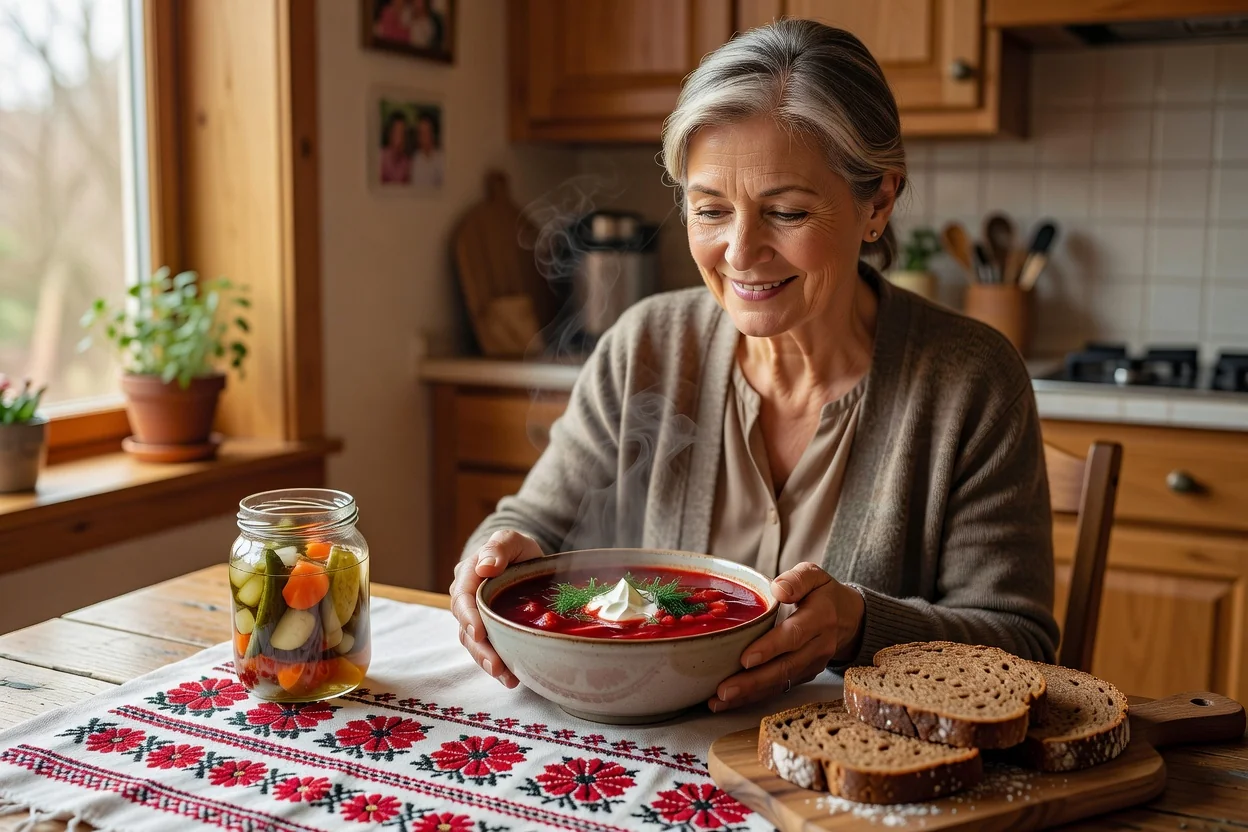
On any given evening, in a Facebook group called BORSCHT TALK CANADA!!, someone posts a photograph of a pot — deep red, almost purple, a wooden spoon resting across the rim — and asks the question that has launched a thousand threads: does your baba put beans in hers? The replies come from Winnipeg, Edmonton, Saskatoon, Toronto, and from descendants in PEI who are trying to reconstruct a recipe their grandmother never wrote down. The soup in the photograph is borscht, and the conversation around it is one of the most active, unselfconscious repositories of Ukrainian-Canadian culture anywhere on the internet.
This article is for the people in that group, and for everyone who has ever wondered why a bowl of beet soup carries so much weight. It traces how borscht travelled from Galician village kitchens to the Canadian prairie, why UNESCO stepped in to protect its culture in 2022, and — most importantly for our readers — how the dish your family makes can become a working tool in your genealogy research.
What Is Borscht Talk Canada?
Borscht Talk Canada is best described as a rolling kitchen-table conversation that happens to take place online. The Facebook community of that name brings together tens of thousands of posts and comments from Ukrainian-Canadians of every generation, along with newcomers from Ukraine itself and curious cooks with no Ukrainian roots at all. The unwritten rules are simple: show your pot, name your region, and be ready to defend your version.
Scroll through the group and the same themes keep surfacing:
- The authenticity debate. Meat or meatless? With beans or without? Tomatoes — acceptable shortcut or heresy? Every thread is a miniature history lesson in regional cooking.
- Memory posts. Members share photographs of grandmothers at stoves, of handwritten recipe cards stained with beet juice, and of church basements long since demolished, asking if anyone else remembers them — the same heirlooms examined in our guide to Ukrainian-Canadian food traditions and family recipes.
- Newcomer questions. Displaced Ukrainians who arrived after 2022 ask where to find proper smetana in Canadian supermarkets, and the community answers with maps.
- Fundraising and solidarity. Borscht suppers advertised in the group routinely raise money for Ukraine — the dish as an instrument of support.
What makes the group remarkable, from a heritage perspective, is that none of it is curated. It is folklore being generated in real time, by ordinary people, about the single most recognizable dish their culture has produced.
From Galician Hearth to Prairie Table
Borscht began as a sour soup — the name derives from the Slavic root for hogweed, the herb that originally provided the tang — and Ukrainian cooks were the ones who made beets its defining ingredient, a shift traced to roughly the sixteenth century. By the time the first organized Ukrainian immigrants reached Canada in 1891, the red beet version was firmly the national dish, and it travelled in their luggage as seeds, as dried borshchovna zelena (sorrel), and above all as memory.
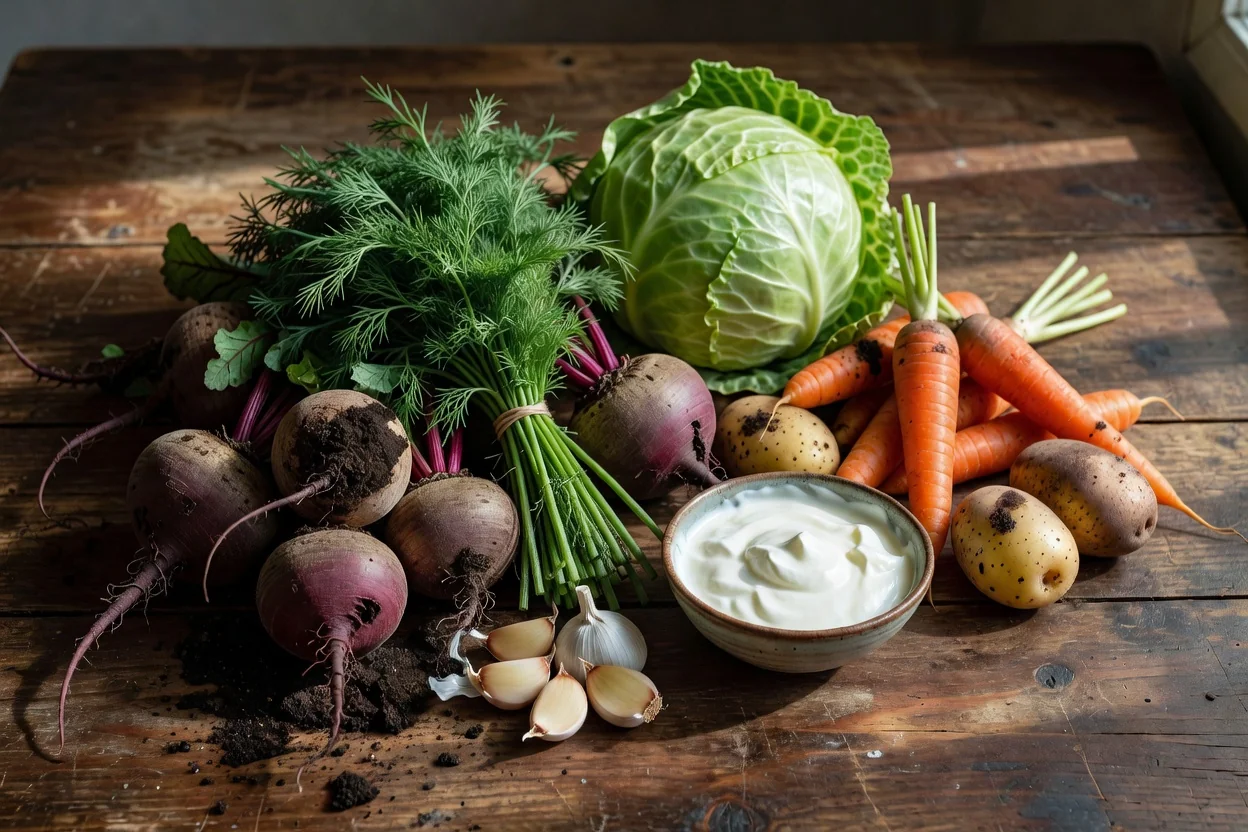
The roughly 170,000 Ukrainians who arrived between 1891 and 1914 settled mostly on prairie homesteads, where the dish adapted within a generation. The old-country recipe called for ingredients that were scarce or unknown on the steppe-like plains: local beets were smaller and sweeter, cabbage stood in for whatever greens the village had grown, and dill — which took to Canadian gardens enthusiastically — became the signature finish. Sour cream, or smetana, was already a prairie staple thanks to dairy farming, so the essential garnish was never at risk.
Crucially, borscht was never only food. In the homestead era it was the dish you served the threshing crew, the dish that marked a visit from the priest, the dish that said a family had enough to share. That social function survived every later transformation, and it is the direct ancestor of today's church-hall suppers. And the recipes themselves were usually transmitted by the women of the family — the same women whose names are often the hardest to trace in official records, a problem this article returns to below.
A Symbol Worth Protecting: UNESCO and the War
To understand why a soup needs protecting, consider what happened to it. In 2020, the culture of Ukrainian borscht cooking was entered on Ukraine's national inventory of intangible cultural heritage, after the chef Yevhen Klopotenko organized a "borscht expedition" that collected family recipes from villages across the country. On 1 July 2022 — four months into Russia's full-scale invasion — UNESCO's Intergovernmental Committee inscribed it on the List of Intangible Cultural Heritage in Need of Urgent Safeguarding, recognizing that war was disrupting the very communities that transmitted the tradition.
The decision mattered because it settled, on the record, a long-running argument. Similar beet soups exist in Russia, Poland (barszcz) and beyond, and for decades "Russian borscht" appeared on menus from New York to Toronto, quietly absorbing a Ukrainian dish into someone else's brand. UNESCO's inscription named the culture as Ukrainian — not the soup in the abstract, but the specifically Ukrainian way of making, serving, and talking about it.
For the roughly 1.4 million Canadians who claim Ukrainian ancestry — the diaspora profiled in our guide to Ukrainian-Canadian population and communities — that recognition landed with particular force. Here was the dish of their childhood suppers, the one their non-Ukrainian neighbours always asked about, formally acknowledged as heritage worth safeguarding. The Borscht Talk Canada group, and dozens of supper-club fundraisers like it, are partly the diaspora's answer: if the tradition is under threat, you keep it alive one pot at a time.
Borscht Across Canada: Variations Worth Tasting
There is no single correct borscht, even within one family — and across Canada the variations map neatly onto the history of the community itself. The table below sketches the main streams a researcher (or a hungry visitor) is likely to encounter.
| Style or setting | Characteristics | Where to find it |
|---|---|---|
| Baba's home borscht | Rich, long-simmered, usually with beef or pork; sweet-sour balance from slow-roasted beets; finished with smetana and fresh dill | Family tables everywhere; the reference standard all other versions are judged against |
| Church-hall borscht | Made in 40-litre stockpots by volunteers; consistent, meaty, slightly milder; served with sliced white bread and sometimes perogies | Ukrainian Catholic and Orthodox parish suppers across the prairie provinces, Ontario and the Maritimes |
| Meatless (fasting) borscht | Rich vegetable version with mushrooms or beans instead of meat; associated with holy days and Christmas Eve tradition | Lenten suppers and Sviata Vechera tables; documented in period cookbooks such as the 1929 Praktychna Kukhnia |
| Mennonite-country borscht | Thinner, often with tomatoes and a sweet-sour note; reflects shared prairie kitchens between Ukrainian and Mennonite communities in Manitoba | Steam-pie country around Steinbach and Winnipeg; community cookbooks from both traditions |
| Festival and competition borscht | Chefs and home cooks compete; borscht ice cream and borscht cocktails have appeared as stunt entries | Borscht Fest in Victoria, BC, where a "Remembrance Borsch" took the People's Choice award in recent years |
Each row of that table is also a genealogical clue. The version your family makes points to a region, a church tradition, and often a specific chain of women who taught it. If you want a well-documented baseline to compare your own reconstruction against, the guide to an authentic borscht recipe with its regional variants walks through the classic preparation step by step, from broth to the final spoonful of smetana.
The Genealogy of a Recipe
Here is where borscht stops being dinner and becomes evidence. Family recipes are among the most information-dense heirlooms a Ukrainian-Canadian family can possess, and they reward the same careful treatment as any other historical source.
Start with the physical artefacts. Handwritten recipe cards are often annotated with exactly the details genealogists chase: a grandmother's maiden name signed in the corner, a village name in the margin ("the way they made it in Borshchiv"), a date, a cross-reference to who gave the recipe to whom. Community cookbooks — printed by parish women's groups, church congregations and fundraising committees from the 1930s onward — typically list every contributor by name, often with their town. A single such book can function as a census of the women of a parish, which is precisely the population that birth and marriage records document least completely.
Then there is the oral dimension. Ask a relative to walk you through their borscht and you will get more than cooking instructions. You will learn who taught them (often a chain of first names stretching back to a village), whether the family was Catholic or Orthodox (meatless traditions and holiday timing differ), and frequently an unprompted migration story: which sibling sponsored whom, which town they first landed in, what they ate the first winter. Our interview-based guide to tracing Ukrainian-Canadian women's maiden names explains why these kitchen-side conversations are often the only surviving trace of the women who carried these recipes — and how to convert what you hear into recordable, checkable leads.
Where the Borscht Talk Happens Today
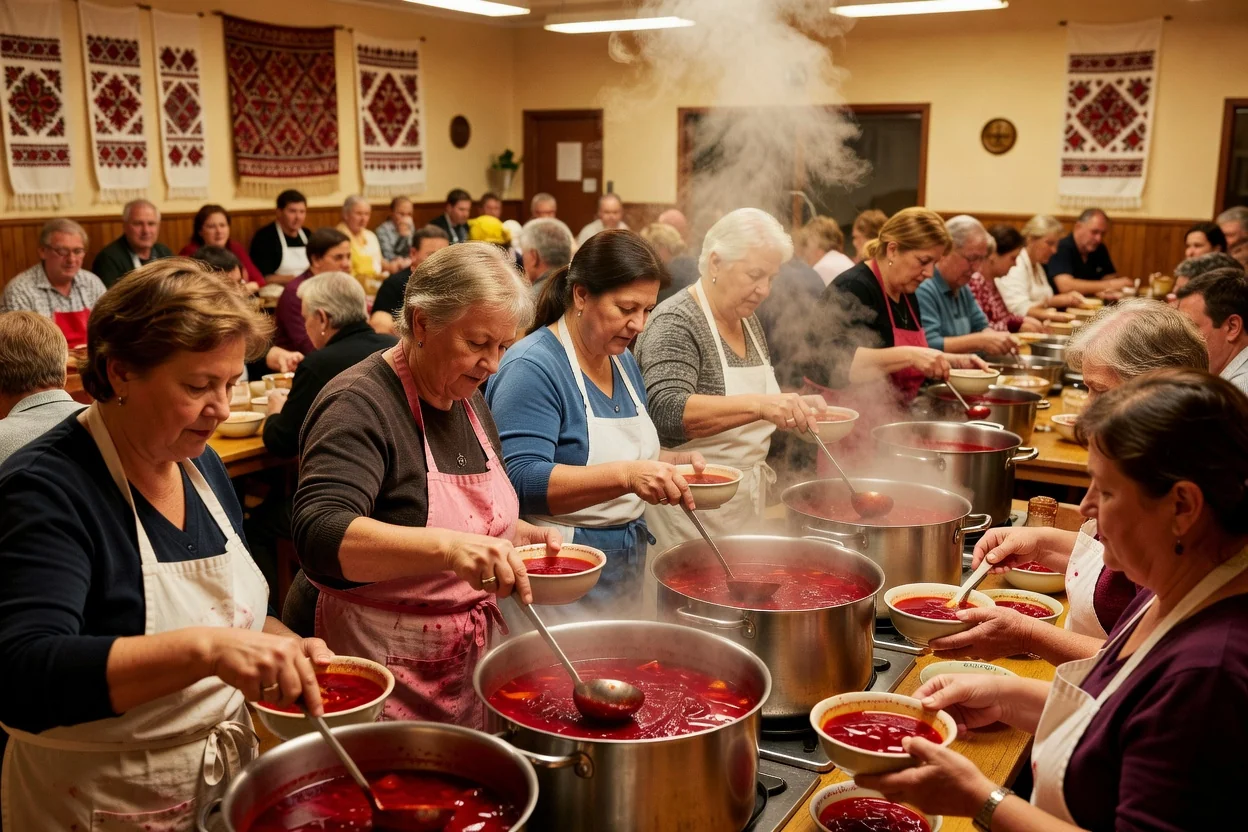
The conversation that the Borscht Talk Canada group hosts online has offline roots that go back almost as far as the community itself. Ukrainian-language radio has served the diaspora for decades — CKJS in Winnipeg has long broadcast an "Ukrainian Hour," and community stations in Brandon and other prairie cities have kept the same tradition — and food has always been part of the patter between the music. Newer arrivals have layered fresh venues on top of the old ones: supper clubs in Toronto and Edmonton, borscht-making workshops run by cultural centres, and the fundraising lunch that has become the default event of almost every Ukrainian-Canadian organization since 2022.
The post-2022 wave of displaced Ukrainians has changed the flavour of the talk in the best possible way. In communities like Fargo, North Dakota — just across the line but culturally continuous with the Canadian prairie — recent arrivals have teamed up with long-established Ukrainian families to cook community meals where borscht is the anchor dish and the room holds both old-timers and newcomers. The same scenes repeat across Canada: a church basement, an enormous pot, and two diasporas separated by a century discovering that they argue about beans in exactly the same way.
For the genealogist, these venues are fieldwork sites. A parish supper is where you meet the second cousin who has the photographs; a festival booth is where the regional association keeps its membership list; and a radio program's guest chair is where family stories get told on the record.
Recording Your Family Borscht Before It Fades
UNESCO's list exists because intangible heritage does not preserve itself. A recipe that lives only in one person's hands is a single point of failure, and every year the generation that cooked from memory, without measuring anything, grows smaller. The good news is that recording a family borscht properly is a one-afternoon project with a permanent payoff. A practical approach:
- Cook together, on camera. Video the eldest cook in the family making the dish in real time, narrating as they go. Capture the gestures — how they test the beets, when they add the garlic — not just the ingredients.
- Write it down the way they actually make it. "A handful," "until it looks right," and "you'll know" are legitimate units. Note them, then add your own measured approximation in brackets.
- Annotate the provenance. Who taught this version? Where did that person's family come from? Which church did they attend? These notes are the genealogy.
- Cross-check against the historical record. Period cookbooks and community collections — like the Ukrainian community cookbooks described in our Ukrainian immigration to Canada timeline and community histories — let you place your family's version in its regional and historical context, and sometimes recover details that were dropped along the way.
- Share it back. Post the finished recipe and its story to the family group chat, or to a community like Borscht Talk Canada. A recipe that circulates cannot be lost.
A century ago, the first Ukrainian settlers in this country measured their welcome by whether there was enough borscht to go around. Today the pot is still on the stove, the argument about beans is still unresolved, and somewhere in your own family's version of the dish there is a record of where you came from — worth writing down before it simmers away.
Sources consulted: UNESCO, Culture of Ukrainian borscht cooking (2022 inscription); UNN, history of borscht and its regional recipes; Wikipedia, Borscht; Taste Report, Solidarity Soup: Remembrance Borsch at Borscht Fest; InForum, Ukrainians share tastes of home in community meal; Savour Calgary, Sviat Vechir and Baba's Cookbook; Eats History, a traditional Ukrainian borscht recipe from the 1930s; Veselka, history of borscht; Facebook community BORSCHT TALK CANADA!!.
Frequently Asked Questions
Borscht Talk Canada is an online community — centred on a Facebook group of the same name — where Ukrainian-Canadians and friends of the culture share borscht recipes, photographs of pots and church-hall suppers, and memories connected to the dish. Anyone interested in Ukrainian-Canadian food culture can join, and the conversations there are a living record of how families actually cook and talk about borscht today.
Borscht belongs to a family of sour soups eaten across Eastern Europe, and similar soups exist in several cuisines. The beet-based version most people picture, however, is distinctly Ukrainian: it was Ukrainian cooks who made beets its defining ingredient, and on 1 July 2022 UNESCO inscribed the culture of Ukrainian borscht cooking on its List of Intangible Cultural Heritage in Need of Urgent Safeguarding, explicitly as a Ukrainian element. That is why borscht has become a symbol of Ukrainian cultural identity, in Canada as in Ukraine.
The recipe crossed the Atlantic with the first immigrants and adapted to the Canadian prairie garden: local beets, cabbage, potatoes and dill, whatever meat was on hand, and a generous dollop of sour cream. Just as distinctively, borscht became community food in Canada — ladled at church suppers, fundraising lunches, ethnic festivals and family tables from Winnipeg to Charlottetown — so the Ukrainian-Canadian version is as much a social institution as a recipe.
Yes. Handwritten recipe cards often carry a grandmother's maiden name or a village in the margin. Community cookbooks printed by churches and women's groups list contributors by name and parish. And the dish itself is a conversation opener: asking a relative how their family made borscht reliably surfaces the names, places and migration stories that no database will hand you.
Cook alongside the eldest person in your family who still makes it, and record the session on video — borscht is learned by watching, not by lists. Fill gaps with community cookbooks from your ancestors' parish or region, and with period Ukrainian cookbooks that document how the dish was made before and after immigration. Then write your own version down, noting who taught you and where their family came from, so the chain does not break again.