Why Regional Patterns Matter for Family History
For many Ukrainian-Canadian descendants, a folded rushnyk or a child's sorochka tucked away in a cedar chest is the only tangible link left to a great-grandmother's village. Unlike a surname, which can be Anglicized, misspelled, or lost across generations, an embroidery pattern is a fixed visual record. Before Ukrainian villages had reliable postal addresses or standardized surnames, a woman's needlework already told anyone who could read it which valley, which parish district, and sometimes which specific settlement she came from.
This matters enormously for family historians on Prince Edward Island and across Canada, where so many Ukrainian settlers arrived from Galicia and Bukovyna between the 1890s and 1914 with little more than a trunk of clothing and linens. A single surviving rushnyk, examined carefully, can sometimes narrow a search from "somewhere in Austria-Hungary" to a specific historical region — a critical clue when parish and civil records have not survived or have not yet been located.
Our companion article on Ukrainian embroidery and vyshyvanka traditions introduces the broader history, symbolism, and cultural role of vyshyvka. This guide goes further into the regional detail: the specific color palettes, motifs, and stitching techniques that distinguish one historical region from another, so that a family heirloom can actually be read as a genealogical clue rather than admired only as decoration.
How to Read an Heirloom Before You Start
Before comparing a family piece against the regional descriptions below, it helps to look at it systematically rather than impressionistically. Textile researchers and museum curators typically examine four elements in sequence: the dominant color combination, the placement of the embroidery on the garment, the stitch technique used, and the specific motifs repeated in the design.
- Dominant colors: Is the piece mostly one or two colors (often a sign of western regions) or a rich multicolor palette (more typical of Bukovyna and the Hutsul area)?
- Placement: Is embroidery concentrated on the collar and cuffs only, or does it extend across the whole chest panel (ustavka) and sleeves?
- Stitch technique: Cross-stitch, satin stitch, drawn-thread (lace-like) work, and low-relief (nyzynka) stitching each point toward different regional traditions.
- Motif type: Purely geometric shapes, stylized florals, or a combination of both help narrow the range of likely regions considerably.
Tip: Photograph the embroidery in natural daylight, both front and back, before doing any research. The reverse side often shows the stitch structure more clearly than the front, and museum or archive staff assisting you remotely will need clear images to offer an opinion on regional origin.
Galicia (Halychyna): Red-and-Black Geometry
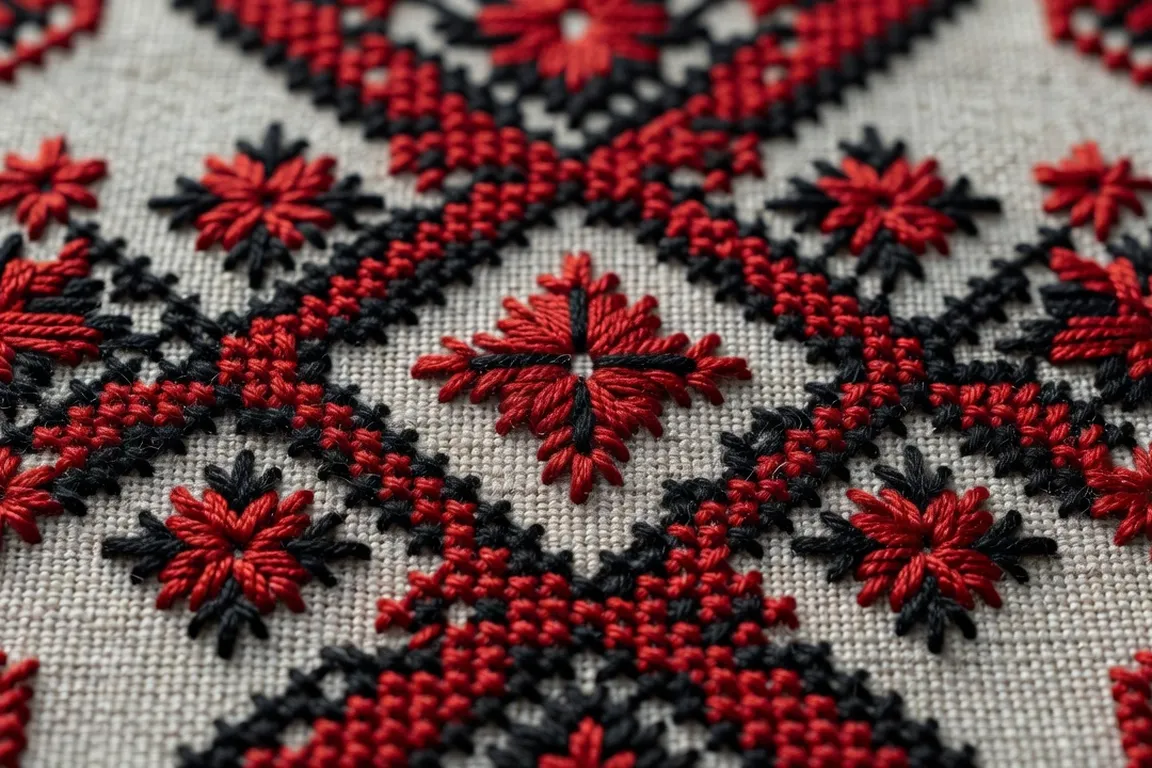
Galicia, the historical region that sent the largest single wave of Ukrainian settlers to Canada before the First World War, is closely associated with a bold red-and-black color scheme built from strict geometric cross-stitch. Descendants of families from villages around Ternopil, Ivano-Frankivsk (formerly Stanyslaviv), and the surrounding countryside will often find this palette on surviving pieces.
Typical Galician motifs include eight-pointed stars, diamonds arranged in repeating bands, and stylized trees rendered as symmetrical geometric shapes rather than realistic foliage. The counted cross-stitch technique produces crisp, angular lines, and the embroidery is frequently arranged in horizontal bands across the chest and sleeve cuffs rather than scattered loosely across the fabric. Because so many early Ukrainian-Canadian settlers on the prairies and in smaller communities such as those on PEI trace back to Galician villages, this is often the first palette researchers encounter when examining pioneer-era heirlooms. For background on the migration wave itself, see our guide to Galicia to Canada: understanding the Ukrainian migration.
Bukovyna: Polychrome Abundance
Bukovyna, the historical region around Chernivtsi that also sent significant numbers of settlers to Canada, is recognized by a strikingly different approach: dense, multicolored embroidery that often covers nearly the entire visible surface of a garment. Where Galician work restrains itself to red and black, Bukovynian embroidery embraces a wide palette — reds, oranges, yellows, greens, and blues combined within a single piece.
The technique frequently combines cross-stitch with satin-stitch elements, and floral motifs are blended freely with geometric shapes, sometimes within the same repeating unit. This abundance was not accidental; a heavily embroidered garment signaled both skill and the relative prosperity of a household, since the material and time investment required was substantial. Families researching Bukovynian roots may also find this region referenced in discussions of Vyshyvanka Day's own origins, since the modern celebration began at a university in Chernivtsi. Our detailed history of Den Vyshyvanky (Vyshyvanka Day) traces that connection in full.
Poltava: White-on-White Refinement
Central Ukraine's Poltava region produced one of the most technically demanding and visually restrained embroidery traditions: bilyi po bilomu, or "white on white." Rather than relying on bold color contrast, Poltava embroiderers created intricate texture and pattern using white thread on white or naturally undyed linen, often through drawn-thread work that pulls and bundles individual threads to create an openwork, lace-like effect.
This style is generally considered the most refined and labor-intensive of the major regional traditions, and pieces in this style were historically associated with formal or ceremonial use rather than everyday wear. If a family heirloom shows subtle raised or openwork texture rather than obvious color patterning, it is worth considering a Poltava or broader central Ukrainian origin, though researchers should be cautious, since white-on-white techniques also appear, less commonly, in a few other central regions.
| Element to check | What Poltava-style pieces typically show |
|---|---|
| Base color | White or unbleached linen, minimal color contrast |
| Texture | Raised or openwork drawn-thread patterning, felt by touch |
| Typical use | Formal wear, wedding linens, ceremonial rushnyky |
Hutsul Region: Carpathian Color and Beadwork
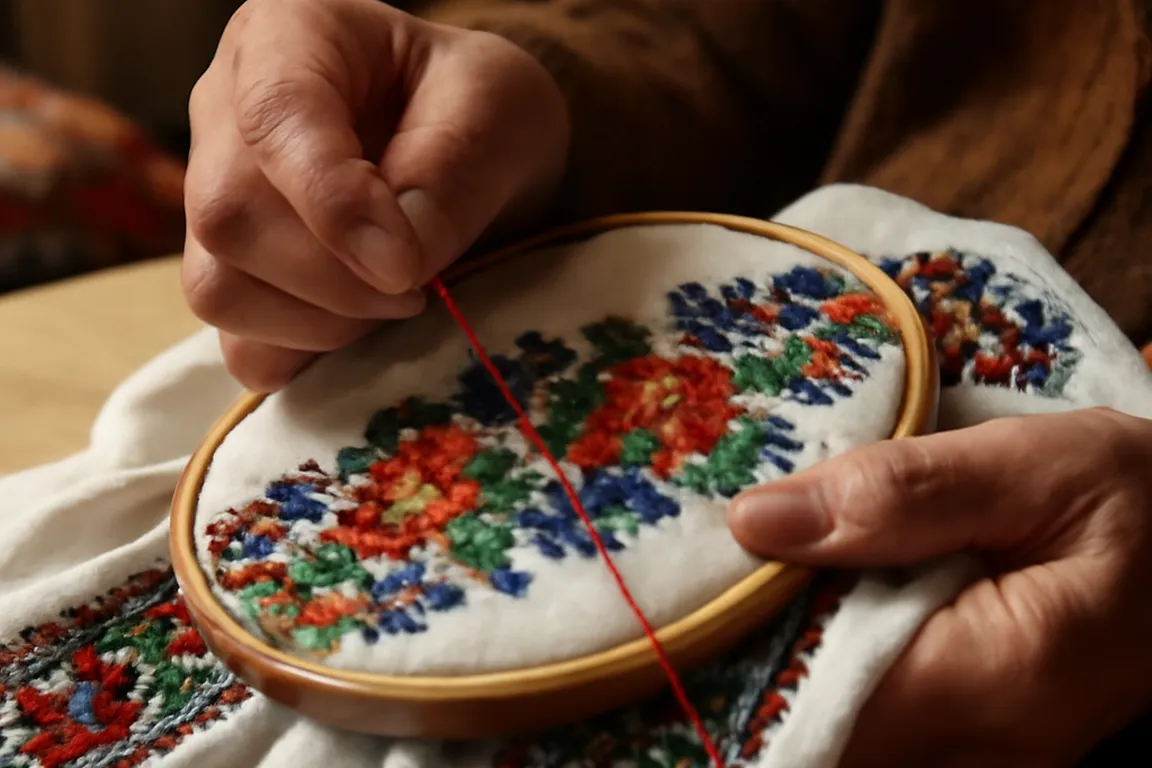
The Hutsul region, in the Carpathian highlands straddling parts of historical Galicia and Bukovyna, produced perhaps the most immediately recognizable regional style because of its combination of embroidery with beadwork and metallic thread. Vivid combinations of red, yellow, green, and orange appear in dense, complex geometric patterns that can seem almost overwhelming compared to the more restrained lowland styles.
Beading, sometimes combined with small metal sequins or coins, was frequently added to festival and ceremonial garments, reflecting the distinct highland pastoral culture of the Hutsuls, who maintained a somewhat separate identity from lowland Ukrainian villagers even while sharing the same broader linguistic and religious traditions. A family heirloom featuring glass beadwork alongside embroidered thread, rather than thread alone, is a strong signal of Hutsul or closely related highland origin.
Volyn and Other Historical Regions
Beyond the four major styles above, several other historical regions sent smaller but still significant numbers of settlers to Canada, each with recognizable embroidery traditions of its own.
- Volyn: Predominantly red-dominant palettes with clean, symmetrical geometric patterns that incorporate floral elements more than Galician work does, without reaching the polychrome density of Bukovyna.
- Podillia: Bold, dense patterns built primarily from black embroidery with red and yellow accents, producing strong visual contrast against the fabric.
- Kyiv region: Plant and floral motifs combined with red-and-blue color schemes, worked in satin stitch and counted thread techniques rather than the dense geometry of the west.
- Podlachia and border areas: Transitional styles blending elements of neighboring Polish and Belarusian embroidery traditions, reflecting centuries of shared borderland settlement.
Because settlement patterns to Canada were not evenly distributed, families with roots in these secondary regions may find fewer published reference collections online, making a direct comparison with museum-held pieces or consultation with a textile specialist more valuable than relying on general web searches alone.
Regional Pattern Comparison Table
The table below summarizes the four regions most commonly relevant to Ukrainian-Canadian genealogy research, condensing the details above into a quick-reference format.
| Region | Dominant Colors | Typical Motifs | Technique |
|---|---|---|---|
| Galicia (Halychyna) | Red and black | Eight-pointed stars, diamonds, stylized trees | Counted cross-stitch, geometric bands |
| Bukovyna | Rich polychrome (red, orange, yellow, green, blue) | Combined floral and geometric motifs | Cross-stitch and satin-stitch blended |
| Poltava | White on white or unbleached linen | Subtle geometric and floral lace-like patterns | Drawn-thread (openwork) technique |
| Hutsul region | Red, yellow, green, orange | Dense geometric patterns, often with beading | Cross-stitch with metallic thread and beadwork |
Keep in mind that these categories describe general tendencies documented by ethnographers over more than a century, not rigid rules — individual embroiderers, family workshops, and even specific villages sometimes developed personal variations that blend elements from neighboring regions, particularly in border areas or among families that had relocated even before emigrating to Canada.
Common Mistakes When Identifying Regional Embroidery
Attempting to identify a family piece's region of origin is a rewarding but sometimes misleading exercise if approached without caution. The following pitfalls come up repeatedly among researchers working from photographs or memory alone.
Common mistake: Assuming that red-and-black embroidery automatically means Galician origin. While red-and-black is strongly associated with Galicia, similar color combinations appear in parts of Podillia and elsewhere. Color alone should never be the sole basis for a regional conclusion — always cross-check motif shape and stitch technique together.
- Judging a piece solely from a faded or low-resolution photograph, where subtle color distinctions between regions can disappear entirely.
- Assuming a machine-embroidered reproduction purchased decades later reflects the family's true ancestral pattern, rather than a commercially popular design of its era.
- Overlooking that an embroiderer may have learned her technique in one village but married into a family from a different region, blending traditions in a single household's textiles.
- Treating regional identification as a substitute for documentary research, rather than as a supporting clue to be combined with parish, homestead, and immigration records.
Connecting a Pattern to a Village: Next Steps
Once you have a reasonable regional hypothesis for a family heirloom, the next step is combining that visual clue with documentary evidence. Village names recorded in baptismal or homestead records can often be cross-referenced against known regional embroidery traditions to confirm — or challenge — an initial impression drawn from the textile alone. If your family's village name has already been identified through other research, our guide to Ukrainian village names and their history can help confirm which historical region that village belonged to before 1918.
Because a family's specific embroidery patterns were often passed down and reproduced within Canadian Ukrainian communities, comparing an heirloom against pieces held by local cultural organizations or displayed at community events can also be productive. Broader folk traditions preserved by Ukrainian-Canadian communities, including embroidery alongside music, dance, and seasonal customs, are covered in our overview of Ukrainian folk traditions in Canada. For a closer look at the symbolic meaning behind specific stitches and how a professional textile artist approaches pattern identification in diaspora collections, our interview feature on vyshyvanka patterns with a textile artist offers additional expert perspective.
Reputable ethnographic museums in Ukraine and abroad maintain reference collections that can help confirm a regional attribution, and consulting institutions such as the Ivan Honchar Museum in Kyiv or the ethnographic holdings referenced by the Internet Encyclopedia of Ukraine can provide additional context beyond what any single family collection can offer. Whether the final answer is Galicia, Bukovyna, Poltava, or one of the smaller historical regions, every heirloom examined carefully adds one more thread — sometimes literally — to the larger story of how a family's roots in the old country continue to be visible in the textiles carried, preserved, and treasured across generations in Canada.
Frequently Asked Questions
Examine the dominant color combination, the placement of embroidery on the garment, the stitch technique (cross-stitch, satin-stitch, drawn-thread, or beadwork), and the specific motifs used. Red-and-black geometric cross-stitch points toward Galicia, rich multicolor patterns suggest Bukovyna, white-on-white drawn-thread work suggests Poltava, and dense patterns with beading suggest the Hutsul region. Comparing these elements together, rather than relying on color alone, gives the most reliable result.
Galician embroidery is typically restrained to a red-and-black palette using precise counted cross-stitch in geometric bands. Bukovynian embroidery, by contrast, uses a much wider, richer color palette combining florals and geometric shapes, often covering a larger portion of the garment. If a piece uses many colors rather than just two, Bukovyna or a related eastern Carpathian region is more likely than Galicia.
Embroidery patterns can narrow a search to a historical region such as Galicia, Bukovyna, or the Hutsul area, which is valuable when a specific village name is unknown. However, patterns rarely pinpoint an exact village on their own, since styles were shared across many villages within a region and could travel with a bride who married into a different community. Regional identification works best combined with parish, homestead, and immigration documentation.
Known as bilyi po bilomu, this style uses white thread on white or unbleached linen, relying on drawn-thread (openwork) technique to create texture and pattern rather than color contrast. It is considered one of the most technically demanding regional styles and was historically used for formal and ceremonial pieces rather than everyday wear.
The Hutsul region in the Carpathian highlands developed a distinct pastoral culture that expressed itself through especially elaborate festival and ceremonial dress. Beadwork and metallic thread, sometimes combined with small metal sequins, were added alongside embroidery to create richly decorated garments for celebrations, distinguishing Hutsul pieces from the thread-only embroidery more typical of lowland regions.