What Is the 1906 Prairie Census and Why Was It Taken?
The 1906 Prairie Provinces Census was a special mid-decade enumeration conducted by the Dominion of Canada in June 1906. It covered only the provinces of Manitoba, Saskatchewan, and Alberta, which were experiencing explosive population growth during the Sifton era of immigration. Unlike the standard decennial censuses, this one was ordered specifically to measure the dramatic demographic changes that had occurred since the 1901 census, as thousands of new settlers arrived to claim homesteads on the open prairies.
Between 1901 and 1906, the population of the Prairie Provinces surged by more than 150 percent in some districts. Ukrainian settlers from Galicia and Bukovyna formed a significant portion of this wave, arriving in the tens of thousands to establish farming communities in areas such as the Yorkton district of Saskatchewan, the Edmonton vicinity in Alberta, and the Interlake region of Manitoba. The 1906 census captured many of these families during their first years on the land, recording details that later censuses could not. Enumerators visited homesteads, villages, and railway sidings throughout June 1906, often traveling by horse and buggy to reach isolated quarter-sections.
This census remains invaluable for Ukrainian-Canadian researchers because it documents the transition from immigrant to settler. It shows family structures shortly after arrival, languages spoken upon landing in Canada, and the rapid shift toward agriculture. The Dominion government used the results to justify further infrastructure spending and to track the success of its immigration policies, but for genealogists the surviving returns provide a rare snapshot of Ukrainian pioneers at a pivotal moment.
Which Records Survive and Where Are They Held?
The original manuscript returns of the 1906 Prairie Census survived in their entirety and are preserved at Library and Archives Canada (BAC-LAC) in Ottawa. Unlike the 1901 and 1911 national censuses, whose original forms were largely destroyed after statistical tabulation, the 1906 schedules were retained on microfilm. The same survival pattern applies to the 1916 Prairie Census, giving researchers two consecutive mid-decade enumerations that bracket the First World War era for Ukrainian communities.
All surviving records fall under the archival series RG 31, Series C-1, Schedule 1. Each reel contains multiple sub-districts arranged by census district number. Because no comprehensive name index exists on major commercial platforms, researchers must first determine the correct district and sub-district using township and range information from homestead records or later censuses. BAC-LAC provides a microfilm reel list on its website that correlates district numbers with specific reels, allowing targeted interlibrary loan requests.
Digital images of the 1906 census are gradually appearing through FamilySearch and the Ancestry platform, but coverage remains incomplete. The most reliable access route continues to be ordering the appropriate microfilm reel through a local library’s interlibrary loan service or visiting the BAC-LAC reading room in person. Once the correct reel is located, the researcher can scan sequentially through sub-districts, watching for the township and range numbers that match known family land descriptions.
Understanding the Census Columns: What Information Was Recorded
The 1906 census form contained twenty columns that recorded essential demographic and economic data. Column 1 listed the name of each individual, while columns 2–4 captured relationship to head of household, sex, and age. For Ukrainian researchers these basic fields often reveal extended family members who arrived together, including grandparents or unmarried siblings who assisted with breaking the land.
Column 7 asked for birthplace. Most Galician Ukrainians appear as “Austria,” while those from northern Bukovyna were frequently listed as “Romania” or “Austria.” The country name “Ukraine” does not appear because the modern state did not exist in 1906. Column 9 recorded mother tongue, and enumerators commonly wrote “Ruthenian” or “Ruthene,” reflecting contemporary terminology for the Ukrainian language. Religion was noted in column 10, with the vast majority of Ukrainian settlers listed as “Greek Catholic” or, less frequently, “Greek Orthodox.”
Columns 15 and 16 asked for year of immigration and naturalization status. These entries are critical because they often provide the only surviving clue to the exact year a family left their village in Galicia or Bukovyna. Occupation (column 17) usually reads “farmer” or “farm labourer,” although some women appear as “domestic servant.” The final property columns indicate whether the family owned or rented the land and whether a mortgage existed, offering direct evidence of early economic progress on the homestead.
| Column(s) | Field | Typical Ukrainian entry |
|---|---|---|
| 1 | Name | Phonetic English spelling of the Ukrainian name |
| 2-4 | Relationship, sex, age | Reveals extended family who arrived together |
| 7 | Birthplace | "Austria" (Galicia) or "Romania"/"Austria" (Bukovyna) |
| 9 | Mother tongue | "Ruthenian" or "Ruthene" |
| 10 | Religion | "Greek Catholic" (majority) or "Greek Orthodox" |
| 15-16 | Immigration year, naturalization | Often the only surviving clue to departure year from the home village |
| 17 | Occupation | "Farmer," "farm labourer," or "domestic servant" |
Point important : the country name "Ukraine" never appears in the 1906 census because the modern state did not yet exist — Galician Ukrainians are recorded as "Austria" and Bukovynians as "Romania" or "Austria," so the religion and mother-tongue columns are what actually reveal Ukrainian ethnicity.
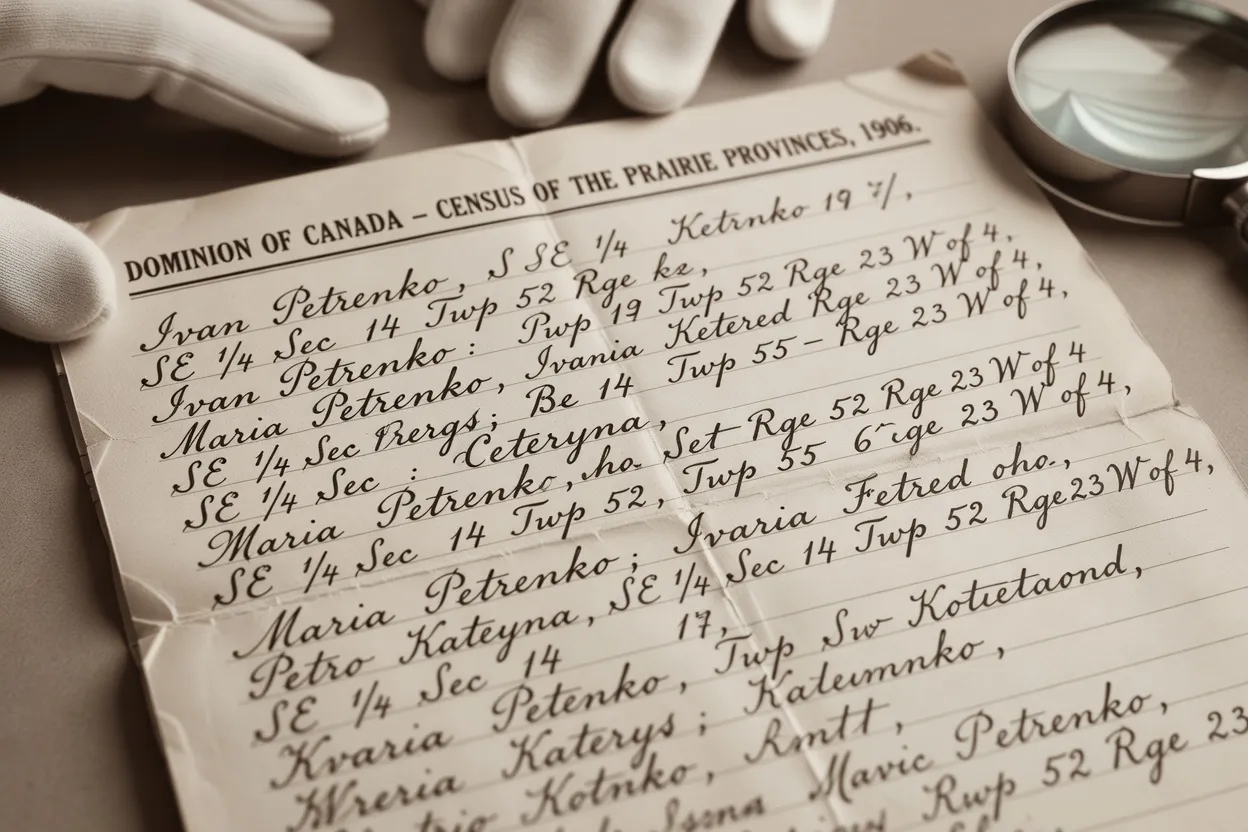
Close-up of 1906 Prairie Census form pages showing Ukrainian family entries.
How to Search the 1906 Prairie Census Online
Researchers can begin with the free BAC-LAC online database, which offers a partial index for selected districts. When an ancestor does not appear, the next step is to browse the digitized microfilm images available on FamilySearch.org under the collection “Canada Census, 1906.” Ancestry.ca provides a limited index that sometimes links to images, though coverage varies by province. Several volunteer projects hosted on GenealogySoft have created free district-level indexes that can be downloaded as spreadsheets.
Effective searching requires flexibility with name spellings and reliance on geographic clues. Enter phonetic variants such as “Kowal” for Koval or “Sawchyn” for Savchenko. If the homestead location is known, search by township and range rather than name. Once the correct sub-district is identified, scan the pages for neighboring families who arrived on the same ship or from the same village; these clusters often appear together on consecutive lines.
When no index exists for a particular reel, navigate by watching the header information at the top of each page. Sub-district numbers and township-range notations appear consistently. Researchers should note the page number and line where the family appears so that the entry can be cited precisely when requesting the corresponding homestead file from BAC-LAC. For deeper context on the land records that complement census research, see our expert interview on prairie homestead records for complementary guidance on the land file system.
Connecting Census Entries to Homestead and Land Records
A 1906 census entry that lists a specific township, range, and meridian provides the exact coordinates needed to locate the corresponding homestead file at Library and Archives Canada. Researchers first consult the Western Land Grants database or the original township registers to confirm the legal land description, then request the full homestead application file. These files frequently contain the original application dated one or two years before the census, creating a direct chronological link.
Conversely, a homestead file that lists a date of entry can be used to narrow the search in the 1906 census. The application often includes the settler’s exact age and birthplace, which can be matched against census columns. Cross-referencing these two record sets frequently reveals the precise village of origin in Galicia or Bukovyna, information that is rarely stated explicitly in the census itself.
Additional land records such as patents and tax assessment rolls can confirm when the family received clear title, usually five to ten years after the census. This timeline helps researchers estimate when Ukrainian-language church records in Canada begin to appear for the family. For historical context on the Ukrainian emigration that brought these settlers to the prairies, read about the history of Ukrainian emigration documented globally.
Ukrainian Names in the 1906 Census: Spelling Variations to Watch For
English-speaking enumerators recorded Ukrainian names phonetically, producing a wide range of spellings within a single district. Common surname transformations include Kovalenko rendered as Koval or Kowal, Savchenko as Sawchenko or Sawchyn, Melnyk as Melnick or Melnyk, and Petrenko as Petrenco or Petrank. Researchers should prepare wildcard searches such as “Kowal*” or “Mel*” to capture these variants.
First names underwent similar anglicization. Mykola often appears as Nicholas, Vasyl as William or Wesley, Oleksandr as Alexander, Halyna as Helen, and Parascheva as Paraska or Pauline. The given name “Ivan” may be listed as John, while “Maria” frequently remains unchanged. Enumerators sometimes recorded the Ukrainian diminutive forms, adding another layer of variation.
The surname Шевченко might appear as Shevchenko, Schevchenko, or even Chwachenko on the same reel. When browsing microfilm, scan for visual patterns rather than exact spelling matches. Keeping a running list of every phonetic rendering encountered in a sub-district greatly improves the chances of locating the target family and its extended relatives.
- Surnames — Kovalenko as Koval/Kowal, Savchenko as Sawchenko/Sawchyn, Melnyk as Melnick/Melnyk, Petrenko as Petrenco/Petrank
- Given names — Mykola as Nicholas, Vasyl as William/Wesley, Oleksandr as Alexander, Halyna as Helen, Parascheva as Paraska/Pauline, Ivan as John
- Search technique — prepare wildcard searches such as "Kowal*" or "Mel*" to capture every phonetic variant on a single reel
Conseil : do not rely on exact spelling matches when scrolling through microfilm. Enumerators wrote what they heard, so the same family surname can change from page to page — scan visually for the family group instead of searching for one fixed spelling.
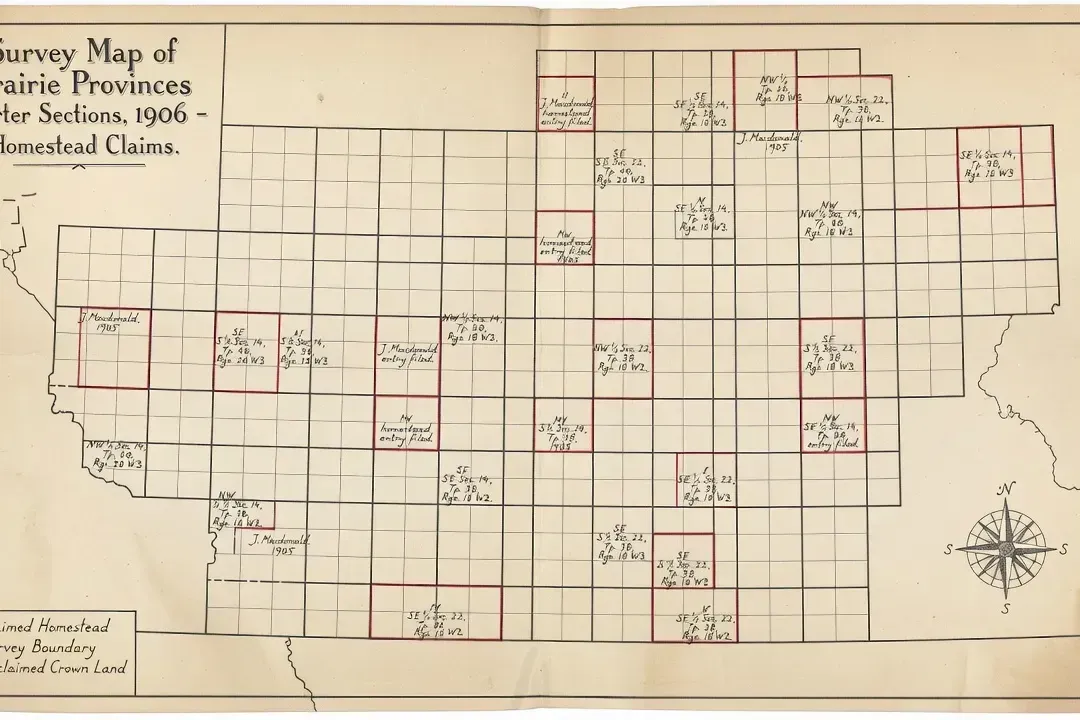
Survey map of Prairie Provinces quarter sections from 1906 showing homestead claims.
Cross-Referencing With Church Records
The 1906 census supplies the household composition and approximate ages, while Ukrainian church baptismal registers supply the missing details of parents’ names, godparents, and the precise village of origin. When the census lists a family as Greek Catholic, researchers should next consult the nearest Ukrainian Catholic parish registers in Canada, which often begin within two or three years of settlement.
Consistency between records strengthens identification. If the census states birthplace as “Austria” and the church record later specifies “Lvivska obl.,” the combination confirms the Galician origin. Marriage records from the same parish frequently list the couple’s ages in a manner that matches the 1906 enumeration, providing an independent verification of identity.
Researchers should also examine the 1906 census religion column alongside later Orthodox or Catholic records, because some families changed affiliation after arrival. For help reading the Ukrainian church records that complement census data, see our complete guide to Ukrainian church records and metrical books.
| 1906 census gives | Church record confirms | Result |
|---|---|---|
| Birthplace "Austria" | Specific district (e.g. "Lvivska obl.") | Confirms Galician origin |
| Household ages | Marriage record ages | Independent verification of identity |
| Religion column (1906) | Later Orthodox/Catholic parish records | Reveals affiliation changes after arrival |
Working With Microfilm at Your Local Library
Most public libraries in Canada participate in the interlibrary loan program that allows patrons to borrow BAC-LAC microfilm reels for a modest fee. When placing a request, specify the exact citation: RG 31, Series C-1, census district number, and year 1906. The library will receive the reel within four to six weeks and notify the researcher when it is ready for viewing.
Modern microfilm readers at larger libraries include digital scanners that permit images to be saved directly to a USB drive. This feature is especially useful when photographing multiple pages for later analysis at home. Researchers without access to a scanner can use a smartphone camera held steady against the viewer eyepiece, adjusting for glare by tilting the device slightly.
Navigation without an index requires patience. Begin at the start of each sub-district and note the township-range header on every page. Mark promising entries with paper slips so they can be revisited quickly. Cross-reference with DNA evidence using our guide to Ukrainian Orthodox church records to triangulate your ancestor’s community.
Case Study: Finding a Galician Family in the 1906 Prairies
Consider the search for the Kovalchuk family, who emigrated from Galicia around 1903 and settled near Yorkton, Saskatchewan. The researcher begins by consulting the 1901 and 1911 censuses to establish the probable census district. The 1906 records for the Yorkton area fall under District 15, Sub-district 12. Ordering the corresponding microfilm reel reveals the family on page 7, line 14: “Kowalchuk, Ivan, age 35, born Austria, Greek Catholic, farmer,” with wife “Maria, age 28,” and children aged seven, four, and one.
The census entry lists Township 25, Range 4, West of the Second Meridian. This legal description leads directly to the homestead file at BAC-LAC, which confirms that Ivan Kovalchuk applied for the northeast quarter of Section 12 in 1904. The application contains the crucial detail that the family originated in the village of Dobromyl in the Lviv district of Galicia. With the village name in hand, the researcher can now search Ukrainian church metrical books for Ivan and Maria’s baptismal records and those of their children born before emigration.
Further steps include checking the 1911 census for the same family to track name changes and additional children, ordering the homestead patent to confirm final ownership, and locating the nearest Ukrainian Catholic parish register for marriages and burials after 1906. Complement this research with our guide to Canadian immigration records for Ukrainian ancestors, which covers the ship manifests and border entry documents that establish the precise year of arrival. The combination of the 1906 census, homestead file, and church records produces a complete migration narrative from village in Galicia to established prairie farm within a single decade.
- Step 1 — check the 1911 census for the same family to track name changes and additional children
- Step 2 — order the homestead patent to confirm final ownership of the land
- Step 3 — locate the nearest Ukrainian Catholic parish register for marriages and burials after 1906
- Step 4 — cross-reference with Canadian immigration records to establish the precise year of arrival
Frequently Asked Questions
The 1906 Prairie Census is partially available online. Library and Archives Canada (BAC-LAC) has digitized portions and made some districts searchable through their online database. FamilySearch.org has microfilm images for some districts. However, a complete, fully indexed online version does not yet exist — many researchers must request specific microfilm reels through the Interlibrary Loan (ILL) program to browse unindexed districts.
Ancestry.ca has a limited index for the 1906 Prairie Census but does not hold a complete searchable version. The 1906 census is a federal record held by Library and Archives Canada (BAC-LAC), which controls digitization rights. Unlike the 1901 census, the 1906 Prairie Census was taken only for the prairie provinces (Manitoba, Saskatchewan, Alberta) rather than all of Canada, and indexing projects have proceeded more slowly for these specialized regional censuses.
The 1906 Prairie Census covered Manitoba, Saskatchewan, and Alberta — the three prairie provinces where the massive Ukrainian immigration wave of 1896-1914 concentrated. Ontario, Quebec, and the Maritime provinces were NOT included in this mid-decade census. If your Ukrainian ancestor settled in Ontario or British Columbia rather than the prairies, you will need to rely on the 1901 or 1911 national census instead.
Ukrainian immigrants in 1906 were typically listed with their birthplace as 'Austria' (for Galicians from the Austro-Hungarian province of Galicia) or 'Romania' (for Bukovynians from the Romanian-administered part of Bukovyna). The term 'Ukraine' did not appear as a country in census records at this time. Their language was often recorded as 'Ruthenian' or 'Ruthene,' and religion as 'Greek Catholic' or 'Orthodox.' Ukrainian names were spelled phonetically by English-speaking enumerators.
If you cannot find your ancestor in the 1906 Prairie Census, try: (1) Search spelling variants — use Soundex or wildcard searches; (2) Search by homestead location — find the township from a land title or homestead file, then browse the census sub-district for that township; (3) Check if they arrived after June 1906 — the census was taken in June 1906, and settlers arriving after that date would not be included; (4) Try neighboring sub-districts — early maps show settlement boundaries that don't always match census sub-districts; (5) Check the 1901 or 1911 census as fallback options.