Why Ukrainian Orthodox Church Records Are Essential for Genealogy
Ukrainian Orthodox church records form the backbone of Ukrainian-Canadian genealogy because they often represent the only surviving documentation for the earliest settlers who arrived between 1891 and 1914. These pioneers came primarily from the regions of Galicia and Bukovyna and immediately established their own parishes upon reaching the Canadian prairies and parklands. Without civil registration in many rural areas during those first decades, the metrychni knyhy (metrical books) kept by these parishes recorded the vital events of births, baptisms, marriages, and deaths, preserving the identities and family connections that would otherwise have been lost to time.
The first wave of Ukrainian immigration coincided with the opening of the Canadian West, and the rapid formation of parishes meant that local priests documented community life in meticulous detail. These registers captured not only names and dates but also the villages of origin in the old country, godparent relationships, and witness information that linked families across continents. Researchers tracing ancestors from this period frequently discover that Orthodox or Greek Catholic parish records provide the missing bridge between Canadian homestead documents and Ukrainian village origins.
Because many early Ukrainian settlers lived in isolated bloc settlements, the church served as both spiritual and administrative center. The resulting records therefore contain rich contextual details unavailable in standard government files, including references to land quarter-sections, family migrations within Canada, and the social networks that sustained pioneer communities through harsh winters and economic hardship.
The Three Main Ukrainian Orthodox Churches in Canada (1890-1960)
Understanding the denominational landscape is critical for genealogists because record-keeping practices and archival locations varied among the three major Ukrainian church bodies active in Canada between 1890 and 1960. Ancestors may appear in registers of the Ukrainian Orthodox Church of Canada, the Ukrainian Greek Catholic Church, or early Russian Orthodox Church parishes, and knowing which tradition a family followed determines where to search.
Ukrainian Orthodox Church of Canada (UOCC)
The Ukrainian Orthodox Church of Canada was formally organized in 1918 and quickly became the largest Ukrainian religious body in the country. Its parishes maintained independent metrical books that reflected a distinctly Ukrainian national consciousness, especially after the First World War. These registers are now scattered among provincial archives and the central UOCC chancery in Winnipeg. Researchers should note that many UOCC congregations began as breakaway groups from Greek Catholic or Russian Orthodox parishes, so earlier entries for the same families may exist under different denominational headings.
Ukrainian Greek Catholic Church
The Ukrainian Greek Catholic Church, also known as the Uniate Church, arrived with the first Galician and Bukovynian settlers and retained strong ties to the Metropolitan See of Lviv. Its Canadian parishes kept records in a format similar to Orthodox metrical books but included additional annotations regarding the Uniate rite. Although technically Catholic, these congregations are often grouped with Orthodox records because of shared liturgical language and cultural practices. The eparchial archives in Winnipeg and Edmonton hold many pre-1950 registers.
Russian Orthodox Church Parishes
Before 1918, many Ukrainian immigrants worshipped in Russian Orthodox Church parishes because no independent Ukrainian Orthodox jurisdiction existed in Canada. These early registers, written in Church Slavonic, frequently list Ukrainian families under Russified spellings. After the Russian Revolution and the rise of Ukrainian national churches, some congregations transferred their allegiance and records to the newly formed UOCC, creating complex custodial histories that researchers must untangle.
| Church Body | Founded / Active | Where Records Are Held |
|---|---|---|
| Ukrainian Orthodox Church of Canada (UOCC) | Organized 1918, largest Ukrainian body | Provincial archives and the UOCC chancery in Winnipeg |
| Ukrainian Greek Catholic Church | Arrived with first Galician/Bukovynian settlers | Eparchial archives in Winnipeg and Edmonton |
| Russian Orthodox Church parishes | Active before 1918, pre-dates independent Ukrainian jurisdiction | Often transferred to UOCC after the Russian Revolution |
Key takeaway: Many UOCC congregations began as breakaway groups from Greek Catholic or Russian Orthodox parishes, so an ancestor's earlier records may exist under a different denominational heading than the one the family used later — always check all three church bodies before concluding a record does not exist.
What Information Do Parish Records Contain?
Baptismal entries typically list the child’s full name, exact date of birth, date of baptism, parents’ full names and patronymics, the parents’ village of origin in Galicia or Bukovyna, and the names of godparents or sponsors. Marriage records provide the bride’s and groom’s names, ages, places of residence, parents’ names, and names of witnesses, often noting whether the marriage was the first for each party. Burial records record the deceased’s name, age at death, cause of death when known, date of burial, and surviving family members, sometimes including the exact homestead location.
- Baptismal entries: child's full name, birth/baptism dates, parents' names and patronymics, village of origin, godparents.
- Marriage records: bride and groom's names, ages, residence, parents' names, witnesses, prior marital status.
- Burial records: deceased's name, age at death, cause of death when known, burial date, surviving family, sometimes homestead location.
Language usage evolved dramatically across the decades. Pre-1920 entries appear almost exclusively in Church Slavonic or Ukrainian Cyrillic cursive. By the 1930s many priests began adding English translations or switching entirely to English, especially in urban parishes. This linguistic shift requires researchers to master both Cyrillic paleography and common English phonetic renderings of Ukrainian names.
Additional fields sometimes encountered include the priest’s signature, the church seal, and marginal notes about later confirmations or transfers to other parishes. These seemingly minor annotations can reveal subsequent family movements across the Canadian West or back to Ukraine during the interwar period.
A complete baptismal entry typically records:
- Child's full name and exact date of birth
- Date of baptism
- Parents' full names and patronymics
- Parents' village of origin in Galicia or Bukovyna
- Names of godparents or sponsors
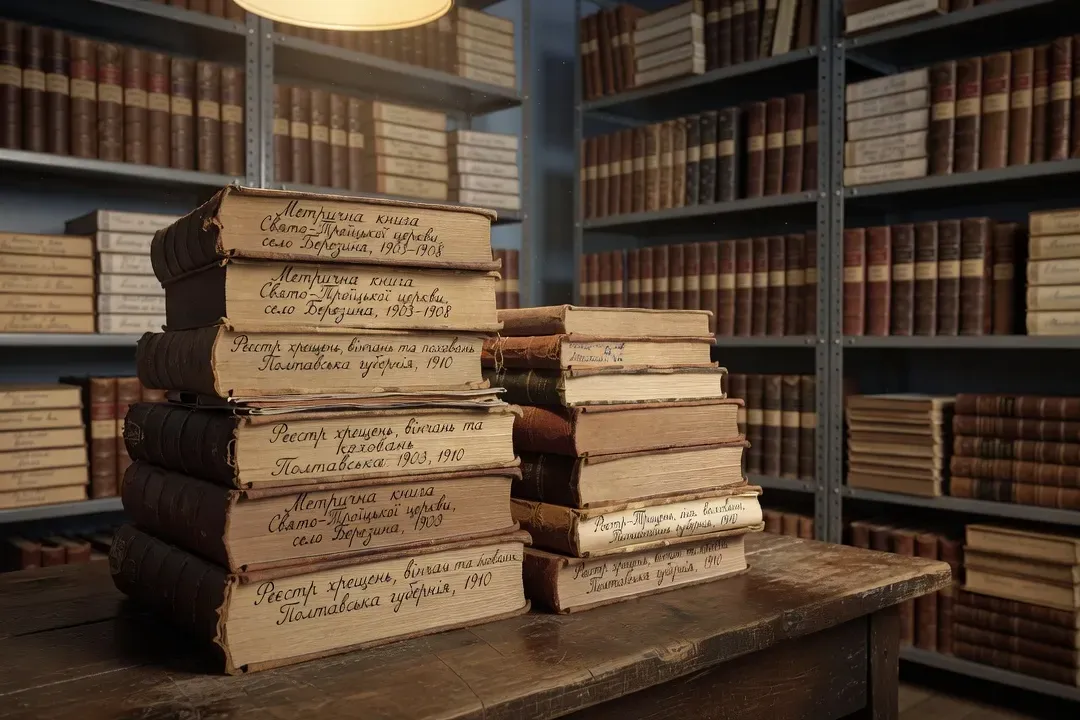
Stack of handwritten Ukrainian church registers and metrical books from the 1900s.
Finding Canadian Ukrainian Orthodox Records at Library and Archives Canada
Library and Archives Canada (BAC-LAC) in Ottawa preserves the single largest collection of microfilmed Ukrainian church registers in the country. Genealogists should begin by searching the online catalog at bac-lac.gc.ca using the terms “Ukrainian” and “parish registers.” The resulting finding aids list specific microfilm reel numbers for individual parishes, many of which cover congregations founded between 1896 and 1930.
Researchers may order microfilm reels for delivery to their local library through the national Interlibrary Loan system. Because some registers contain information less than one hundred years old, certain reels remain restricted and require formal application or proof of relationship. Planning ahead is essential, as processing times can exceed several months.
For genealogists planning to combine archival research with travel to Ukraine, explore discover Ukraine's living heritage through organized genealogy tours as an inspiring complement to archive work.
Provincial Archives: Province-by-Province Guide
The Archives of Manitoba holds extensive Ukrainian Orthodox registers from the Interlake region, the Dauphin settlement bloc, and Winnipeg parishes. Researchers can contact the archives by email to request specific parish names; staff will confirm whether registers have been microfilmed or remain in original form. Remote users should provide the exact church name and approximate date range to expedite searches.
The Saskatchewan Archives Board maintains two branches in Regina and Saskatoon that together cover Yorkton, Canora, and Vegreville-area parishes. Many of these records were microfilmed in the 1980s and are available on interlibrary loan. The Saskatoon office also holds several parish anniversary books that supplement the metrical entries with photographs and biographical sketches.
The Provincial Archives of Alberta serves the large Ukrainian communities of Vegreville, Edmonton, and Lethbridge. Its collection includes both UOCC and Greek Catholic registers. Staff recommend submitting written requests that include the civil township and range numbers of ancestral homesteads, as these details often appear in parish membership rolls.
The Archives of Ontario preserves smaller but historically significant collections related to postwar displaced persons who arrived after 1945. Although the Ukrainian population in Ontario was modest before the Second World War, the archives contain important confirmation and marriage records for families who later migrated eastward from the prairies.
| Province | Repository | Coverage |
|---|---|---|
| Manitoba | Archives of Manitoba | Interlake region, Dauphin settlement bloc, Winnipeg parishes |
| Saskatchewan | Saskatchewan Archives Board (Regina and Saskatoon) | Yorkton, Canora, Vegreville-area parishes |
| Alberta | Provincial Archives of Alberta | Vegreville, Edmonton, Lethbridge; UOCC and Greek Catholic registers |
| Ontario | Archives of Ontario | Postwar displaced persons after 1945; confirmation and marriage records |
Practical checklist before contacting a provincial archive:
- Have the exact parish name and civil township/range numbers of the ancestral homestead ready
- Provide an approximate date range for the event you are researching
- Ask whether the register has been microfilmed or remains in original form
- Check whether the record falls under any privacy restriction requiring proof of relationship
Common mistake: Contacting a provincial archive with only a family name and no township or range number. Staff at the Provincial Archives of Alberta specifically recommend including the civil township and range of the ancestral homestead, since these details often appear in parish membership rolls and dramatically narrow the search.
Digitized Collections: What's Online in 2026
FamilySearch.org remains the premier free resource for Ukrainian-Canadian church records. Key collections include “Canada, Alberta, Church Records, 1882-1966,” which encompasses several Ukrainian parishes in east-central Alberta, and “Canada, Manitoba, Church Records,” which covers Winnipeg and Interlake congregations. Some volumes have been indexed by volunteers while others must be browsed image by image.
Individual parishes have begun uploading their own digitized registers to congregational websites, particularly for post-1950 entries still held locally. Researchers should always consult the FamilySearch wiki page for the specific parish under investigation, as coverage and indexing status change frequently.
For finding Ukrainian church records in the homeland before emigration, see our comprehensive guide to Ukrainian church records and metrical books.
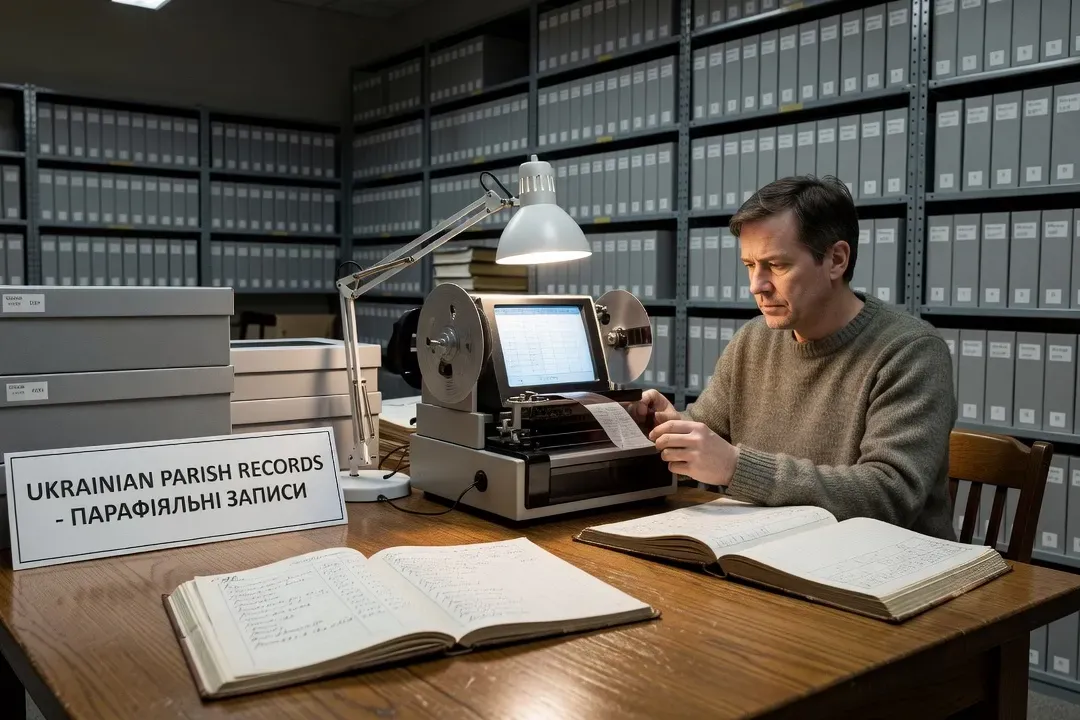
Canadian archival reading room with researcher examining Ukrainian parish records microfilm.
Working With Handwritten Records: Script and Language Tips
Early Canadian Ukrainian church records present significant paleographic challenges. Pre-1920 entries were customarily written in Church Slavonic or Ukrainian Cyrillic cursive, requiring familiarity with letter forms that differ markedly from modern printed Ukrainian. After 1930, English increasingly replaced Cyrillic, yet many priests continued to record names phonetically.
Common difficulties include the Anglicization of given names (Mykola rendered as Nicholas, Vasyl as William) and the phonetic spelling of surnames that varied from one priest to the next. Researchers should prepare for abbreviations such as “р.” for рік (year), “м.” for місяць (month), and “д.” for день (day), as well as “с.” for син (son) and “д.” for дочка (daughter).
Common pitfall: Assuming a given name was recorded consistently across a family's Canadian records. Anglicization was applied inconsistently even within the same family — Mykola might appear as Nicholas in one register and Nick or Nicolas in another, so search all common variants.
Our detailed guide to reading old Cyrillic church records covers the pre-revolutionary alphabet, key vocabulary, and Julian-to-Gregorian date conversion.
Hiring a Professional Researcher for Church Archives
When time or travel constraints prevent personal visits, hiring a qualified researcher is often the most efficient route. The Association of Professional Genealogists (APG) directory and the Board for Certification of Genealogists (BCG) credential provide reliable starting points for locating experienced professionals. Ukrainian-specific expertise can be found through the Ukrainian Genealogical and Historical Society of Canada and the East European Genealogical Society based in Winnipeg.
Researchers typically charge between $50 and $150 per hour. Before engaging anyone, request a written agreement that specifies the scope of work, expected turnaround time, and handling of restricted records. Provide the professional with all known names, approximate dates, and suspected parishes to maximize results.
To complement church record research with DNA evidence, read our interview with DNA genealogy expert Dr. Taras Kovalenko.
Beyond Births and Deaths: Confirmation and Burial Records
When a search stalls despite these record sets — a common experience given inconsistent transliteration and scattered custodial histories — our interview with a Ukrainian-Canadian genealogist on breaking through research brick walls covers practical strategies for getting unstuck.
Confirmation records list every member confirmed in a given year, noting name, age, parents, and sponsor. These entries frequently appear in separate books and can reveal teenagers or young adults whose baptisms occurred in Ukraine or in another Canadian parish. Parish membership rolls, known as parafiyalni knyhy, provide annual snapshots of each family unit and often record the precise homestead quarter-section, offering invaluable land-use context.
Burial records and cemetery registers sometimes include the deceased’s birth village in Ukraine, a detail rarely found elsewhere. Parish anniversary books, or yuvileini knyhy, published for significant milestones, contain photographs, family histories, and lists of founding members that supplement the formal registers.
These additional sources transform a simple lineage into a multidimensional portrait of community life. By combining metrical books (metrychni knyhy) with membership rolls and anniversary publications, researchers can reconstruct not only vital events but also the social and economic networks that sustained Ukrainian-Canadian settlements for generations. The records preserved by these churches remain living testaments to resilience and cultural continuity; every page turned brings researchers closer to the voices and stories of their ancestors. Persistent inquiry, careful attention to language shifts, and strategic use of both digital and archival resources will continue to unlock new chapters in Ukrainian-Canadian family histories for years to come.
Frequently Asked Questions
Ukrainian Orthodox church records in Canada are held at Library and Archives Canada (BAC-LAC) in Ottawa, which has the largest microfilm collection; provincial archives in Alberta, Saskatchewan, Manitoba, and Ontario; and directly at surviving parishes. The Ukrainian Orthodox Church of Canada (UOCC) also maintains diocesan archival collections. FamilySearch.org has digitized portions of many collections and makes them available free online.
Many are available free through FamilySearch.org — search for province-specific church record collections and browse by parish. Library and Archives Canada's online catalog (bac-lac.gc.ca) lets you identify microfilm reels that can be borrowed through the Interlibrary Loan program. Some individual parishes have digitized their own registers and posted them on parish websites or Facebook groups.
Early records (1891-1920s) were usually written in Church Slavonic or Ukrainian Cyrillic. Through the 1930s-1950s, records increasingly shifted to bilingual Ukrainian-English formats. By the postwar era, most parishes kept records entirely in English. The language depends heavily on the decade and the specific parish priest. Knowing the approximate date of the event helps predict which language you will encounter.
Contact the parish directly — most parishes are willing to help researchers with specific name and date requests. Provide the full name of the individual, the approximate year of the event (baptism, marriage, or burial), and any known family members. Many parishes charge a small research fee ($10-25). For parishes that have closed, contact the Ukrainian Orthodox Church of Canada diocesan office, which may hold transferred records.
Yes. When a Ukrainian Orthodox parish closed, records were typically transferred to a surviving nearby parish, the UOCC diocesan archive, or a provincial archive. Library and Archives Canada holds microfilm copies of many records from closed churches. Contact the UOCC head office in Winnipeg for guidance on locating records from closed parishes, and check the FamilySearch wiki page for the specific province and era you are researching.