If your Ukrainian ancestor appears in Canada but family tradition says they first landed in the United States, search the border-crossing records as well as passenger lists. The key source is commonly called the St. Albans Lists: federal records of entries from Canada into the United States, covering 1895–1954 across much of the entire border, not merely Vermont. A Canadian arrival record may document the first move north; a United States passenger list, border form, or later crossing may reveal the earlier route, relatives, birthplace, and intended destination that Canadian records do not show.
Why “the United States first” changes the research plan
For many Ukrainian families, immigration was not a single, straight journey from an Austro-Hungarian, Russian, Romanian, or later Polish-controlled homeland to a Canadian homestead. A person from Galicia or Bukovyna might cross the Atlantic to a United States port, work for a period in an American industrial town, then continue to Manitoba, Saskatchewan, Alberta, or another Canadian destination. Others entered Canada first and later moved south in search of work, family connections, or land. If you have not yet organized the basics of this kind of search, our guide on how to start Ukrainian genealogy research is a useful starting point before tackling a two-country trail.
This pattern is especially relevant when a Canadian census identifies a household as Ukrainian, Ruthenian, Galician, Bukovynian, Austrian, Polish, Russian, or Romanian by origin, but no obvious Canadian passenger arrival can be found. The missing record may not actually be missing. Your ancestor may have arrived at a United States port and crossed the land border later.
That route can leave evidence in several jurisdictions:
- a passenger list at a United States port such as New York;
- a United States immigration or border-crossing record after arrival from Canada;
- a Canadian border-entry or immigration record connected with the move north;
- census records on both sides of the border;
- naturalization, military, land, employment, church, or vital records that preserve an earlier residence.
The practical lesson is simple: do not let a Canadian residence make you assume a Canadian first arrival. Start with the place where the person lived, but investigate the route that brought them there. For a broader framework for Canadian sources, see our guide to Canadian immigration records for Ukrainian ancestors.
What the St. Albans Lists actually are
The name “St. Albans Lists” causes understandable confusion. Officially, these are St. Albans District records, but they are not limited to St. Albans, Vermont. They include records of entries into the United States from Canada along a broad stretch of the international boundary. Depending on date and location, crossings at or near points in Washington, Montana, North Dakota, Minnesota, Michigan, New York, and other border regions may be represented.
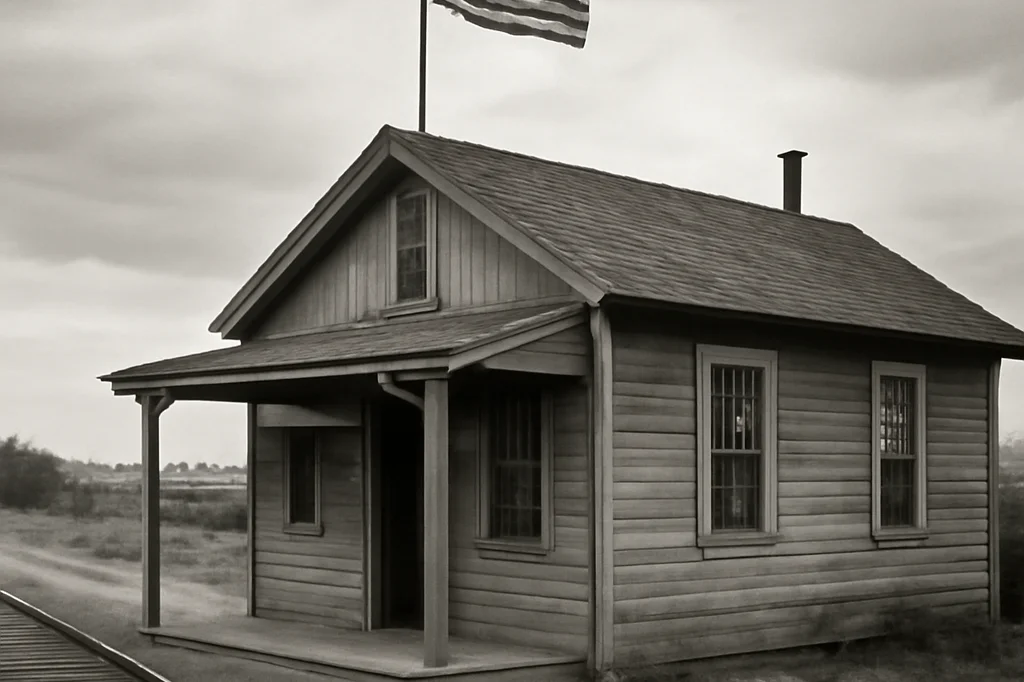
Border inspection stations like this recorded crossings between the United States and Canada well before 1906.
The collection covers 1895 to 1954. It is particularly useful for identifying people who had already spent time in Canada and then entered the United States, whether permanently, temporarily, or repeatedly. For Ukrainian-Canadian research, that can mean a prairie settler moving south for employment, a family member joining relatives in an American town, or a person whose Canadian stay was only one stage in a longer migration.
Researchers should resist treating the St. Albans Lists as a complete census of border movement. They are an immigration-record collection with changing administrative practices. A person may have crossed the border without appearing where you expect, may be indexed under a distorted spelling, or may be present in a different regional record series. Still, when found, an entry can be exceptionally revealing because it may connect a Canadian place of residence to a United States destination, relative, employer, or prior arrival.
| Research situation | Record set to search first | Why it may help |
|---|---|---|
| An ancestor lived in Canada but reportedly arrived through New York | United States passenger lists, then Canadian immigration and border records | The ocean arrival may predate the move into Canada and identify the home village or contact person. |
| A Canadian prairie resident later appears in the United States | St. Albans District records for entries from Canada into the United States | A border record may name the Canadian residence and the intended American destination. |
| A crossing occurred in the western border region after 1917 | Seattle district records, as well as relevant indexed border collections | Crossings west of the Montana/North Dakota state line were filed through Seattle after 1917 rather than St. Albans. |
| A Canadian-born child or descendant moved south around 1900–1905 | Later border crossings, censuses, vital records, and local sources | Canadian-born people were not recorded on the St. Albans Lists until 1906. |
The 1906 limitation that can derail a search
One limitation deserves special attention. People of Canadian birth were not recorded on the St. Albans Lists until 1906. This affects many Ukrainian-Canadian family histories because children born in Canada to immigrant parents often later crossed into the United States with their families or independently.
Manifest ledgers recorded a crossing in columns -- name, origin, and destination among them.
Suppose an immigrant couple arrived in Canada in the 1890s, had children in Manitoba or Ontario, and moved to the United States between 1900 and 1905. The foreign-born parents may be more likely to appear in a border-related immigration record than their Canadian-born children. Or the entire family may be difficult to locate for that early move. A later crossing, return trip, or subsequent immigration event may provide the first record in which the Canadian-born family members appear.
Do not interpret an absent St. Albans entry as proof that no crossing occurred. In this period, absence can reflect the rules of recordkeeping rather than the family’s actual experience. This is one of the reasons a good immigration timeline must be built from multiple sources rather than from a single database result.
When the expected border record is absent, look for supporting evidence:
- Canadian and United States census entries, especially immigration year, birthplace, citizenship, and residence information;
- birth registrations for children, which can establish where the family was living at key dates;
- marriage, death, obituary, cemetery, and probate records that identify former homes or surviving relatives;
- naturalization files, draft registrations, and military service documents;
- city directories, land records, church registers, and newspapers in likely Canadian and American communities.
A missing record should narrow your questions, not end the investigation.
Where to search and how to handle indexing
The St. Albans District records are indexed and available through FamilySearch, Ancestry, MyHeritage, and Findmypast. Each platform has its own search interface, index quality, image access arrangements, and filtering options. Searching more than one can be worthwhile, particularly when the surname is common, heavily Anglicized, or vulnerable to transcription errors.
Names from Ukrainian regions often changed several times before reaching a Canadian or American record. A person from Galicia may be listed by a Polish spelling, a Germanized spelling, a Ruthenian label, a shortened surname, or an English approximation. A woman may appear under a maiden name, married name, husband’s given name, or a form that omits her personal name altogether. Place names can be equally unstable: a village may be recorded as being in Galicia, Austria, Poland, Bukovyna, Romania, Russia, or Ukraine, depending on the date, clerk, and informant.
Use a layered search rather than a single exact-name query. Begin with the known name, then loosen one element at a time. Search surnames with and without common endings; try alternate given names; test phonetic options; and search relatives who may have travelled separately. A brother, cousin, or adult child can lead you to the correct household when the head of family has been indexed poorly.
Useful search variations include:
- surname plus a Canadian province or known town;
- surname plus a suspected United States destination;
- given name with approximate birth year and birthplace;
- surname variants based on Polish, Ukrainian, German, Romanian, or English spellings;
- the names of relatives listed in census households, marriage records, or obituaries.
Always inspect the original image when it is available. Indexes are guides, not substitutes for the record. A handwritten border form may contain a residence, contact, route, previous admission, or stated purpose of travel that does not appear in the database fields. The reverse side or continuation page can matter as much as the indexed front page.
Do not search St. Albans alone: the Seattle district issue
For crossings after 1917, geography becomes crucial. Crossings west of the Montana/North Dakota state line were filed through the Seattle district rather than the St. Albans district. A researcher who knows only the nickname “St. Albans Lists” can easily search the wrong collection and conclude incorrectly that a western-border crossing left no federal trail.
This matters for Ukrainian families with connections to western Canada and the northwestern United States. A household that lived in Alberta, Saskatchewan, British Columbia, Washington, Idaho, Montana, or nearby regions may have crossed through a western point where the relevant filing arrangement differs from the better-known St. Albans records.
Before searching, write down the likely crossing area and an estimated date. Even a broad window helps. Ask whether the family’s known residences make an eastern, central, Great Lakes, or western route more plausible. Railway connections, relatives, work sites, and settlement patterns can all point toward a region. The answer may remain uncertain, especially for seasonal workers or families who moved more than once, but the geographic question prevents wasted effort.
The distinction is administrative, not merely geographical. It does not mean that western crossings were unimportant or undocumented; it means the researcher must identify the appropriate regional collection. This is a recurring problem in border research: the family’s route did not change because a records office changed its filing practice, but the trail we follow today certainly does.
Build a two-country migration timeline before chasing every result
Border records become much easier to interpret when you first create a timeline. Use a spreadsheet, research log, or simple chronological table. Enter every known event: birth, marriage, children’s births, passenger arrival, census appearances, land purchase, military service, naturalization, death, and reported movements. Include the source for each fact and distinguish documented information from family tradition.
For example, a family may be found in a Canadian census, then a child is born in an American state, followed by a return to Canada and a later military attestation. That sequence suggests more than one movement. A border entry may be the missing connection, but it must fit the chronology. Do not force a record to fit simply because the surname looks close.
Consider these questions while building the timeline:
- When is the person first documented in North America?
- Where were children born, and what do those birthplaces reveal about the family’s movements?
- Did the family have relatives in a United States city before it appeared in Canada?
- Does a census immigration year describe ocean arrival, arrival in Canada, or a later move?
- Was the border movement permanent, seasonal, temporary, or repeated?
- Which household members disappear from one country’s records and reappear in the other?
For families from the former Austrian crownland of Galicia, migration networks often mattered as much as official destination statements. A relative or neighbour may have established an initial foothold in an American city, while other kin eventually acquired land in Canada. Our discussion of Galicia-to-Canada Ukrainian migration can help place that movement within a wider community context.
Use border evidence with Canadian, American, and military records
A border form is rarely the final answer. Its greatest value is often the lead it provides: a named relative, a Canadian address, an American destination, a prior residence, or an approximate travel date. Follow each clue into records created at the place named on the form.
If a record indicates that a traveller was going to join a relative in the United States, search that relative in census schedules, directories, naturalization files, local newspapers, and church registers. If it identifies a former Canadian residence, search land, tax, school, municipal, parish, and cemetery records in that area. If it gives a port or an earlier United States arrival date, work backward to passenger lists and related immigration documents.
Military records can also clarify the timeline. A Canadian military file may preserve addresses, next of kin, prior occupation, and later correspondence that reveals cross-border movement. For descendants of First World War soldiers, consult our guide to Ukrainian-Canadian First World War CEF military service records. Such records do not replace border documents, but they may show where a man was living before enlistment or whom he considered his closest family contact.
There is an unavoidable tension in this work. Immigration records can appear precise because they have dates, ports, and official headings, yet the information was often supplied under pressure, through language barriers, or by someone who did not fully understand the questions. Ages, village names, destinations, and even names can vary. Treat a border record as evidence to compare, not as an unquestionable statement of fact.
A practical workflow for the Ukrainian-Canadian researcher
Work from what you know outward. The goal is not to search every possible border database blindly; it is to test a clear migration hypothesis and revise it as evidence appears.
- Identify the immigrant or first Canadian-born generation in the family line.
- Create a timeline of residences on both sides of the border.
- Search Canadian immigration and census records for the earliest confirmed Canadian appearance.
- Search United States passenger lists if the family tradition, dates, or later records point to an American first arrival.
- Search the St. Albans District indexes for entries from Canada into the United States between 1895 and 1954.
- For likely post-1917 western crossings, identify and search the Seattle district material rather than relying only on St. Albans results.
- Account for the pre-1906 gap affecting Canadian-born travellers.
- Open images, transcribe the record carefully, and record every person and place named.
- Use the new clues to search local records in both countries.
- Write a short proof summary explaining what is known, what is inferred, and what remains unresolved.
Whatever your starting point, organize names, places, dates, variant spellings, and source citations as you go, before the evidence becomes overwhelming.
Border-crossing research rewards patience because it exposes movement that is often invisible in a one-country search. A Canadian homestead record may tell you where the family settled. A United States passenger list may show where they entered North America. A later border form may connect the two. Together, those records can turn a vague story of “coming to Canada” into a documented account of how one family actually moved through North America.
Frequently Asked Questions
My ancestor lived in Canada. Why should I search United States records at all?
Canadian residence does not prove Canadian first arrival. Many immigrants from Galicia, Bukovyna, and other Ukrainian regions entered through United States ports, including Ellis Island, before moving into Canada. Others lived in Canada and later crossed into the United States for work or family reasons. Searching both countries helps distinguish an ocean arrival from a later land-border movement. It can also identify relatives and destinations that are not mentioned in the Canadian record trail.
Are the St. Albans Lists only for people who crossed at St. Albans, Vermont?
No. “St. Albans Lists” is the common name for St. Albans District records, but the records extend beyond Vermont and cover entries from Canada into the United States along much of the border. Depending on the time period, they can include crossings associated with border areas in places such as New York, Michigan, Minnesota, North Dakota, Montana, and Washington. The collection name reflects the administrative district, not a requirement that every traveller passed through the Vermont town.
Why can I not find my Canadian-born ancestor in an early border-crossing search?
A major limitation is that Canadian-born people were not recorded on the St. Albans Lists until 1906. If a Canadian-born child or adult moved into the United States around 1900–1905, the absence of an entry may reflect the recordkeeping rules of the period. Search for later crossings, return journeys, census records, local vital records, directories, and documents for foreign-born parents or siblings. A later record may preserve the evidence of an earlier move.
What should I do if the crossing was in British Columbia, Alberta, Saskatchewan, Washington, Idaho, or Montana after 1917?
Do not limit your search to the St. Albans District collection. After 1917, crossings west of the Montana/North Dakota state line were filed through the Seattle district. Establish the likely border region from residences, family contacts, railway routes, employment locations, and children’s birthplaces, then search the appropriate regional records. An unsuccessful St. Albans search is not enough to rule out a western crossing.
How can I tell whether a border-crossing record belongs to my family when the name is spelled differently?
Compare the whole record, not the surname alone. Evaluate age, birthplace, occupation, spouse or parent, Canadian residence, United States destination, relatives named in the record, travel date, and the family’s known timeline. Search spelling variants shaped by Ukrainian, Polish, German, Romanian, Russian, and English usage, and look for siblings or cousins. A poorly indexed record may still be the right person if the associated places and relationships fit the evidence better than any competing candidate.