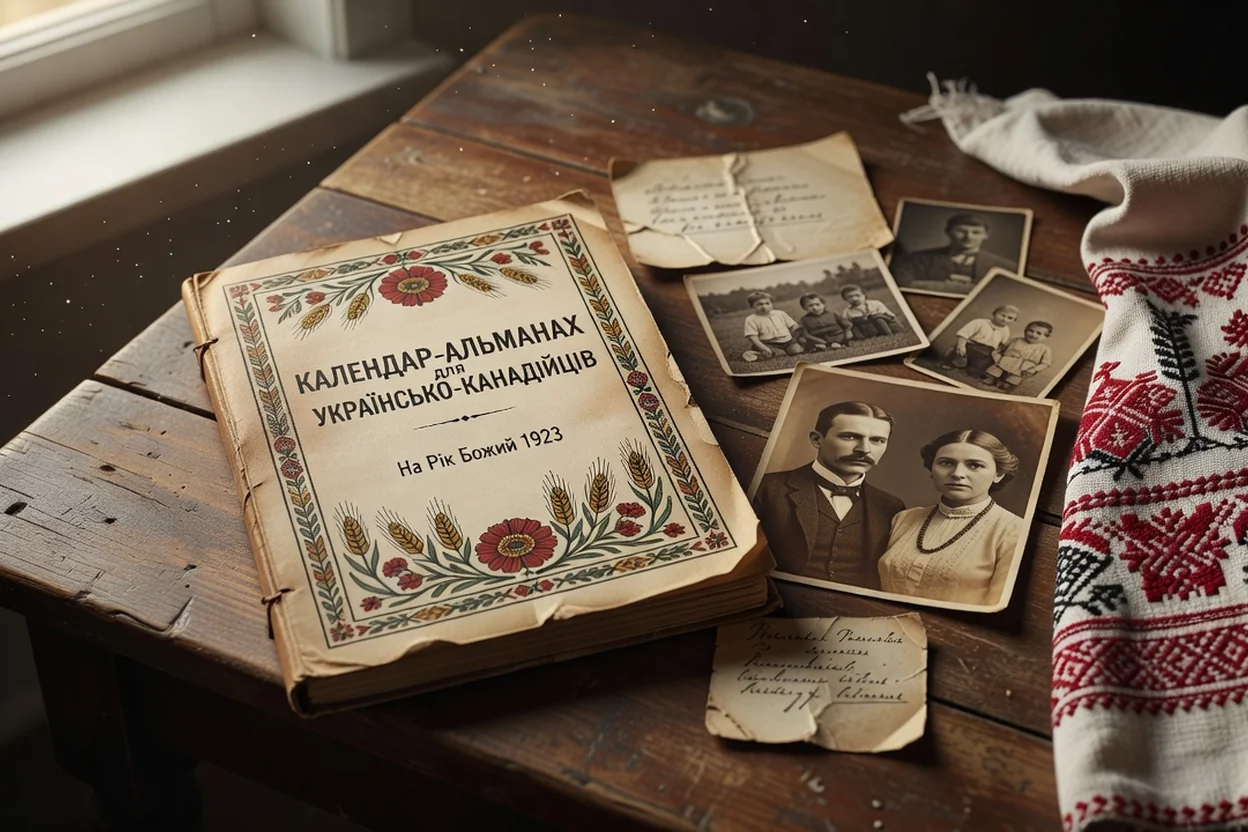
Ukrainian-Canadian almanacs and calendars were annual publications — part yearbook, part magazine, part memorial book — printed from the early 1900s through the 1970s by community publishers, churches, and newspapers, most of them in Winnipeg. They contain exactly the material genealogists need most: pioneer biographies with home-village names, obituaries, captioned photographs, subscriber and supporter lists, and community chronicles. Major runs survive at Library and Archives Canada, the University of Manitoba, the Archives of Manitoba, and Oseredok in Winnipeg, with digitized examples readable online.
Every immigrant community printed newspapers, but Ukrainians in Canada printed almanacs with unusual enthusiasm. The format — a pocket or desk calendar for the coming year, padded with essays, fiction, and portraits — was a Central European tradition the settlers brought with them, and it suited a readership that wanted both practical help and a record of what the community had built. For the family historian, these volumes are time capsules that recorded people by name at a moment when almost no other institution did.
What Almanacs Contain and Why They Matter
An almanac issue typically ran to a hundred or more pages. Its core was the calendar itself — months, saints' days, and feast days for the coming year, often with moon phases and weather lore carried over from the old-country format. Around that core, editors assembled durable content:
- Pioneer and jubilee biographies. Sketches of leading settlers and community figures, usually naming their district or village of origin, year of arrival in Canada, and family details. These are the single most valuable almanac content for genealogy.
- Obituaries and memorial notices. Death notices of community members, frequently longer and more personal than newspaper obituaries, and sometimes the only published notice of a death in an isolated district.
- Photographs with captions. Portraits of families, church congregations, executive committees, and graduating classes — almost always captioned with full names.
- Subscriber and supporter lists. The back pages often listed the readers and donors who sustained the publication, a ready-made directory of engaged community members by town.
- Community chronicles and local news. Reports from branches and districts naming who hosted, who spoke, who was elected, and who moved where.
Almanacs complement the newspapers covered in our guide to the Ukrainian-Canadian community press. Where a newspaper tells you what happened last week, an almanac tells you what the community wanted remembered: who founded the parish, who donated the land, who died that year and where they came from.
The First Winnipeg Imprints, 1902–1920
The earliest Ukrainian calendar-almanacs in Canada appeared in Winnipeg, the hub of the community's publishing life. The pioneering title was the Kalendar Kanadiis'koho Rusyna — the Calendar of the Canadian Ruthenian — whose illustrated almanac issues appeared from the mid-1910s. The Illustrovany Kalendar Kanadiyskoho Rusyna (Illustrated Calendar-Almanac of the Canadian Ruthenian), published in Winnipeg in 1916, and the 1917 yearbook issue are singled out in bibliographies as rare and valuable sources on pioneering life, with striking photographic material.
In 1915 the weekly newspaper Ukrainskyi Holos (Ukrainian Voice) began issuing its own Kalendar Ukrayins'koho Holosu, which continued in various forms for more than four decades, into the late 1950s, published by Trident Press. Its issues combined the calendar format with community news, historical articles, and photographs, and because the newspaper had one of the largest circulations in the community, its almanac had the widest distribution of any Ukrainian-Canadian annual.
These pre-1920 imprints matter disproportionately. They were printed while the first immigrant generation was still alive, and their editors knew their readers personally. A biography of a settler in a 1917 almanac was often written by someone who had travelled with him from the same county — which is why the home-district details they record are so reliable.
Church, Press, and Fraternal Calendars
After the First World War, the almanac tradition spread to every institution of community life. Each of the major churches published its own calendar: the Ukrainian Catholic calendar and the Ridna Nyva (Native Field) calendar of the Ukrainian Orthodox Church of Canada, both of which carried parish news, clergy appointments, and memorial material alongside the church year. Mutual-benefit societies and national organizations issued calendars for their members, and commercial publishers joined in, selling advertising space to Ukrainian-Canadian businesses whose notices — blacksmiths, general stores, farm implement dealers — identified occupations and addresses.
The press remained the largest producer. Besides the Ukrainian Voice almanac, Winnipeg's other newspapers and magazines issued their own annuals, and the pattern repeated in Toronto after the Second World War. For genealogists, the practical lesson is to search by institution, not just by title: if your ancestor's family belonged to a particular parish or society, that body's calendar is as likely to name them as any newspaper.
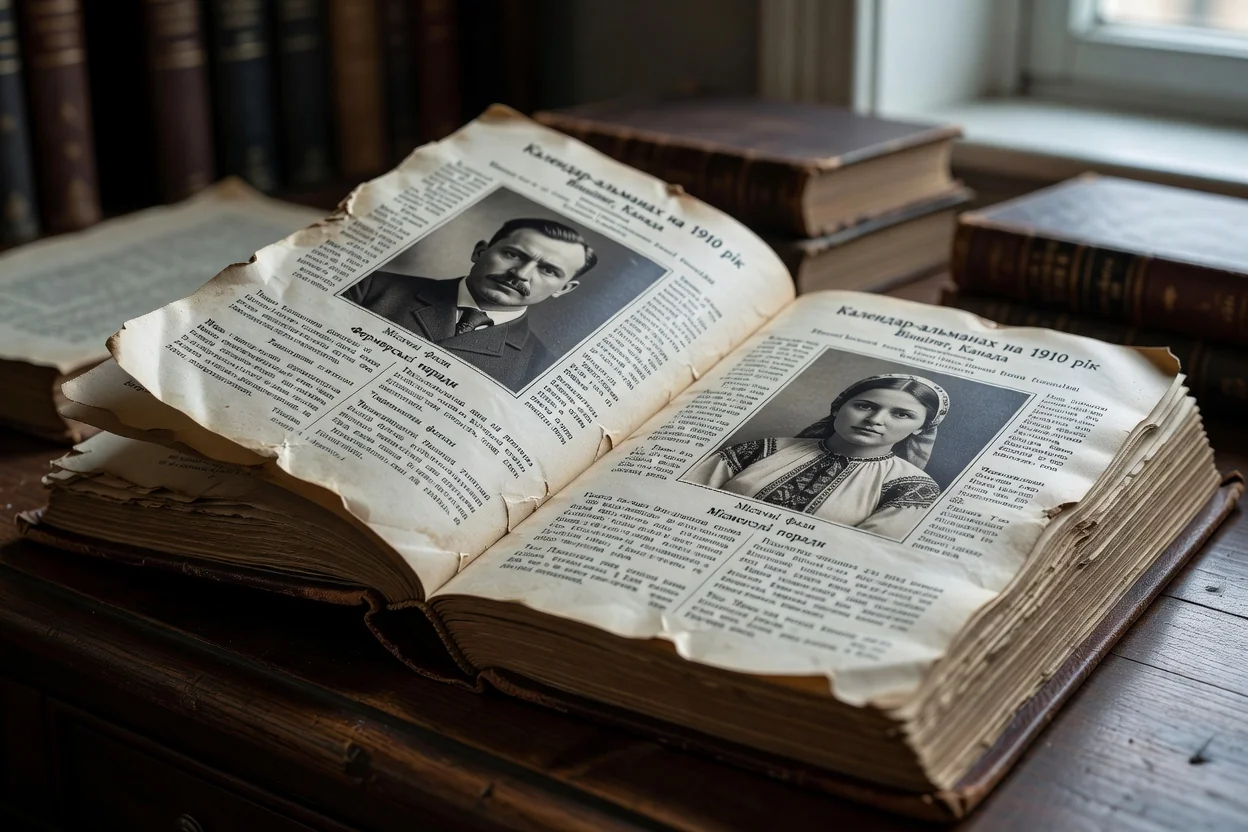
Reading these old volumes requires some comfort with historical Cyrillic typography and with the inconsistent transliteration of the era. Our guide to Ukrainian surname spelling variants in Canadian records applies here with full force: a family may appear under two or three different spellings within a single issue, and indexes compiled by later researchers may use a fourth.
Postwar Almanacs, 1948–1970
The displaced-person immigration of the late 1940s reinvigorated the almanac tradition. The postwar community was larger, better organized, and more urban, and its annuals grew correspondingly ambitious. The Kalendar-Al'manakh Novoho Shlyakhu (New Pathway Calendar-Almanac), published in Winnipeg from the mid-1950s by the New Pathway press, continued the press-almanac tradition for the postwar readership. The Kalyendar Kanadiyskoho Farmera (Canadian Farmer Calendar-Almanac), issued by National Publishers in 1954, served the agricultural readership of the prairie press. Church and organizational calendars of the 1950s — including the Ukrainian Orthodox Ridna Nyva — document the new parishes and halls the postwar wave built.
Postwar almanacs are genealogically important for a different reason than the pioneer issues: they recorded a generation in motion. Displaced-person families appear in parish anniversary books, in lists of new members, and in the growing obituary columns of the 1950s and 1960s. An almanac issue from 1956 can pin a DP family to a specific prairie town two censuses before their descendants appear anywhere else.
The whole corpus of these publications — several hundred titles across the period 1903–1970 — was indexed in the standard printed bibliography of Ukrainian serial publications in Canada, which remains the starting point for locating any title. The bibliography itself is now old enough to be consulted in major reference libraries and through the Internet Archive.
The table below summarizes the best-known calendar-almanac titles and what each offers the family historian.
| Title | Publisher and place | Years | Genealogical content | Where to look |
|---|---|---|---|---|
| Illustrovany Kalendar Kanadiyskoho Rusyna (Illustrated Calendar-Almanac of the Canadian Ruthenian) | Canadian Ruthenian, Winnipeg | from 1916 | Pioneer biographies, photographs of contemporary events, early community chronicles | Diasporiana digitized copies; Oseredok library |
| Kalendar Ukrayins'koho Holosu (Ukrainian Voice Almanac) | Trident Press, Winnipeg | 1915–1958 | Community chronicles, commemorative articles, biographies, illustrated issues | University of Manitoba microfilm; LAC |
| Ridna Nyva (Ukrainian Orthodox calendar) | Ukrainian Orthodox Church in Canada, Winnipeg | 1950s onward (earlier church calendars from the 1920s) | Parish news, clergy appointments, memorial notices, church year | Church consistory archives; Oseredok |
| Kalendar-Al'manakh Novoho Shlyakhu (New Pathway Calendar-Almanac) | The New Pathway, Winnipeg | 1954 and later | Postwar community news, personal notices, illustrations | LAC; University of Manitoba |
| Kalyendar Kanadiyskoho Farmera (Canadian Farmer Calendar-Almanac) | National Publishers, Winnipeg | 1954 and later | Agricultural readership notices, business advertisements naming occupations and addresses | LAC; provincial archives |
Where to Find Almanacs Today
Survival of these annuals is patchy, so knowing where the concentrations are held saves months of searching:
- Library and Archives Canada (Ottawa). The national repository holds extensive runs of Ukrainian-Canadian serials and a dedicated Ukrainian-Canadian genealogy research guide that describes the collections.
- University of Manitoba Libraries. Holds microfilm and catalogued copies of Ukrainian-Canadian newspapers, almanacs, and serials, searchable through its catalogue; the natural first stop for Ukrainskyi Holos and its almanac.
- Archives of Manitoba (Winnipeg). Provincial records and community fonds that often contain almanac issues filed with the organizations that produced or received them.
- Oseredok — Ukrainian Cultural and Educational Centre (Winnipeg). Museum, archives, and library under one roof; its library is particularly strong in rare Winnipeg imprints, and its collections include the visual and documentary record of the community.
- Digitized collections. The Diasporiana project has digitized runs of major Ukrainian-Canadian calendar-almanacs readable online, and the Internet Archive hosts both the serials bibliography and full-text reference works. Searching a surname in a digitized almanac takes minutes where it once took a research trip.
When a search succeeds, capture everything on the page, not just the paragraph you wanted: the neighbouring columns almost always contain relatives, godparents, or neighbours from the same district, and those names corroborate the identification.
For help converting the village names these volumes record into modern locations, reference guides to the historical and double spellings of Ukrainian place names are invaluable, since pre-war almanacs used Austrian, Polish, and Ukrainian forms for the same villages.

Using Almanac Evidence Responsibly
Almanac content was written by community members about community members, and it carries both the strengths and the biases of that intimacy. Treat it as testimony to be corroborated:
- Verify biographical details against civil records. A pioneer sketch's claim about a year of arrival should be checked against passenger lists and naturalization files.
- Note the perspective of the publisher. Church and organizational calendars promoted their own institutions; a family prominent in one calendar may have been equally active in a rival one it never mentions.
- Transcribe names exactly, then search variants. Copy the Cyrillic form as printed, add your transliteration, and search the variant spellings systematically.
- Cite precisely. Title, issue year, publisher, city, page, and holding institution — small print runs make the repository part of the citation.
Almanacs sit naturally within a broader research plan. If you are new to Ukrainian-Canadian research, begin with our getting-started guide, which places print sources like almanacs alongside census, church, and land records. And because the earliest almanacs quote immigrants' own words in their own orthography, familiarity with reading old Cyrillic records pays direct dividends here.
A Worked Example
Consider a typical research problem: a family tradition says great-grandfather arrived from "near Ternopil" around 1903, but no passenger list or naturalization record confirms it. A search of a digitized run of a Winnipeg calendar-almanac turns up a 1917 biography of a settler with the same surname in the same Manitoba district. The biography names his home village — recorded in the Austrian official spelling of the day — his year of arrival, and the ship he sailed on. Two hours later, that ship's passenger list, searched by the Austrian spelling, yields the whole family: parents, four children, and a destination address matching the homestead file. The almanac did not replace the civil record; it supplied the key — the exact name form and village — that unlocked it.
That is the almanac's role in Ukrainian-Canadian genealogy: not a substitute for archives, but the bridge between family memory and the records that prove it. With several hundred titles printed between 1903 and 1970 and a growing share digitized, these humble annuals reward any researcher willing to page through them.
Sources consulted: Internet Archive, Ukrainian Serial Publications in Canada (bibliography of titles 1903–1970); Diasporiana, digitized Ukrainian-Canadian calendar-almanacs and 1917 Kalendar Kanadiis'koho Rusyna; Library and Archives Canada, Ukrainian Canadians genealogy guide; Oseredok Ukrainian Cultural and Educational Centre, collections and research; University of Manitoba Libraries, Ukrainian serials and CIUS archival collections; CIUS Archives, catalogued Ukrainian-Canadian publications; Internet Archive, Ukrainian settler reference works; Ukrainian Genealogy Group resource lists.
Frequently Asked Questions
A newspaper appeared weekly or daily and reported current events; an almanac or calendar appeared once a year, was designed to be kept for twelve months, and mixed practical information (dates, feast days, tide and weather tables) with durable content such as biographies, historical essays, photographs, and memorial notices. For genealogists, almanacs are often richer than newspapers because their content was curated for posterity rather than immediacy.
Some are. Diasporiana.org.ua has digitized runs of major Ukrainian-Canadian calendar-almanacs that can be read online, and the Internet Archive hosts reference works that index the whole corpus of Ukrainian-Canadian serials. Library and Archives Canada, the University of Manitoba, and Oseredok in Winnipeg hold original and microfilmed copies that can be consulted in reading rooms, and the University of Manitoba Libraries catalogue which Ukrainian serials they hold on microfilm.
Frequently, yes. Pioneer biographies and jubilee sketches usually stated the immigrant's district or village of origin in Galicia, Bukovyna, or Volhynia, because regional origin was a badge of identity in the diaspora. Obituaries did the same. Even an advertisement can help: a blacksmith or merchant advertising his home-district provenance tells you where the family network reached back to.
Cite the full imprint exactly as it appears: title in transliteration and translation, the year of the issue (almanacs were usually dated for the coming year), publisher and city, page or column number, and the repository or digital collection where you consulted it, plus a scan or photograph of the page. Because print runs were small, identifying the holding institution matters for anyone who wants to verify your citation.
Almanacs were printed in small runs for a working immigrant readership, used hard for a full year, and then discarded. Paper drives during the World Wars destroyed many household copies, and few institutions collected ethnic ephemera systematically before the 1970s. Surviving copies tend to be held by a handful of archives and by families who kept them as heirlooms, which is why each surviving issue is worth searching carefully.