About Dr. Taras Kovalenko
Dr. Taras Kovalenko is a Certified Genetic Genealogist (CGG) and DNA Research Specialist based in Toronto, Ontario. He holds a PhD in Molecular Genetics from the University of Toronto and has spent 15 years helping Ukrainian-Canadian families use DNA evidence to break through genealogical brick walls. He is a regular speaker at the Ukrainian Genealogical Society of Canada and a contributor to the Journal of Genetic Genealogy.
Q1: Dr. Kovalenko, you specialize in DNA genealogy for Eastern European families. Why has DNA testing become particularly valuable for Ukrainian-Canadian researchers?
DNA testing has emerged as a crucial tool for Ukrainian-Canadian genealogical research primarily due to the historical challenges that have led to significant gaps in paper trails. Events such as World War I and II, Soviet collectivization policies, the devastation of the Holodomor, and various border shifts have resulted in the destruction of many records. Village churches, which often housed vital records, were frequently targeted in fires or confiscated by authorities, leaving researchers with scant documentation.
DNA testing circumvents these hurdles by connecting living relatives directly, bypassing the need for historical documents that may no longer exist. The Ukrainian diaspora is extensive, with communities spread across Canada, the United States, Brazil, and Argentina, creating a rich pool for DNA testing. This widespread diaspora increases the likelihood of finding living relatives who can confirm familial connections, even when documentation is missing. Thus, DNA not only helps fill in the blanks left by lost records but also provides a means to confirm genealogical relationships, making it an invaluable resource for those tracing their Ukrainian roots.
Q2: Between AncestryDNA, 23andMe and MyHeritage, which platform do you recommend for someone trying to find Ukrainian relatives?
For individuals seeking to connect with Ukrainian relatives, I recommend starting with AncestryDNA. It boasts the largest database overall, particularly strong for North American matches, which can be advantageous given the large Ukrainian-Canadian population. Once tested, I advise uploading your raw DNA data to MyHeritage, which offers a robust database for European matches, especially Eastern European ones. MyHeritage also hosts a significant number of users from the Ukrainian region, which increases the chances of finding relevant matches.
While 23andMe provides excellent ancestry composition insights, it is not as strong for finding specific Ukrainian relatives due to its smaller user base in that region. MyHeritage's "Theory of Family Relativity" feature is particularly useful, as it automatically connects shared matches to a tree, offering a visual aid in understanding familial connections. Additionally, uploading to FamilyTreeDNA and GEDmatch, both of which are free, can further expand your match pool by allowing you to make connections across different platforms.
| Platform | Access | Strength for Ukrainian Research |
|---|---|---|
| AncestryDNA | Paid | Largest overall database; strongest for North American Ukrainian-Canadian matches |
| MyHeritage | Paid, free upload | Robust European database; strong Ukrainian-region user base; Theory of Family Relativity |
| 23andMe | Paid | Excellent ancestry composition insights, weaker for Ukrainian-specific matches |
| FamilyTreeDNA | Paid, free upload | Y-DNA and mtDNA haplogroup analysis; largest Ukrainian participant database for Y-DNA |
| GEDmatch | Free | Cross-platform chromosome browsing and admixture calculators |
Key takeaway: No single platform is sufficient on its own. Test on AncestryDNA for the largest match pool, then upload your raw data for free to MyHeritage, FamilyTreeDNA, and GEDmatch to maximize your chances of finding Ukrainian and Galician relatives.
Q3: Can DNA testing help identify if ancestors were from Galicia, Bukovyna or another specific region of Ukraine?
While ethnicity estimates from DNA tests are often too broad to pinpoint specific regions like Galicia or Bukovyna, chromosome matching offers a more precise approach. Ethnicity estimates typically provide a general sense of Eastern European ancestry but lack the granularity needed to distinguish between Ukrainian regions.
Chromosome matching, however, can be more insightful. By matching your DNA with individuals from specific Ukrainian oblasts, you can infer regional origins. On platforms like GEDmatch, you can utilize geographic clustering to observe which regions your DNA matches are predominantly from. For instance, if a significant number of your matches trace their ancestry to Ternopil, Ivano-Frankivsk, or Lviv, it suggests Galician roots. Additionally, Bukovynian ancestry sometimes exhibits a distinct Romanian admixture, which can be a clue to regional origins.
Q4: Many of our readers share ethnicity results that say 'Ukrainian' or 'Eastern European' with very little precision. How can they extract more value from these results?
To maximize the value of DNA results denoting 'Ukrainian' or 'Eastern European' ancestry, it's essential to delve beyond ethnicity percentages and focus on match analysis. Firstly, sorting your matches by the amount of shared DNA (measured in centimorgans or cM) allows you to prioritize contacting your closest genetic relatives.
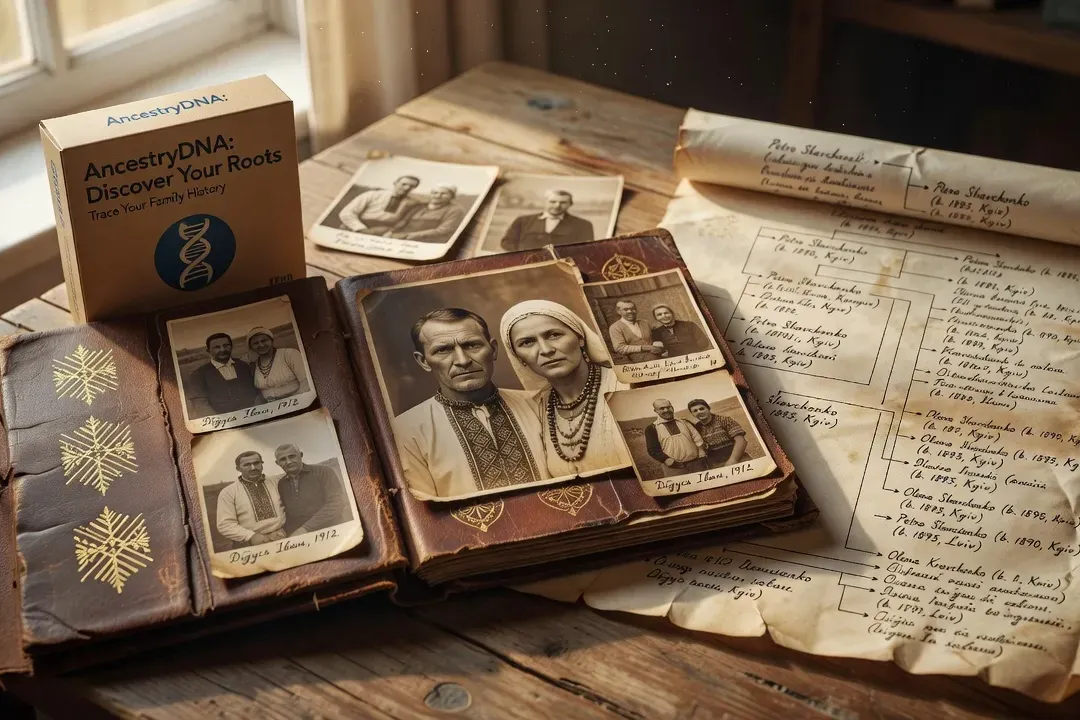
DNA ancestry test kit next to old Ukrainian family photograph album and handwritten genealogy chart.
Building a "match tree" is another effective strategy. By adding known relatives to your family tree, the platform can automatically extend potential connections. Shared matches can help identify common family lines, and examining surnames in match trees for Ukrainian names can provide additional clues.
Utilizing the Leeds Method is also beneficial. By color-coding matches according to grandparent lines, you can organize your matches efficiently. Ultimately, the genealogical value in DNA testing lies more in analyzing matches than in ethnicity percentages, as these connections offer practical leads in uncovering family history.
Q5: What about autosomal DNA versus Y-DNA or mtDNA for Ukrainian genealogy — when does it make sense to use the more specialized tests?
When exploring Ukrainian genealogy, understanding the differences between autosomal DNA and more specialized tests like Y-DNA and mtDNA is crucial. Autosomal DNA, which examines all ancestral lines up to 5-6 generations, is the most versatile and widely used test for genealogical purposes.
Y-DNA testing, which focuses exclusively on the direct paternal line, can be particularly useful for researching Ukrainian patrilineal surnames or for comparing men who share the same surname. This test is ideal for delving deeper into paternal lineage and is best conducted through FamilyTreeDNA, which has the most extensive database of Ukrainian participants.
mtDNA testing, on the other hand, traces the direct maternal line. While less commonly used in genealogy, it can provide insights into deep maternal ancestry. For example, certain Y-DNA haplogroups like R1a-Z280 and I2a-Dinaric are prevalent in Galicia, offering clues to regional origins. Each type of test has its place in genealogy, depending on the specific research goals and family lines of interest.
| Test Type | Traces | Best Use in Ukrainian Genealogy |
|---|---|---|
| Autosomal DNA | All ancestral lines, 5-6 generations | Most versatile; general match-finding across all family lines |
| Y-DNA | Direct paternal line only | Confirming patrilineal surnames; comparing men who share a surname |
| mtDNA | Direct maternal line only | Deep maternal ancestry; less common in practical genealogy |
Common mistake: Expecting ethnicity percentages to precisely identify a Ukrainian region or village. Ethnicity estimates are too broad for that level of detail — chromosome matching and shared-match analysis with people from specific oblasts is a far more reliable approach.
Q6: How do you approach chromosome browsing to confirm whether a DNA match shares a specific ancestor?
Chromosome browsing is an invaluable tool for confirming whether a DNA match shares a specific ancestor. Platforms like MyHeritage, FamilyTreeDNA, and 23andMe offer chromosome browsers, whereas AncestryDNA does not. By examining which segments of DNA are shared across multiple people from the same family line, you can "triangulate" a shared ancestor.
When using chromosome browsers, it's important to look for the same DNA segment shared by different relatives, as this indicates inherited DNA from a common ancestor. Generally, segments larger than 7 centimorgans (cM) are considered reliable for matching, while segments smaller than 7 cM may be false positives.
GEDmatch is another free tool that allows chromosome browsing across platforms, enabling users to analyze and compare their DNA with a broader set of potential matches. This cross-platform capability can be particularly useful for confirming shared ancestry and refining genealogical hypotheses.
Q7: Are there Ukrainian DNA databases or reference populations that you find particularly reliable?
Several Ukrainian DNA databases and reference populations are highly reliable for genealogical research. MyHeritage's Ukrainian reference population and the FamilyTreeDNA's Ukrainian project (known as the Ukrainian DNA Project) are prominent resources. The GEDmatch database also offers Ukraine-specific reference populations, providing valuable data for those seeking to understand their genetic roots.
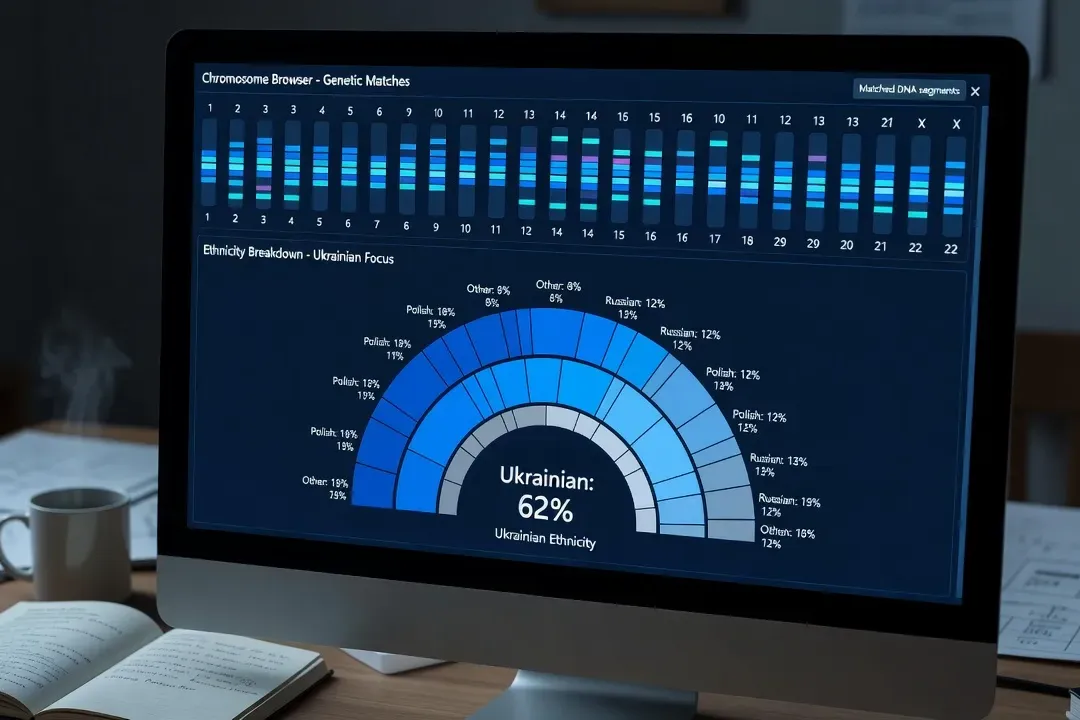
Chromosome browser visualization on computer screen with Ukrainian ethnicity breakdown chart.
Organizations like the Ukrainian Genealogical Society of Canada play a significant role in encouraging members to test and contribute to these databases. Academic resources such as the Genographic Project's Ukrainian data and the Human Genome Diversity Project's Belarusian/Ukrainian reference populations enhance these databases' reliability and depth.
However, it's worth noting that reference populations for Western Ukraine, including Galicia and Bukovyna, are underrepresented compared to Central and Eastern Ukraine. For those whose DNA results point to Ukrainian origins and who want to explore the regions where their ancestors lived, connecting with DNA matches through organized visits to Ukrainian regions can be a powerful complement to genetic research.
Q8: What are the most common mistakes Ukrainian-Canadians make when starting their DNA genealogy journey?
Common mistakes that Ukrainian-Canadians make when beginning their DNA genealogy journey include:
- Testing only on one platform and not exploring others.
- Expecting ethnicity percentages to precisely identify a region or village, which they typically cannot.
- Failing to build a family tree linked to their DNA results, which limits the potential for discovering connections.
- Not reaching out to DNA matches, as the matching itself is only half the work — collaboration is key.
- Confusing half-relationships and endogamy, the latter of which can inflate estimated relationship closeness.
- Not uploading raw DNA data to GEDmatch and FamilyTreeDNA, both of which offer free uploads and can significantly expand the match pool.
These errors can hinder progress in genealogical research. To complement DNA research with traditional archive sources, see our guide to choosing the right DNA test for Ukrainian ancestry.
Q9: For someone who has already tested but feels stuck, what's the single most effective next step you recommend?
If you're feeling stuck after testing, the most effective next step is to maximize your DNA's reach. Start by uploading your raw DNA data to all free platforms, such as MyHeritage, FamilyTreeDNA, and GEDmatch, to broaden your match pool. Next, examine your closest 20 matches and identify those with family trees — reach out to these individuals to collaborate on potential connections.
Simultaneously, continue building out your family tree as extensively as possible, allowing matching algorithms to connect you with known families. Joining the Ukrainian DNA Project on FamilyTreeDNA can also be beneficial, as project administrators offer guidance in interpreting results. If your brick wall is on the paternal line and you're male, consider Y-DNA testing for additional insights.
For those interested in starting from scratch, our guide to the 15 best Ukrainian genealogy websites covers all the free databases that complement DNA research.
Quick Takes: True or False?
3 Key Takeaways for Ukrainian-Canadian DNA Researchers
- Genetic genealogy is a powerful tool for overcoming the challenges posed by lost Ukrainian records. DNA testing connects living relatives, helping to confirm family ties where traditional documentation is sparse or nonexistent.
- Using multiple DNA testing platforms and free upload sites like GEDmatch can dramatically expand your network of potential relatives and improve the likelihood of meaningful discoveries.
- Building a comprehensive family tree linked to your DNA results and actively engaging with close matches are crucial strategies in maximizing the potential of your DNA research. For traditional archive research that complements DNA, our guide to Ukrainian Orthodox church records in Canada is an essential companion.
Pairing DNA results with documentary sources — especially our guide to Ukrainian surnames and their genealogical significance — helps researchers distinguish between unrelated families sharing common patronymic names and trace variant spellings back to a single ancestral village. In conclusion, Ukrainian-Canadian researchers can significantly benefit from incorporating DNA testing into their genealogical pursuits. By leveraging the strengths of genetic tools and collaborating with DNA matches, the path to uncovering rich family histories becomes more accessible and rewarding.
Frequently Asked Questions
Yes, AncestryDNA can identify Ukrainian ancestry through its ethnicity estimates, which include a 'Ukrainian' region and 'Eastern Europe & Russia' category. However, the precision varies — AncestryDNA is strongest at identifying North American Ukrainian-Canadian descendants because of its large North American database. For finding cousins still in Ukraine, MyHeritage typically produces more European matches. The most reliable approach is to test on AncestryDNA and upload your raw DNA file to MyHeritage, GEDmatch, and FamilyTreeDNA to maximize your match pool.
For Ukrainian genealogy, the best approach combines AncestryDNA (largest overall database, strong for North American Ukrainian diaspora) with MyHeritage DNA (best European database, most Ukrainian-region matches). FamilyTreeDNA is the top choice for Y-DNA and mtDNA testing. After testing, upload your raw DNA from AncestryDNA to GEDmatch (free) and MyHeritage (free) to access additional matching databases. This multi-platform strategy maximizes your chances of finding Ukrainian cousins.
Ethnicity estimates for Ukrainians are moderately accurate at the regional level but imprecise at the village or oblast level. All consumer DNA companies can reliably identify Eastern European ancestry, and most now have specific 'Ukrainian' regions in their ethnicity reports. However, because Ukraine's population has been influenced by many neighboring peoples over centuries — Poles, Russians, Romanians, Hungarians — the ethnicity breakdown for Galician and Bukovynian Ukrainians often includes Polish, Romanian, or Balkan components. Treat ethnicity estimates as a starting point, not a definitive regional identifier.
Yes, but with limitations. MyHeritage has the largest number of Ukrainian-based testers among consumer DNA platforms, making it the best choice for finding relatives in Ukraine. FamilyTreeDNA also has a substantial Eastern European database. However, testing rates in Ukraine remain lower than in Canada or the USA, so the pool of potential matches is smaller. As testing becomes more common in Ukraine — particularly through diaspora-initiated programs — the number of available matches is growing. The GEDmatch database, which accepts uploads from multiple platforms, also helps consolidate matches across services.
Third cousins share on average about 0.78% of DNA, or roughly 53 centimorgans (cM) across multiple segments. However, this varies considerably — the actual range is typically 0 to 173 cM. Due to the endogamy common in some Ukrainian village communities (where families intermarried within a small geographic area over generations), you may share higher-than-expected amounts of DNA with matches from specific regions. This endogamy effect can make DNA relationships appear closer than they genealogically are, so always confirm relationships through documentary research when possible.