Introduction
For many Ukrainian Canadians, genealogy research is more than a hobby — it is a journey back to a place that exists now only in family stories and faded photographs. The villages of Galicia, Bukovyna, and Volhynia from which the great immigration waves departed over a century ago are real places, accessible today. But they require planning, knowledge, and some courage to visit.
Vasyl Marchenko has spent 12 years helping members of the North American and European Ukrainian diaspora make that journey. As the founder of Roots in Ukraine, a heritage tour company based in Lviv, he has organized hundreds of research trips, guiding families from the reading rooms of the Lviv State Archives to the cemeteries of remote Galician villages where their great-great-grandparents are buried.
Andrew Kowalski, research editor at Ukrainian Genealogy Group PEI, sat down with Marchenko to discuss what a genealogy research trip to Ukraine in 2026 actually looks like — the safety realities, the logistical details, and the strategies that produce results.
Safety, Logistics, and Getting to Lviv
Andrew Kowalski: Let’s address the central question immediately. Can someone actually travel to Ukraine for genealogy research in 2026, given the ongoing war?
Vasyl Marchenko: Yes, but with full awareness of the situation and genuine preparation. Western Ukraine — Lviv in particular — has been significantly less affected by the direct violence of the war than the east and south. Lviv receives tourists, researchers, and journalists regularly. The city’s cultural and archival institutions continue to function.
What I tell every client is this: you are visiting a country at war. There are air raid alerts. There is visible military presence. You will see evidence of a society under enormous stress. But the Lviv I work in every day is also a city where people go to cafes, children go to school, and researchers work in archives. The decision to travel is a personal one, and I am not going to tell anyone that there is no risk. What I can tell you is that with proper preparation, the research can be done and the trip can be meaningful.
For any non-Ukrainian Canadians, I want to mention that resources exist for practical travel preparation to Ukraine. French-speaking Canadian researchers may also find useful guidance at this comprehensive Ukraine travel resource, which covers logistics, cultural context, and current travel conditions.
Andrew Kowalski: For someone who has never been to Lviv, what is the city like, and why is it the base of operations for Galician genealogy research?
Vasyl Marchenko: Lviv is one of the most beautiful cities in central Europe. The old town is a UNESCO World Heritage Site — Baroque and Renaissance architecture, cobblestone streets, half a dozen languages mixed in the air. It was known in the Austrian period as Lemberg; the Poles called it Lwów; Ukrainians always called it Lviv. All of those histories have left their mark on the city, which is exactly what makes it so rich for genealogy research.
Practically, Lviv is the base for Galician research because that is where the archives are. The Central State Historical Archives (TsDIAL) holds the Greek Catholic and Roman Catholic parish records for most of historical Galicia — the records your ancestors appear in, going back to the 1780s. The Lviv State Regional Archives (DALO) holds administrative and land records. The Lviv University Library has important historical collections.
Getting to Lviv from Canada has become somewhat more complex since commercial flights to Ukraine are suspended, but the route is manageable. Most travellers fly to Krakow or Warsaw, then take the train across the border. The train between Krakow and Lviv takes about three to four hours and is comfortable. I meet clients at Lviv Central Station.
Key takeaway: Lviv is the base for Galician research because the archives are there — the Central State Historical Archives (TsDIAL) holds Greek Catholic and Roman Catholic parish records back to the 1780s, and the city remains accessible via Krakow or Warsaw despite suspended commercial flights.
| Archive | Holds |
|---|---|
| Central State Historical Archives (TsDIAL) | Greek Catholic and Roman Catholic parish records for most of historical Galicia, back to the 1780s |
| Lviv State Regional Archives (DALO) | Administrative and land records |
| Lviv University Library | Important historical collections |
| Central State Historical Archives of Ukraine in Kyiv (TsDIAK) | Hetmanate period and central/eastern Ukrainian regional records |
Research Itinerary, Preparation, and Working in the Archives
Andrew Kowalski: What is the typical itinerary for a five to seven day research trip?
Vasyl Marchenko: Day one is orientation and registration. We go to TsDIAL together, I introduce you to the staff, you complete the registration, and we identify which funds — which collections — contain records for your ancestral villages. We also visit the finding aids room to understand the scope of what is available.
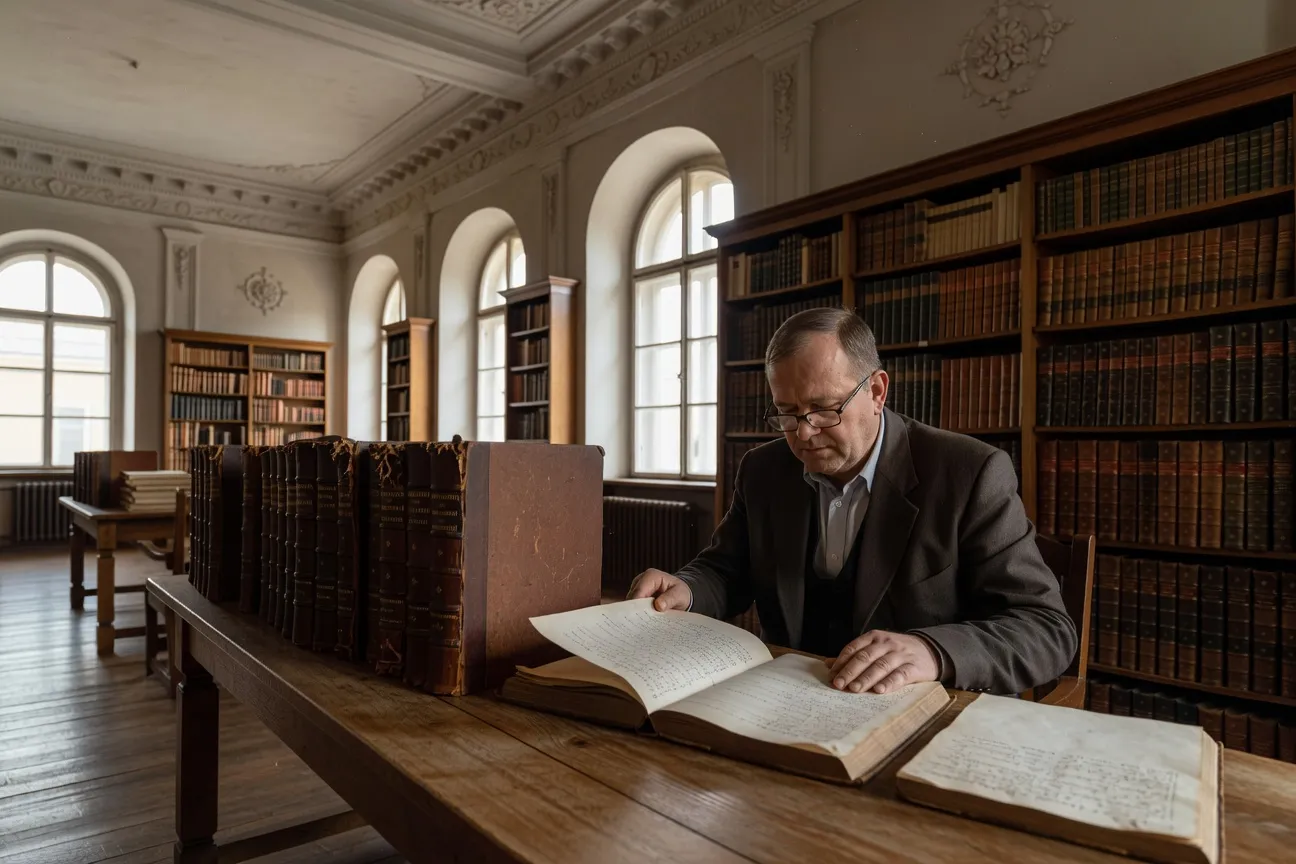
The key logistics: reading rooms have limited hours, typically morning to mid-afternoon on weekdays. Records must often be ordered one business day in advance. You cannot simply walk in and request a specific register immediately — you place the request, and the archivists retrieve it the following day. So the research rhythm is: arrive, orient, place requests for day two. Then days two through five are intensive reading room sessions, examining registers, making digital photographs, and placing new requests each afternoon for the next day.
| Day | Activity |
|---|---|
| Day 1 | Orientation and registration at TsDIAL; identify relevant funds (collections); visit the finding aids room |
| Days 2-5 | Intensive reading room sessions: examining registers, photographing entries, placing next-day requests |
| Result after 5 days | Ten to fifteen individual registers examined; some clients trace a family back six generations |
On a well-organized trip, a researcher can examine ten to fifteen individual registers in five days. That is significant progress for a family history. I have clients who have identified their ancestral village, found their great-great-grandparents’ marriage entry, and traced the family back six generations in a single trip.
Andrew Kowalski: What preparation should researchers do before they arrive?
Vasyl Marchenko: Preparation is the difference between a productive trip and a frustrating one. Three things are essential.
First, know your ancestral village. I cannot overstate this. Without a village name, the archive is essentially inaccessible. The records are organized by parish, not by surname — there is no nationwide surname index. If you arrive in Lviv saying “my family came from Ukraine” with nothing more specific, we can do very little with archive records. Our most important tool is a starting village, and you should identify it from Canadian records before you travel.
Second, know the denomination. Greek Catholic records are in one part of TsDIAL; Roman Catholic records are in another; Orthodox records may be in different archives entirely. Knowing whether your ancestors were Greek Catholic, Roman Catholic, or Orthodox directs us to the correct collection immediately.
Third, bring your Canadian documentation. Your naturalization papers, census extracts, ship manifests — bring everything you have. These documents sometimes contain village information or name spellings that help us identify the correct records even when the family story is unclear.
The three essentials, in order of importance:
- Know your ancestral village — without it, the archive is essentially inaccessible
- Know the denomination — Greek Catholic, Roman Catholic, or Orthodox, since each directs research to a different collection
- Bring your Canadian documentation — naturalization papers, census extracts, and ship manifests can reveal village names or spelling variants
Andrew Kowalski: What about hiring a local researcher rather than travelling in person? Is that a viable alternative?
Vasyl Marchenko: Absolutely, and for many people it is the better choice. Not everyone can spend ten days in Ukraine, not everyone is comfortable with the current situation, and not everyone has a budget for international travel. A local researcher can access the archives, read the documents, photograph them, and send you the results.
What you lose with remote research is the experience — seeing the archive with your own eyes, standing in a building where your ancestors’ vital records have been stored for two centuries, potentially visiting the ancestral village. For some people this experiential dimension is important; for others, getting the information is what matters. Both approaches are legitimate.
If you hire a local researcher, vet them carefully. Look for professional credentials, references from previous diaspora clients, and clear communication about what services they provide, their fees, and their timelines. A good researcher will ask you intelligent questions about your family before they begin. Be wary of anyone who promises results without asking for village or denomination information first.
| Travel to Lviv in person | Hire a local researcher | |
|---|---|---|
| Experience | Sees the archive and village firsthand | No firsthand experience |
| Cost | Higher (flights, lodging, guide) | Lower, pay per research day |
| Access | Full access with escort/orientation | Depends on vetting the researcher |
| Best for | Those wanting the emotional/heritage dimension | Those who mainly want the records |
Common pitfall: Hiring a local researcher without vetting them first. Be wary of anyone who promises results without asking for your ancestral village or religious denomination — a credible researcher always asks intelligent questions about your family before starting work.
Andrew Kowalski: Is it possible to visit the ancestral village itself?
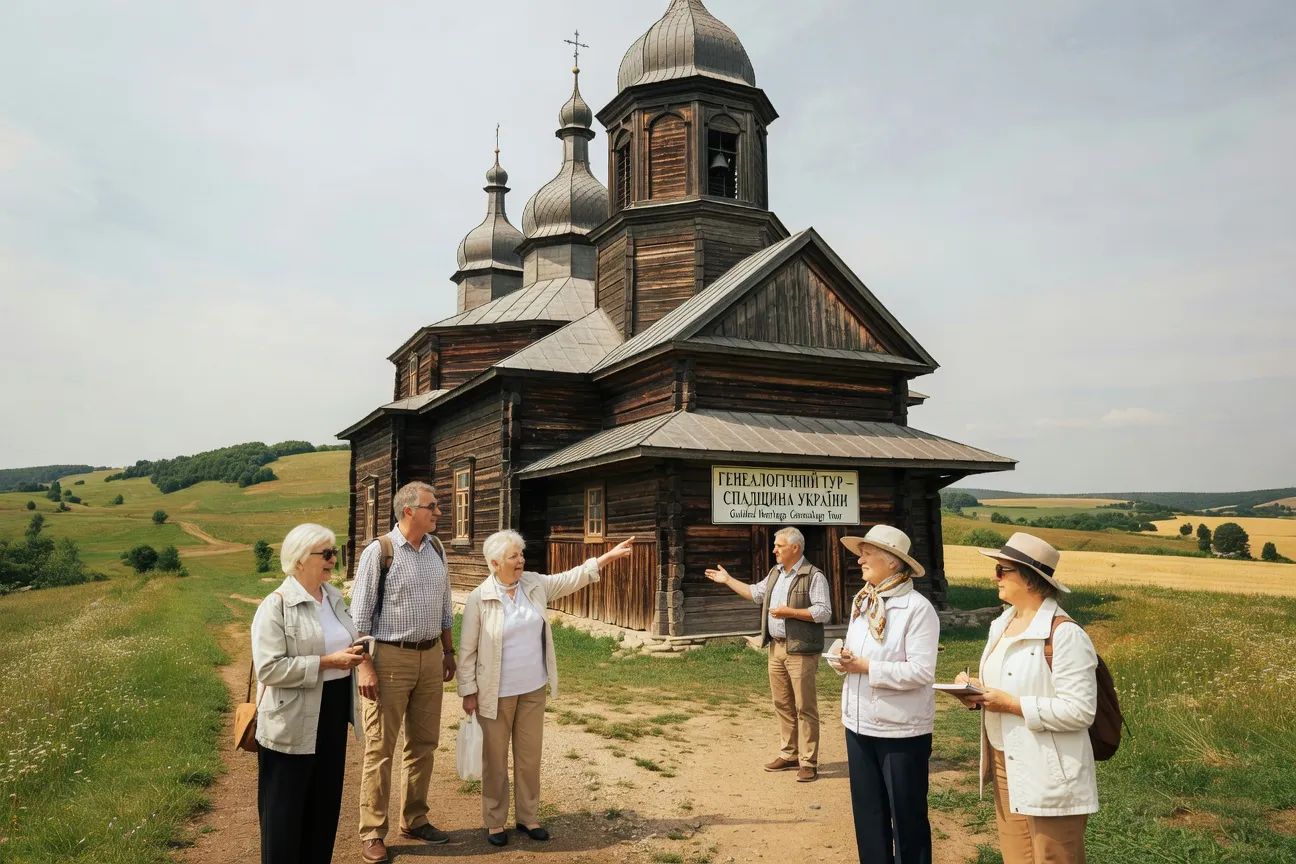
Vasyl Marchenko: For most Galician villages, yes, and this is often the most emotionally significant part of the trip for clients. Many ancestral villages are within two to four hours of Lviv by car. We can drive out on a day trip or stay overnight.
What you find in the village today depends on its history. Some villages have a Ukrainian Greek Catholic church that may be the same building — or on the same site — as the one where your ancestors were baptized. Some have a village cemetery with Ukrainian surnames still readable on the stones. Some local councils maintain archives of their own with 20th-century records. In some villages, elderly residents can point out the sites where specific families lived.
What you will not usually find is a preserved ancestral homestead. The 20th century was brutal to the physical fabric of rural Ukrainian life — wars, Soviet collectivization, depopulation. But the landscape is often recognizable from historical photographs and descriptions, and standing in the actual village where your family originated is an experience that no amount of remote research can replicate.
Andrew Kowalski: What about Kyiv? Is there valuable genealogy research to be done there?
Vasyl Marchenko: Kyiv holds records primarily relevant to researchers with family roots in central and eastern Ukraine — the regions that were part of the Russian Empire rather than Austria-Hungary. For Galician family lines, Kyiv is generally not necessary, and the security situation makes it less practical to recommend for most clients in 2026.
That said, the Central State Historical Archives of Ukraine in Kyiv (TsDIAK) holds significant collections from the Hetmanate period and from the Kyiv, Poltava, Chernihiv, and other central Ukrainian regions. If your family came from these areas, Kyiv is the relevant archive. I do help clients with central Ukrainian research on request, but Lviv is where my primary expertise and infrastructure are concentrated.
Researchers whose family came from the former Austrian crownland of Bukovyna — today’s Chernivtsi Oblast — will find that the relevant archives are in Chernivtsi rather than Lviv. The record situation there is somewhat different from Galicia. See our specialist interview on Bukovyna genealogy and the Chernivtsi archives for a full breakdown.
Andrew Kowalski: What do researchers typically discover that surprises them?
Vasyl Marchenko: Two things, consistently.
The first is how much detail the records contain. People arrive expecting minimal information and are surprised to find not just names and dates but the names of all four grandparents, the village of the bride’s family, the godparents’ surnames (which often lead to additional research lines), the occupation of the head of household, and sometimes a note about a dispensation indicating that the couple were related. The Habsburg administrative machine was thorough.
The second thing that surprises people is the village. They expect to find a place that has moved on entirely from its Ukrainian heritage — and sometimes it has. But sometimes the church is still there, with liturgy sung in Church Slavonic, and the priest knows the surnames of the founding families going back four generations. Sometimes an elderly woman in the village carries the same surname as your great-grandmother and may be a distant relative. These moments of living connection to a past that seemed purely historical are why people keep coming back.
Andrew Kowalski: Any final advice for someone beginning to plan a trip?
Vasyl Marchenko: Three things. Start your preparation with the research, not the travel. Find your village first, using Canadian records, FamilySearch, and community resources like the guide to Lviv archives for genealogy. Travel without a village is tourism; travel with a village is pilgrimage.
Marchenko's closing advice, summarized:
- Start with research, not travel — find your village first using Canadian records and FamilySearch
- Be patient with the archives — Ukrainian archives are underfunded and understaffed, but the staff are dedicated professionals
- Bring an empty notebook — the sensory experience of the archive fades faster than photographs
Be patient with the archives. Ukrainian archives are underfunded and understaffed, but the people who work in them are professionals who care deeply about their collections. Come prepared, be respectful, and you will be treated well.
And finally: bring an empty notebook. The experience of a research trip to Ukraine is not something you can photograph adequately. The smells of the archive, the feel of a 200-year-old register, the sight of your great-great-grandmother’s name in a priest’s handwriting — write it down. These things fade faster than the photographs, and they are the ones worth keeping.
For researchers beginning their genealogy journey and looking for the right starting point before considering a trip, see our guide to how to start Ukrainian genealogy research.
Frequently Asked Questions
Western Ukraine, including Lviv and the surrounding region, has remained substantially safer than eastern and southern Ukraine throughout the conflict. Air raid alerts occur but major damage to the city has been limited. That said, no one can guarantee safety in a country at war, and travellers must make an informed personal decision. All major Western governments continue to advise against non-essential travel to Ukraine. Lviv-based genealogy tours have continued operating with careful attention to shelter procedures and flexible scheduling. Travellers should have comprehensive travel insurance, register with their embassy, and be prepared for changes to plans at short notice.
For most researchers with Galician ancestry, the first stop should be the Central State Historical Archives of Ukraine in Lviv, known as TsDIAL or CDIAK. This archive holds the Greek Catholic and Roman Catholic parish records for most of historical Galicia. Registration is required; bring a valid passport and expect to complete brief paperwork before accessing the reading room. Staff members speak Ukrainian and some speak English.
A productive research trip typically requires five to seven days minimum for a single family line. The first day involves registration and orientation at the archives; subsequent days involve requesting and examining specific funds (collections). Archive reading rooms have limited operating hours, and records must often be ordered a day in advance. A two-week trip allows for both Lviv research and a side trip to Kyiv or to the ancestral village itself, if conditions permit.
Costs vary significantly based on accommodation choices and services required. Budget travel in Lviv remains considerably cheaper than in Western European cities. A rough estimate for a one-week trip from Canada, including flights, accommodation in Lviv, archival access fees, a professional researcher for two days, and local transport, ranges from approximately CAD $3,000 to $5,500. Guided heritage tours with full logistical support can run higher. A local researcher without full tour support is the most affordable option.
For many researchers, the ancestral village can be identified through Canadian records (ship manifests, homestead files, census records) without ever visiting Ukraine. Once the village is identified, FamilySearch.org and other online databases may have the relevant church records accessible online. A trip to Ukraine becomes most valuable when records must be examined in person, when the village itself is the destination for a heritage experience, or when hiring a local researcher to search non-digitized archives.