The Foundation of Ukrainian Family Research
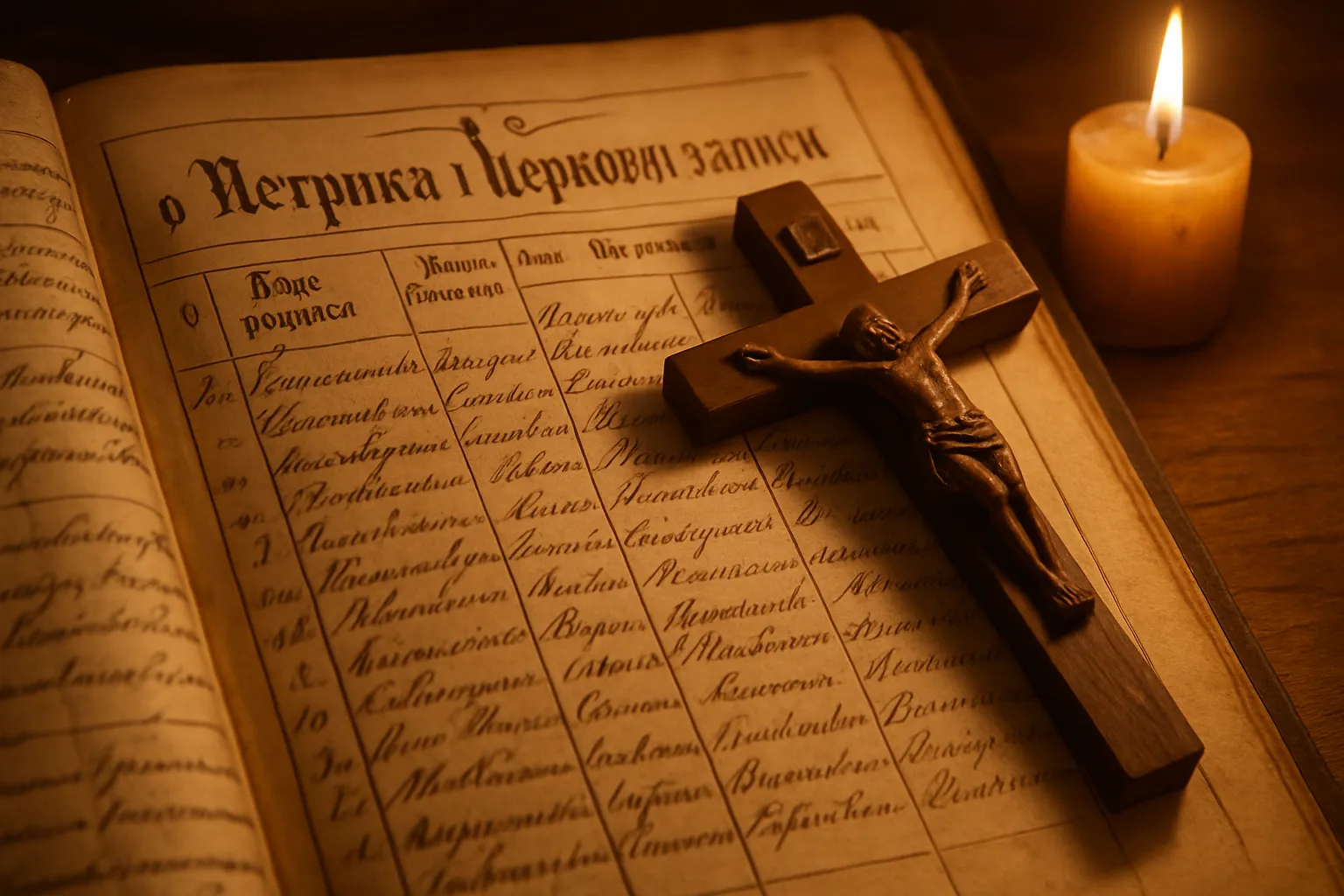
Ask any experienced Ukrainian genealogist where the research begins and ends, and the answer is almost always the same: in the metrical books. These parish registers — maintained by priests across three centuries and across the entire sweep of Ukrainian territory — contain the births, marriages, and deaths of millions of ordinary people who left no other written record of their existence. They are, for most Ukrainian families, the deepest point the documentary trail will ever reach.
Metrychni knyhy (метричні книги) — literally “metrical books” from the Latin matricula — are the Ukrainian term for these registers. The word is used regardless of the language the record was written in or the denomination of the church that kept it. Greek Catholic, Orthodox, Roman Catholic: all maintained metrical books following broadly similar formats, recording the same three categories of vital event that determined the shape of a family tree — who was born, who married, and who died.
This guide covers everything a genealogist needs to know to find, access, and read Ukrainian metrical books in 2026. It assumes no prior knowledge of Ukrainian, Russian, Latin, or Polish, and no previous genealogical experience. If you are still at the beginning of your research and need to identify an ancestral village before searching the records, start with our guide on how to start Ukrainian genealogy research. By the end, you will understand what these records contain, where to find them online for free, and how to extract the information you need from entries written in scripts and languages you may never have encountered before.
A Brief History: How Metrical Books Came to Exist
Before the 18th century, Ukrainian churches kept records in an irregular and unstandardized way. Some parishes maintained registers; many did not. What changed everything was the administrative reach of empires.
The Austrian Mandate of 1784
For western Ukraine — the region known as Galicia, which came under Habsburg (Austrian) control in 1772 — the critical date is 1784. In that year, Emperor Joseph II issued a decree requiring all parishes, regardless of denomination, to maintain standardized registers of births (baptisms), marriages, and deaths. The registers were to follow a uniform tabular format, be legible, and be kept in duplicate. One copy remained with the parish; the other was sent to the diocesan archives.
This edict created the foundation for modern Galician genealogy. It explains why Ukrainian genealogical records are so much better preserved for Galicia than for regions that remained under Russian rule, and why the standard entry format for Galician records is Latin rather than Slavic — the Austrian state, operating in a multilingual empire, found Latin the most practical administrative language.
Russian Imperial Records
For central and eastern Ukraine, which remained part of the Russian Empire, the development of systematic record-keeping followed a different timeline and logic. The Orthodox Church in the Russian Empire had been maintaining some registers since the reforms of Peter the Great in the early 18th century, but standardized civil registration through church books became more consistent from the 1820s onward. In these territories, the records are written in Russian and use the Cyrillic alphabet, following formats mandated by the Russian Orthodox Synod rather than the Habsburg civil administration.
What Happened to the Records
The fate of Ukrainian metrical books in the 20th century is a story of partial survival. World War I, the Russian Civil War, World War II, Soviet rule, and various administrative upheavals destroyed or scattered enormous quantities of archival material. Records from Galicia survived better than those from eastern Ukraine, partly because the Habsburg duplicate system spread records across multiple locations, partly because western Ukraine experienced somewhat less total destruction, and partly because Austrian-era records were transferred to Polish archives after 1918 and thus survived the Soviet period intact.
Researchers should approach their searches with realistic expectations: records for some parishes, some years, and some regions simply no longer exist. But the surviving material is vast, and the ongoing digitization programs of FamilySearch, Ukrainian archives, and Polish archives continue to bring previously inaccessible records online.
Key takeaway: Galician records survived considerably better than those from eastern Ukraine, largely because the Habsburg duplicate system spread copies across multiple archives and Austrian-era records were transferred to Polish custody after 1918, protecting them through the Soviet period.
| Region/Rule | Key Date | Effect on Records |
|---|---|---|
| Galicia — Austrian mandate | 1784 | Emperor Joseph II required standardized, duplicate registers for all denominations |
| Central/Eastern Ukraine — Russian Empire | 1820s onward | Standardized Orthodox Synod record-keeping in Russian, Cyrillic alphabet |
| Galicia — post-1918 | 1918 | Austrian-era records transferred to Polish archives, largely surviving Soviet period intact |
The Structure of a Metrical Book: What You Will Find
All metrical books, regardless of denomination or language, are divided into the same three main sections. Understanding this structure allows you to navigate an unfamiliar register quickly.
Part I: Births and Baptisms
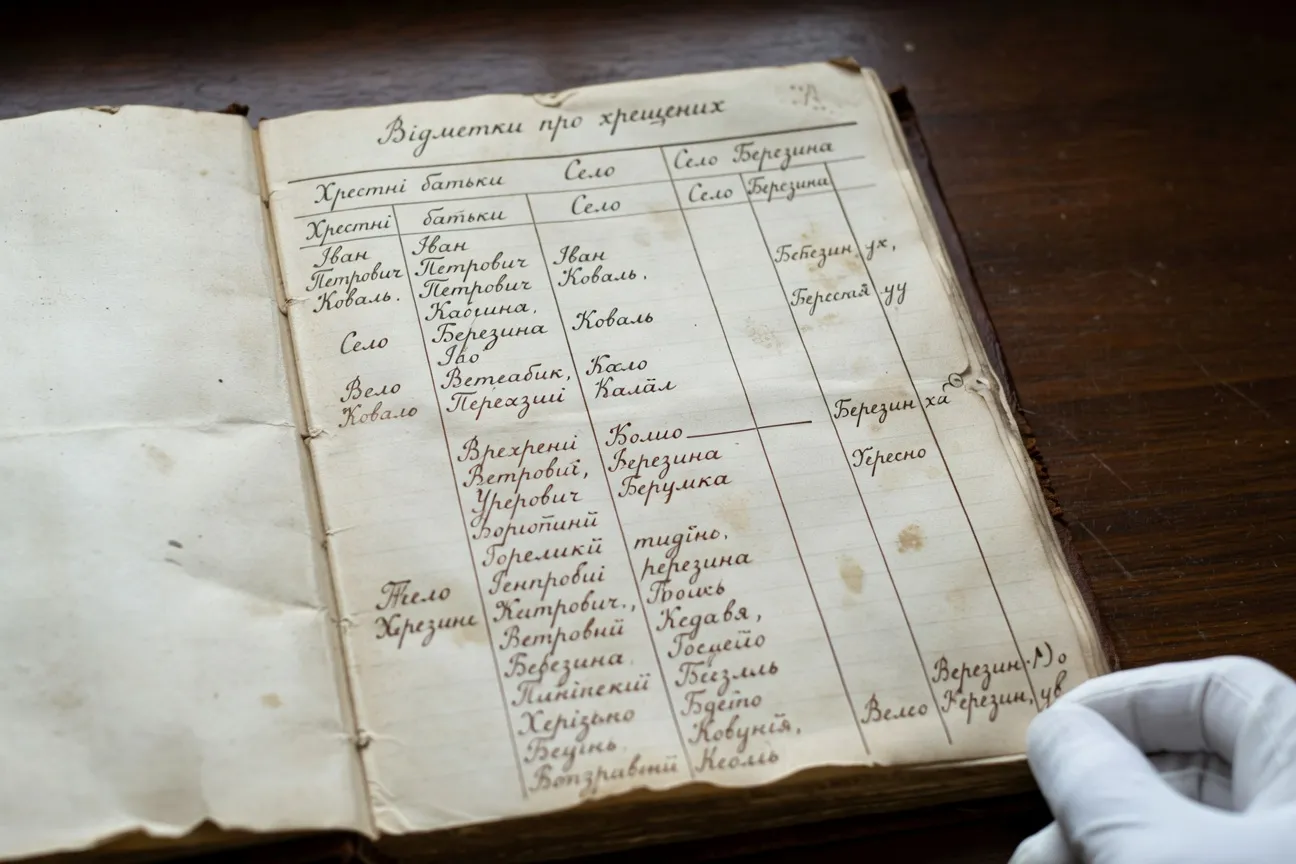
The birth and baptism register is typically the longest section and the most valuable for genealogists. A complete entry in a Greek Catholic register from Galicia will contain:
- Entry number — male and female entries are usually numbered separately within each year
- Date of birth — the actual day of birth
- Date of baptism — usually one to five days after birth; in winter or when the child was ill, the gap might be longer
- Name of the child — given name, in its Latin form for Greek Catholic records (Joannes, Maria, Basilius) or Church Slavonic/Russian form for Orthodox records (Ioann, Maria, Vasiliy)
- Village of residence — the family’s home village, which may differ from the parish location
- Father’s name and surname — including his occupation or social status (farmer, craftsman, nobleman)
- Mother’s name — including her maiden name (this is crucial: it provides an additional surname to research)
- Godparents’ names — the names and sometimes villages of both godparents; these were often relatives or neighbors and can open additional research lines
- Officiating priest — name and sometimes signature
For researchers focused specifically on Canadian-side records of these same baptisms and confirmations once a family had settled here, see our companion guide to Ukrainian baptism and confirmation records in Canada.
Part II: Marriages
Marriage entries contain information about both families, making them particularly valuable for linking genealogical lines. A typical entry includes:
- Date of the wedding ceremony
- Names, ages, and village of origin of the groom and bride
- Names of parents of both parties — including the bride’s maiden name and her mother’s maiden name
- Marital status — whether either party had been married before
- Social status — particularly relevant for nobility or landowners
- Names of witnesses — usually two witnesses, often relatives or neighbors, each with their village of origin
- Officiating priest
- Notation of any dispensation — if the couple were related within the canonical degrees prohibited by the church, a dispensation from the bishop was required and recorded
For genealogists, marriage records are uniquely valuable because they document the connection between two families at a specific moment. The witnesses are often relatives, making each witness name a potential new line to investigate.
Part III: Deaths and Burials
Death records are often the shortest entries in a metrical book, but they contain information not available elsewhere. A typical entry includes:
- Date of death
- Date of burial
- Name and age of the deceased
- Village of residence
- Cause of death — in the vernacular of the era; many entries simply say “old age,” “fever,” or “died young”; some specify epidemic diseases like cholera or typhus
- Name of the surviving spouse (if applicable)
- Name of the father (for children) or the deceased’s own father’s name (for adults)
- Officiating priest
Death records spanning decades in the same parish can reveal patterns of disease and hardship that illuminate the historical context your ancestors lived in.
Where to Find Ukrainian Metrical Books Online for Free in 2026
The digitization of Ukrainian genealogical records has accelerated dramatically since 2000, and in 2026 a substantial portion of surviving Galician records — and a growing proportion of other Ukrainian records — is accessible online without travel or fees.
FamilySearch.org
FamilySearch is the largest and most important single source for Ukrainian church records. Operated by The Church of Jesus Christ of Latter-day Saints, FamilySearch has microfilmed or digitized hundreds of thousands of Ukrainian parish registers across all denominations.
For Galicia specifically, FamilySearch has digitized most of the collections originally microfilmed by the LDS Church from Polish state archives (AGAD Warsaw) and Ukrainian archives. Many of these records are available to view immediately with a free FamilySearch account. Some collections are restricted to FamilySearch Center viewing, but the catalog is fully searchable without an account.
To find records for a specific village, use the FamilySearch Catalog:
- Go to familysearch.org/catalog
- Search by locality: “Ukraine” then the oblast (region), then the village name
- Browse the collections listed for that locality
- Records with a camera icon are available to view online
Genealogy Indexer
genealogyindexer.org provides searchable indexes for millions of Galician birth, marriage, and death records. Unlike FamilySearch, Genealogy Indexer focuses on surname indexes rather than images — it tells you in which register and year a surname appears, which you can then look up in the original records on FamilySearch or in archives.
Genealogy Indexer is particularly useful when you know a surname but not the village. By searching the surname across all indexed records, you can find all parishes where that name appears, which may help identify the correct branch of your family.
Polish Digital Archives: Szukajwarchiwach.gov.pl
The Polish national archives portal Szukajwarchiwach.gov.pl provides free online access to scanned records from Polish state archives, including a substantial collection of Galician church records that came under Polish custody after World War I.
The portal is in Polish, but the archive structure is navigable with a browser translation tool. Records are organized by archive and fond (collection), and searching requires knowing the archive name and record series. For Ukrainian genealogy, the most relevant collections are held at the AGAD Warsaw and various provincial archives.
CDIAK: Central State Historical Archives of Ukraine
The Central State Historical Archives of Ukraine in Lviv (TsDIAL, or CDIAK) is the primary Ukrainian repository for Galician church records. TsDIAL has been digitizing its collections and makes an increasing number of records available through its online catalog at cdiak.archives.gov.ua.
Access to the full digital archive may require creating an account, and some records are still available only by visiting in person or through a hired researcher. For more information on accessing these records remotely, see our Lviv Archives guide for genealogy research.
| Source | Best For | Access |
|---|---|---|
| FamilySearch.org | Digitized images of most Galician denominations | Free with account |
| Genealogy Indexer | Surname indexes when the village is unknown | Free |
| Szukajwarchiwach.gov.pl | Galician records held in Polish state archives | Free |
| CDIAK / TsDIAL | Original Ukrainian archive holdings in Lviv | Free catalog, in-person or hired researcher for full access |
Common mistake: Searching only FamilySearch and concluding a village's records don't exist online. Genealogy Indexer and the Polish Szukajwarchiwach.gov.pl portal frequently hold Galician records that are not yet on FamilySearch — always check all four sources before assuming a record is unavailable.
How to Read Metrical Book Entries
Reading a 19th-century Ukrainian church record requires no linguistic fluency, but it does require some preparation. The key insight is that metrical book entries are formulaic: every entry of the same type follows the same template, with only the names, dates, and places changing. Once you learn the template, you can extract information from any entry in that series.
Latin-Format Greek Catholic Records (Galicia, 1784-1920s)
The standard Latin-format entry for a Greek Catholic baptism in Galicia looks something like this:
Anno [year], mense [month], die [day] ego [priest’s name], parochus in [village/parish], baptizavi infantem nomine [child’s name], natum/natam die [date], ex [father’s name], [father’s occupation/status], et [mother’s name] coniugibus in [village], patrinis [godfather’s name] et [godmother’s name].
Key vocabulary:
- Anno/mense/die — year, month, day
- baptizavi infantem — baptized the infant
- nomine — named
- natum/natam — born (male/female)
- ex … et … coniugibus — from [father] and [mother], spouses (i.e., the child of their marriage)
- in — in [village]
- patrinis — godparents
The months are in Latin: Januarii (January), Februarii (February), Martii (March), Aprilis (April), Maii (May), Junii (June), Julii (July), Augusti (August), Septembris (September), Octobris (October), Novembris (November), Decembris (December).
Numbers in the date are written as Roman numerals (V, X, XXI, etc.) or as Arabic numerals depending on the period and individual priest.
Russian-Format Orthodox Records
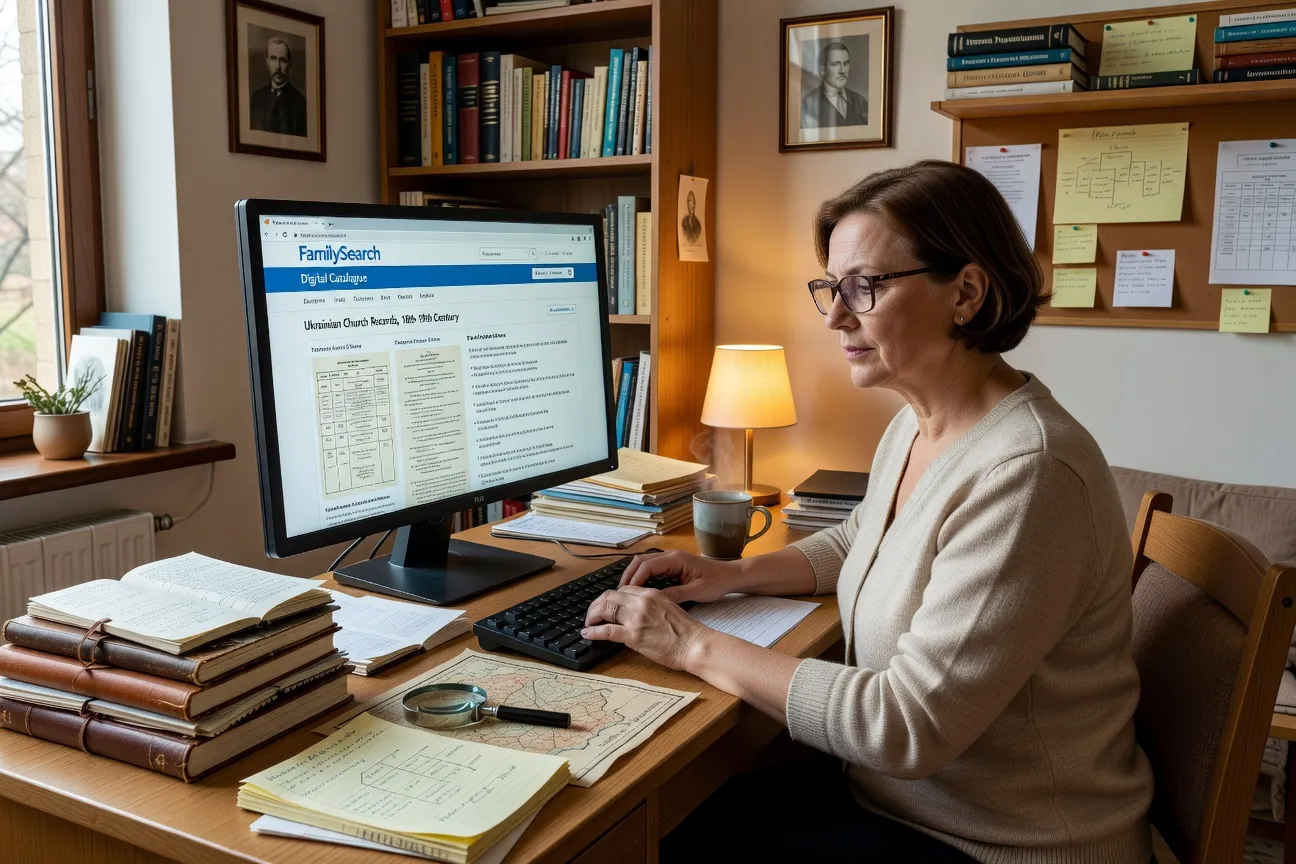
Orthodox records from the Russian Empire follow a tabular format with standardized column headers in Russian. The columns typically include (in order): entry number, year/month/day of birth, year/month/day of baptism, name given at baptism, father’s name and rank/status, father’s village, mother’s name with maiden name, and names of godparents.
The Cyrillic alphabet can be learned as a reading alphabet (without pronunciation) in approximately three to five hours. A printable Cyrillic-to-Latin transliteration chart, available on many genealogy websites, is sufficient for reading the names and places in an Orthodox register.
| Denomination | Primary Language | Record Format |
|---|---|---|
| Greek Catholic (Uniate) | Latin, sometimes Polish or Latinized Ukrainian names | Austrian standardized tabular format after 1784 |
| Orthodox | Church Slavonic / Russian, Cyrillic alphabet | Russian Orthodox Synod format, evolving over time |
| Roman Catholic | Latin | Similar Austrian tabular format, held in same archives as Greek Catholic |
Greek Catholic vs. Orthodox vs. Roman Catholic: Critical Differences
The denomination your ancestors belonged to determines which archive holds their records, what language the records are in, and what format the entries follow.
Greek Catholic (Uniate)
Greek Catholic records are the most commonly encountered by descendants of Galician immigrants, as the majority of first-wave Ukrainian immigrants to Canada came from Greek Catholic families. These records followed the Austrian standardized format after 1784, are written primarily in Latin (with names sometimes in Polish or Latinized Ukrainian forms), and were organized into bound registers by parish and year.
The key characteristic of Greek Catholic records is the Austrian tabular format: a printed table with standardized columns fills each page, and the priest writes the entry data into the columns. The consistency of this format makes Greek Catholic records among the easiest to read once you understand the column structure.
Orthodox
Orthodox records from Russian Imperial Ukraine are written entirely in Church Slavonic or Russian using the Cyrillic alphabet. The format follows Russian Orthodox Synod regulations, which evolved over time. Older records (pre-1820) may be less standardized; later records follow a consistent table format.
A critical difference for genealogists: Orthodox records were kept by the parish but inspected and archived by the Russian civil administration. Duplicate copies (metrical books for the state) were often sent to district offices, meaning survival rates may differ between church-held and civil-held copies.
Roman Catholic
Roman Catholic records appear in the genealogical research of Ukrainian families primarily in areas with mixed Ukrainian-Polish populations (parts of Galicia and Volhynia) and among families who converted between denominations. Roman Catholic records from Galicia follow a format similar to Greek Catholic records — Latin language, Austrian tabular format after 1784 — and are held in the same archives. For Polish Catholic records from the Russian Empire zone, the Genealogical Society’s indexing projects and Polish archives are the primary access points.
| Denomination | Primary Language | Format |
|---|---|---|
| Greek Catholic (Uniate) | Latin, with Polish/Latinized Ukrainian names | Austrian standardized tabular format after 1784 |
| Orthodox | Church Slavonic / Russian, Cyrillic alphabet | Russian Orthodox Synod format, less standardized before 1820 |
| Roman Catholic | Latin | Similar Austrian tabular format after 1784, same archives as Greek Catholic |
Key takeaway: The denomination determines everything about where to search — Greek Catholic and Roman Catholic Galician records are held together in Latin-format registers, while Orthodox records from further east require reading Cyrillic and are archived separately under different retention rules.
When Records Are Missing: Filling the Gaps
The gaps in Ukrainian genealogical records are significant but not insurmountable. Several strategies can help when the metrical books you need are not available.
Search for duplicates. The Austrian system required duplicate registers, and many Greek Catholic records have two or three surviving copies held in different archives. If the TsDIAL copy was damaged, the AGAD copy may be intact.
Try the nearest parish. Family oral tradition sometimes incorrectly identifies the home parish. Try searching neighboring parishes, especially if the family lived near a parish boundary.
Use civil registration records. In Galicia, Austrian civil registration (Ziviltandesmittelungen) was introduced in the 1870s as a supplement to church records. These civil records, held in Austrian-era district court archives, sometimes survive where church records do not. For Canadian settlers, Dominion Lands homestead files sometimes identify the village of origin, providing the starting point needed to locate the right metrical book series.
Consult the Genealogy Indexer. Even when the original images are not available, the index may show that records for your village exist somewhere — pointing you to an archive or collection you had not considered.
Common pitfall: Giving up after the first archive search returns nothing. The Austrian duplicate registry system means many Greek Catholic records survive in two or three separate archives — if the TsDIAL copy is missing or damaged, the AGAD Warsaw copy may still be intact.
Hire a professional researcher. For records that require in-person archive access in Ukraine, engaging a local genealogist with experience in the specific archive and time period is often the most efficient approach. Our guide to reading old Cyrillic church records can help you communicate precisely with a researcher about what you need.
Beginning Your Search
The practical starting point for any search in Ukrainian metrical books is a village name. Without knowing which village (or at least which parish) your ancestors came from, searching the metrical books is nearly impossible — the records are organized geographically, not by surname.
If you do not yet have a village name, begin with Canadian records: ship manifests, homestead files, naturalization papers, and census records often contain the village of origin. Community history books and church records in Canada may also document the home parishes of founding families.
Once you have a village name, use the FamilySearch Catalog to identify what records exist, verify the geographic and denominational context of the village, and begin reading. The first entry you successfully decode — reading a name your family has carried for generations, written in a priest’s hand in a village church two centuries ago — is a moment that genealogists tend to remember for the rest of their lives.
Frequently Asked Questions
Metrical books (метричні книги, metrychni knyhy) are parish registers maintained by Ukrainian churches to record vital events: births and baptisms, marriages, and deaths. They were the primary system of civil registration before state vital records were introduced. For most Ukrainian genealogists, they are the single most important source for research before the 20th century.
FamilySearch.org is the best free source, with millions of digitized Ukrainian church records from Greek Catholic, Orthodox, and Roman Catholic parishes. The Genealogy Indexer (genealogyindexer.org) provides searchable indexes for many Galician records. The Polish Szukajwarchiwach.gov.pl portal has Galician records from Polish archives. Some collections require a FamilySearch account (free) or can only be viewed at a FamilySearch Center.
The language depends on the period and region. Greek Catholic records from Galicia (western Ukraine) were often in Latin, especially for printed column headers, with names in Latinized or Polish forms. Orthodox records from eastern and central Ukraine used Church Slavonic and Russian. After 1867 in the Polish administration period, some Galician records switched to Polish. After 1920, Ukrainian and Polish were common. Records from the Austro-Hungarian period (1784-1918) often follow a standardized Latin-format table.
Austrian authorities required standardized parish registers beginning in 1784 for Galicia, so records from that date onward are relatively well preserved. Some earlier records survive from the late 1600s and early 1700s, but coverage is uneven. For territories under the Russian Empire, systematic record-keeping began somewhat later. In practice, most researchers find continuous records available from approximately 1780-1800 onward.
Several strategies can help when records are missing. Check duplicate registers — many parishes were required to send copies to district or diocesan archives, so if one copy was destroyed, the other may survive. Try neighboring parishes, as boundaries shifted and some families attended the nearest church regardless of jurisdiction. Use civil registration records that began in the 1820s-1870s depending on the region. Consult inventory lists at FamilySearch to see what collections exist. And remember that some records remain undigitized in local archives and require in-person research or a hired researcher.
Yes, with some preparation. Start by learning the Cyrillic alphabet for Russian and Ukrainian records (it can be learned in a few hours). For Galician Greek Catholic records in Latin, the column headers and formulas are repetitive and can be learned from a reference table. The key genealogical data — names, dates, village names — follows predictable patterns in every entry. With a glossary of common terms and a few practice records, most researchers can extract essential information without fluency in any of the record languages.