Why Baptism and Confirmation Records Matter for Genealogy
For Ukrainian-Canadian families, baptism and confirmation records are frequently the earliest and most reliable documentation of an ancestor's existence in Canada. Civil birth registration was inconsistent or entirely absent in many rural bloc settlements before the 1920s, which means the parish baptismal register — not a government office — is often the only surviving proof that a child was born on a given date to a given set of parents. These sacramental registers, kept in Ukrainian Greek Catholic and Ukrainian Orthodox parishes from Manitoba to Alberta, capture details that go far beyond a simple date of birth.
Confirmation records, meanwhile, are consistently overlooked by beginning researchers, yet they often solve genealogical puzzles that baptismal registers cannot. A confirmation entry can reveal that a teenager baptized in a village in Galicia or Bukovyna was later confirmed in a prairie parish, confirming both the family's emigration date and their new parish affiliation. Together, these two record types create a documentary thread that follows a person from infancy through adolescence, long before most Canadian civil records begin.
Because these registers were maintained by parish priests rather than government clerks, their survival depends heavily on the fate of individual congregations — some of which merged, closed, or transferred their books to diocesan or provincial custody over the past century. Understanding how to trace that custodial chain is often the single biggest hurdle facing family historians today.
Baptism Records vs. Confirmation Records: What's the Difference?
Baptism (also called christening) records document the sacrament performed shortly after birth, usually within days or weeks. Confirmation, by contrast, was administered years later — often between the ages of seven and sixteen depending on the parish and era — and marked full admission into the church community. Because the two sacraments were recorded in separate ledgers, a single individual may appear in two entirely different books, sometimes decades apart and occasionally in two different parishes if the family had relocated.
The table below summarizes the core differences researchers should keep in mind when searching parish archives.
| Feature | Baptism Records | Confirmation Records |
|---|---|---|
| Typical age recorded | Days to weeks after birth | 7 to 16 years old |
| Primary purpose | Registers entry into the Christian faith | Registers full church membership |
| Key names listed | Parents and godparents (khrestni) | Confirmand, parents, and sponsor |
| Village of origin noted | Frequently, for both parents | Sometimes, if recently arrived |
| Best use for genealogy | Establishing birth date and parentage | Tracking migration and parish transfers |
| Common Ukrainian term | Khreshchennya | Myropomazannya (chrismation) |
In Eastern-rite practice — followed by both Ukrainian Greek Catholic and Ukrainian Orthodox parishes — baptism and confirmation (chrismation) were traditionally performed together in infancy, unlike the Roman Catholic pattern of a later, separate confirmation. However, many Canadian parish registers still kept distinct confirmation or "myropomazannya" books for record-keeping purposes, particularly for children baptized privately or by a visiting priest. Always check whether your ancestor's parish maintained separate books before assuming the two events are recorded together.
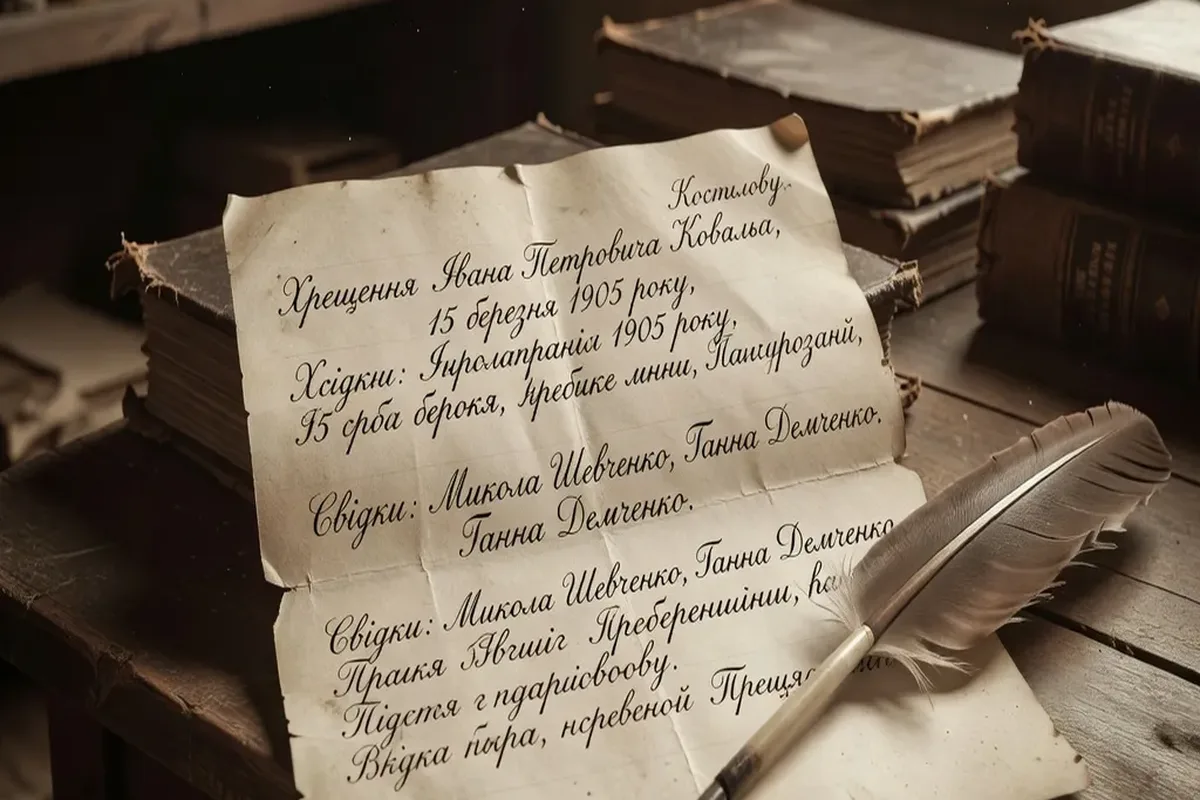
Open handwritten Ukrainian parish baptism register with faded ink entries from the early 1900s.
What Information Do Baptismal Entries Contain?
A typical Ukrainian Canadian baptismal entry, whether Greek Catholic or Orthodox, generally records the following details:
- Full name of the child and the exact date of birth
- Date and place of baptism, including the officiating priest's name
- Father's full name, patronymic, and occupation (often "farmer" or "homesteader")
- Mother's full name, including her maiden name
- Village and district of origin in Galicia, Bukovyna, or Volhynia
- Names of godparents (khrestni batky), who were frequently relatives or close neighbours
- Legitimacy notation and, occasionally, the homestead quarter-section
This level of detail makes baptismal registers invaluable for reconstructing extended family networks. Godparents were rarely chosen at random; they were often siblings, cousins, or in-laws, and identifying repeated godparent pairings across multiple baptismal entries can reveal family clusters that never appear together in any civil document. For background on how these entries fit into the broader system of church record-keeping, see our companion guide to Ukrainian church records and metrical books.
Entries from before 1920 are almost always written in Church Slavonic or Ukrainian Cyrillic script, while later entries increasingly shift to bilingual or fully English formats. Researchers should also watch for marginal annotations, which sometimes note a later marriage, a confirmation performed elsewhere, or a family's move to another province.
Confirmation Books: A Hidden Source for Tracking Families
Confirmation registers are among the most underused genealogical sources in Ukrainian-Canadian research. Because confirmation was typically administered during a bishop's periodic visitation rather than on a fixed annual schedule, these books often list multiple age groups together, sometimes spanning several years since the previous visit. This creates a rich, dated snapshot of every eligible child in the parish at a specific moment in time.
Tip: If you cannot find a baptismal entry for an ancestor born abroad, check the confirmation books of the family's first Canadian parish. Confirmation entries for immigrant children sometimes state the year of arrival in Canada and the child's approximate age, which can substitute for a missing birth record.
Confirmation books also help researchers track families that moved between parishes — a common occurrence as Ukrainian settlers relocated from initial homestead blocks to towns or to other provinces in search of work. A child confirmed in one parish and later appearing as a witness or godparent in a different parish's records often signals a documented family migration that can be cross-referenced with homestead and land records. Our guide on Ukrainian homestead records and Dominion Lands files explains how to confirm such moves using federal land grant documentation.
Sponsors listed in confirmation entries — distinct from baptismal godparents — frequently represent a second generation of family connections, since sponsors were sometimes chosen from among community elders or respected parishioners rather than close relatives. Documenting both sets of names across a family's baptismal and confirmation entries can uncover an entire web of kinship and community ties spanning multiple parishes.
Which Denomination? Greek Catholic, Orthodox, and Roman Catholic Parishes
Most Ukrainian-Canadian families belonged to either the Ukrainian Greek Catholic Church or the Ukrainian Orthodox Church of Canada, though a smaller number were absorbed into Roman Catholic parishes, especially in areas without a nearby Eastern-rite church. Knowing which tradition an ancestor followed determines exactly which archive to search first.
The comparison below outlines where each denomination's baptism and confirmation registers are most commonly preserved today.
| Denomination | Typical Record Language | Primary Archival Custodian |
|---|---|---|
| Ukrainian Greek Catholic | Church Slavonic, later Ukrainian/English | Eparchial archives (Winnipeg, Edmonton, Toronto) |
| Ukrainian Orthodox Church of Canada | Ukrainian, later bilingual English | UOCC Consistory Archives, Winnipeg |
| Russian Orthodox (pre-1918 parishes) | Church Slavonic | Transferred largely to UOCC or provincial archives |
| Roman Catholic (absorbed parishes) | Latin headings, English entries | Diocesan chancery archives |
It is not unusual for a single family to appear across two denominations over a generation, particularly if their original parish closed or if a new Ukrainian Orthodox congregation formed nearby after 1918 and drew away part of the Greek Catholic membership. When a search in one denomination's records comes up empty, always check the neighbouring tradition before assuming the record does not survive. For a broader overview of how these denominational histories intersect, our detailed article on Ukrainian Orthodox church records in Canada traces the formation of the three main church bodies active between 1890 and 1960.
Ukrainian Greek Catholic church exterior on the Canadian prairies with onion dome architecture.
Provincial Archives: Where to Look by Province
Provincial archives across the Canadian West and beyond hold substantial collections of transferred parish registers, particularly for congregations that closed or consolidated over the twentieth century. Coverage and access rules vary significantly, so the table below offers a starting reference point.
| Province | Key Repository | Notes for Researchers |
|---|---|---|
| Manitoba | Archives of Manitoba, Winnipeg | Strong coverage of Interlake and Dauphin-area parishes |
| Saskatchewan | Saskatchewan Archives Board (Regina/Saskatoon) | Yorkton and Canora bloc settlement registers |
| Alberta | Provincial Archives of Alberta, Edmonton | Vegreville, Edmonton, and Lamont-area parishes |
| Ontario | Archives of Ontario, Toronto | Mostly postwar displaced-persons era parishes |
| Prince Edward Island / Atlantic | Local parish and diocesan records | Smaller, scattered communities; contact parishes directly |
When contacting a provincial archive, provide as much specific information as possible: the exact parish name (registers are almost always filed by congregation, not by surname), an approximate date range, and — if known — the civil township and range of the family's homestead. Staff at these archives frequently manage requests by email and can confirm within a few weeks whether a register has been microfilmed, digitized, or remains accessible only in original form.
Digitized Online Collections and Databases in 2026
FamilySearch.org continues to be the most comprehensive free resource for digitized Ukrainian-Canadian parish records, including numerous baptism and confirmation registers embedded within its broader "Church Records" collections for Alberta, Manitoba, and Saskatchewan. Indexing quality varies by collection: some volumes are fully name-searchable while others require page-by-page browsing using the parish name and date range as your guide.
- Search the FamilySearch catalog by province, then filter for "Church records" and the relevant denomination.
- Check the Library and Archives Canada online finding aids for microfilm reel numbers tied to specific parishes.
- Consult individual parish or diocesan websites, some of which have begun posting scanned confirmation class photographs and partial registers.
- Review the list of top free Ukrainian genealogy websites and databases for additional niche collections updated throughout 2026.
Because digitization projects are ongoing, it is worth revisiting a previously "unavailable" collection every year or two, as archives continue to add newly scanned material. Setting a calendar reminder to recheck a specific parish's status is a simple habit that has rewarded many patient researchers.
Reading Godparents, Sponsors, and Witnesses Correctly
One of the most common sources of confusion in baptism and confirmation records is misidentifying the role of each named individual. Parents, godparents, sponsors, and witnesses each serve a distinct function, and conflating them can send a researcher down the wrong genealogical path entirely.
Common mistake: Assuming a godparent listed in a baptismal record is automatically a blood relative. While many godparents were indeed family members, it was equally common for close neighbours or respected community figures to serve in this role, especially in small bloc settlements where mutual support outweighed strict kinship ties.
To interpret these roles accurately, keep the following distinctions in mind:
- Godparents (khrestni batky): Named at baptism, responsible for the child's religious upbringing.
- Confirmation sponsors: Named at confirmation, sometimes different individuals from the baptismal godparents.
- Witnesses: Occasionally listed separately in marriage-adjacent baptismal notations, confirming the event took place before others.
Cross-referencing the same names appearing repeatedly as godparents across multiple families within a parish can help reconstruct informal community networks, which is particularly useful when trying to identify a family's likely village of origin — since godparent relationships often carried over from the old country to the new settlement.
Common Mistakes When Searching Baptism Records
Even experienced researchers run into predictable pitfalls when working with Ukrainian-Canadian sacramental records. Being aware of these in advance can save months of unproductive searching.
Common mistake: Searching only under the Anglicized version of a surname. Priests frequently recorded names in their original Cyrillic or a phonetic Latin transliteration that differs substantially from the spelling a family later adopted in English-language documents. Always search multiple spelling variants.
- Assuming a missing baptismal entry means the event never occurred, rather than checking neighbouring parishes for children born near a parish boundary.
- Overlooking the possibility that a family baptized a child in Ukraine before emigrating, meaning the earliest Canadian record may actually be a confirmation.
- Failing to check both Greek Catholic and Orthodox registers when a family's denomination changed after a parish split.
- Ignoring marginal notes, which frequently contain corrections, later sacraments, or transfer information critical to tracing a family's full timeline.
For readers still working through the alphabet and abbreviations found in these older entries, our dedicated resource on reading old Cyrillic church records covers common scribal shorthand and calendar conversion issues in detail.
Requesting Records Directly from a Parish
When archival copies are incomplete or unavailable, contacting the parish directly — or its successor diocese if the original congregation has closed — remains the most reliable path to original baptism and confirmation records. Most parishes are accustomed to genealogical inquiries and will conduct a lookup for a modest research fee, typically between ten and twenty-five dollars.
To improve your chances of a successful response, include the following in any written request:
- The full name of the individual, including any known variant spellings
- An approximate year of birth or confirmation, with a reasonable date range if uncertain
- The names of parents or other known family members
- Any known homestead location, township, or nearby town
If the parish itself has closed, contact the relevant diocesan or eparchial chancery office, which typically retains custody of registers from defunct congregations. For families researching alongside a heritage trip to Ukraine, planning a visit through resources like Ukraine travel and heritage tour guides can complement archival research by connecting descendants directly with ancestral villages named in these very baptismal entries.
Patience and persistence remain essential throughout this process. Baptism and confirmation registers, though sometimes scattered across multiple archives and written in unfamiliar scripts, offer some of the richest and most personal documentation available to Ukrainian-Canadian family historians. Every entry uncovered — a godparent's name, a village of origin, a confirmation date years after emigration — adds another thread to the larger story of a family's journey from the villages of Galicia and Bukovyna to the prairies, towns, and provinces of Canada. With careful cross-referencing between parish archives, provincial repositories, and digitized collections, researchers can continue to piece together these stories for generations to come.
Frequently Asked Questions
Ukrainian baptism records are held by the original parish (if still active), diocesan or eparchial archives for closed congregations, provincial archives such as those in Manitoba, Saskatchewan, and Alberta, and Library and Archives Canada, which holds microfilm copies of many collections. FamilySearch.org has digitized a growing number of these registers for free public access.
Baptism records document the sacrament performed shortly after birth and typically list parents and godparents. Confirmation records document a later sacrament, sometimes performed years afterward during a bishop's visitation, and list the confirmand, parents, and a sponsor. In Eastern-rite tradition the two are theologically linked but were often recorded in separate parish books.
Common reasons include the child being baptized in Ukraine before the family emigrated, the family attending a neighbouring parish rather than the nearest one, spelling variants of the surname in the original Cyrillic or transliterated form, or the register itself having been lost, damaged, or not yet digitized. Checking confirmation books and neighbouring parishes often resolves these gaps.
The two traditions used broadly similar formats since both follow the Eastern-rite liturgical calendar, but Greek Catholic registers are generally held in eparchial archives while Ukrainian Orthodox Church of Canada records are held by the UOCC Consistory Archives in Winnipeg. Some early parishes also began as Russian Orthodox congregations before transferring allegiance and records after 1918.
Most parishes and diocesan archives charge a modest research fee, typically between ten and twenty-five dollars, for a specific name and date lookup. Provincial archives generally charge only for photocopying or digital reproduction rather than the search itself. Hiring a professional researcher for extensive searches typically costs fifty to one hundred fifty dollars per hour.
Yes. Because confirmation was administered periodically during bishop's visitations, a confirmation entry in a new parish can reveal exactly when a family relocated from their original settlement. Comparing baptismal and confirmation parish locations for the same individual is one of the most effective ways to trace internal migration during the early twentieth century.