If you are tracing Ukrainian-Canadian ancestors who grew up on the Prairies between the 1890s and the 1940s, school records may hold the answer to a problem that census returns and church registers cannot solve: a near-contemporary record of a child's birth date, the family's address, and the name of a parent or guardian, all in a single line. Because civil birth registration was patchy in Manitoba, Saskatchewan, and Alberta well into the twentieth century, the admission line in a one-room school register frequently functions as a substitute birth record.
This guide explains what Ukrainian-Canadian school records contain, why the bilingual school era matters for understanding your ancestors' education, where registers are held today in each province, and how to build them into a research plan alongside census schedules, homestead files, and church registers.
Why School Records Matter in Ukrainian-Canadian Genealogy
The first Ukrainian immigrants arrived in Canada in 1891, and within two decades their children filled hundreds of one-room schools across the Prairies. Manitoba alone eventually counted more than 2,500 rural schools. Each of those schools kept registers, and each register recorded pupils at a moment when few other institutions touched their lives: before marriage, before military service, before naturalization, and often before any civil registration of their birth.
School records solve three recurring problems in Ukrainian-Canadian research:
- Filling the birth-registration gap. Western provinces did not register births systematically until the early twentieth century, so many children born in the 1890s and 1900s have no civil birth certificate. A school admission entry giving age and admission date often narrows a birth year to within twelve months.
- Linking children to parents and land. Registers normally name the parent or guardian responsible for the pupil, and the school district boundary was drawn around a known group of farm families. A child in the Lukowce, Melba, or Beckett district of Manitoba was almost certainly the son or daughter of a nearby ratepayer.
- Confirming religion and ethnicity. The denomination of the school, the teacher's remarks, and the language recorded for instruction can corroborate a family's Greek Catholic or Orthodox affiliation when surnames have been anglicized.
School records rarely stand alone. Their real power appears when they are cross-referenced with the 1906 prairie census and land records, which place the same families on the same quarter-sections a few years earlier or later, and with parish registers, which record the baptisms the civil authorities never knew about.
What a One-Room School Register Contains
A typical prairie school register is a bound book or later a printed form, organized one page or one row per pupil per school year. The information was recorded by the teacher, usually in English after the 1890s, though Ukrainian names appear in many spellings. Understanding the standard fields helps you extract the maximum genealogical value:
| Field in the register | Genealogical value |
|---|---|
| Pupil name | Confirms how the family spelled or anglicized its surname at a specific date — Kowalchuk, Kovalchuk, or Kowalczuk may all appear for the same household across years |
| Age or date of birth | The single most valuable field when civil registration is missing; a stated age on a known admission date brackets the birth year |
| Address or location | Places the family within the school district, usually farm-based; combine with district maps to identify the quarter-section |
| Parent or guardian | Names the head of household, allowing you to reconstruct siblings who attended the same school |
| Date of admission and leaving | Tracks family moves between districts; a child who disappears from one register and reappears in another has located the family's migration |
| Attendance and conduct remarks | Occasionally notes transfers, promotions, or causes of absence that hint at illness, harvest work, or family events |
| Religion and language of instruction | Inferred from the school's denomination or explicitly noted in some registers; corroborates church affiliation and bilingual-school status |
One caution: ages in school registers are not always accurate. Parents sometimes overstated a child's age to qualify for admission or to keep an older child home for farm work. Treat a stated age as evidence, not proof, and weigh it against census ages and church baptismal dates.
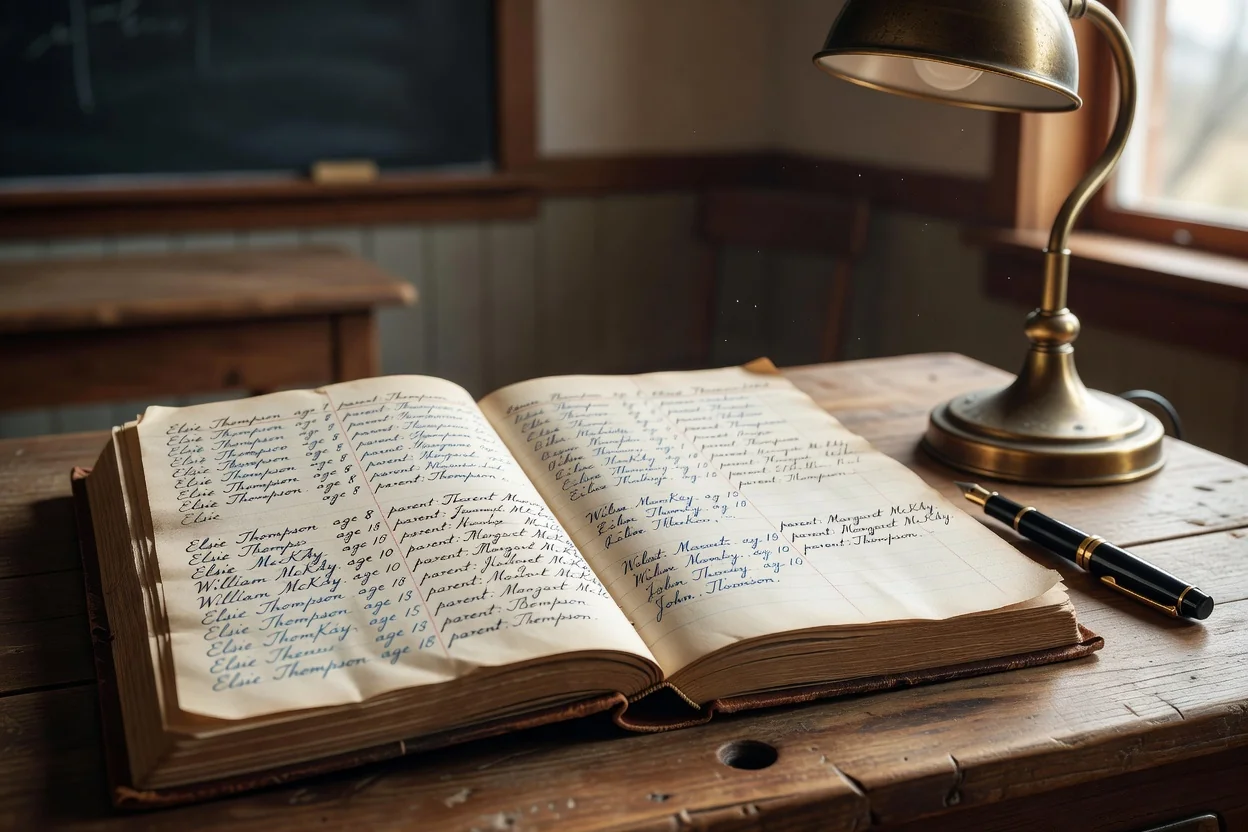
Spelling variation deserves special attention. Teachers recorded Ukrainian surnames phonetically, and a family may appear under two or three forms within the same book. When searching digitized indexes, try the rules described in our guide to Ukrainian surname spelling variants in Canadian records rather than searching one exact form.
The Manitoba Bilingual School Era, 1897–1916
For nearly twenty years, Ukrainian was a language of instruction in Manitoba's public schools. The Laurier-Greenway compromise of 1897 amended the Manitoba Schools Act to allow bilingual instruction where at least ten pupils spoke a language other than English. Ukrainian settlers, most of them newly arrived from Galicia and Bukovyna, used the clause to keep their language in the classroom alongside English.
The system grew quickly. By 1915, Manitoba counted 111 bilingual schools serving Ukrainian- and Polish-speaking children, with 114 teachers and 6,513 pupils. Inspectors such as William James Sisler visited these schools officially, and the Ruthenian Training School in Winnipeg prepared Ukrainian-speaking teachers for the classroom.
In March 1916, the Norris government abolished bilingual schools outright, and Ukrainian instruction in the public system ended. The episode matters to genealogists in two ways. First, school records from 1897 to 1916 may be written partly in Ukrainian or record Ukrainian as the language of instruction, which helps confirm ethnicity. Second, the closure pushed Ukrainian education into voluntary institutions — and those institutions left their own records.
Ridna Shkola and Parish School Records
After 1916, Ukrainian-Canadian communities built a parallel school system of their own. The Ridna Shkola ("native school") movement organized Saturday and after-hours classes in Ukrainian language, history, religion, and culture. The Ridna Shkola society of Winnipeg opened its school in 1918, and similar programs spread across the Prairies and into Ontario. Parish halls and church basements hosted many of these classes, which is why church archives sometimes hold attendance lists, concert programs, and examination records that no public archive collected.
These voluntary-school records are scarce but precious. Where they survive, they can:
- Name siblings together, because Saturday classes drew entire families from one parish;
- Record the Ukrainian form of names that appear only in anglicized form in public records, linking the two versions of the same person;
- Document teachers and organizers, who were often community leaders also visible in church minutes and mutual-benefit society records.
Ask the parish, the diocesan or consistory archives, and the local cultural centre before assuming nothing survives. In many communities, a single ledger from the 1930s survived in a church basement and later passed to a regional archive or museum.
Where to Find School Records by Province
School records are a provincial responsibility in Canada, so each province keeps its own archives and applies its own access rules. The table below summarizes the main repositories and what they hold.
| Province | Repository | What it holds | Access notes |
|---|---|---|---|
| Manitoba | Archives of Manitoba | Daily school registers by district, including districts with large Ukrainian populations such as Hamburg, Melba, Beckett, Edison, and Lukowce | Search the Keystone database; some records stored off-site require two business days' notice |
| Saskatchewan | Provincial Archives of Saskatchewan | Attendance registers and school district files; microfilms of about 1,000 district histories compiled in 1955 with pioneer biographies and settler lists | Attendance registers may be restricted; a reference archivist can advise. Local copies sometimes sit with school divisions or community museums |
| Alberta | Provincial Archives of Alberta | Ukrainian fonds including school, church, and community records, described in the archives' Ukrainian-language guide; homestead records complement school files | Consult the published Ukrainian guide PDF; some fonds unprocessed, so contact reference staff directly |
| Ontario | Archives of Ontario | Student and teacher records for certain schools and boards from the 1800s to 1968, plus examination reports, 1867–1949 | Records of smaller boards vary widely; check the archives' student and teacher records page |
| Prince Edward Island | Public Archives and Records Office (PARO) | School inspectors' annual reports RG10 for 1830–1910 and later reports in the Journals of the Legislative Assembly; trustees' records | Registers naming individual pupils are limited; inspectors' reports describe schools district by district |
For families on Prince Edward Island, where the Ukrainian community was small, school evidence usually comes indirectly: inspectors' reports, trustees' minute books, and local newspaper notices of school concerts and examinations. The settlement context is described in our history of Ukrainian settlers on Prince Edward Island.
For prairie families, remember the school district file even when the register is lost. In Saskatchewan, the district file typically contains the founding petition and the names of the first ratepayers — the very heads of household you are tracing — together with cadastral maps showing where each owned land. Read together with the Dominion Lands homestead records, a district file can reconstruct the entire founding population of a Ukrainian bloc settlement school.
If your ancestor's family came from the Carpathian foothills of Galicia or Bukovyna, pairing the Canadian school record with knowledge of the home region makes the research richer; resources on the Carpathian region and its historical geography can help you place the old-country village named in family tradition.
Yearbooks and Student Publications
School records do not end at the classroom door. As the community matured, Ukrainian-Canadian students produced yearbooks, literary magazines, and student newspapers that are themselves genealogical sources. The University of Manitoba's yearbook, The Brown and Gold, published from 1914 to 1967, is digitized in the university's digital collections and names thousands of students, clubs, and hometowns — including many young Ukrainian-Canadians of the interwar and postwar generations. College and high school reunion books from Ukrainian church colleges and Catholic high schools serve the same purpose.
Yearbook entries give you photographs, full names as the student used them, degrees, club memberships, and hometown references. A student listed as "Mary Korchinski, Dauphin, Man." in 1932 confirms both a name form and a family location that might take years to reconstruct from public records alone.
A Research Plan for School Records
Approach school records methodically, working from the known to the unknown:
- Establish the family's school district. Use homestead records, the 1906 census, or land maps to determine which school district served the family's quarter-section. District boundaries followed settlement density, not township lines.
- Locate the register. Search the provincial archives catalogue by district name. If the register is missing, ask about the district file, district histories, and any local museum holdings.
- Search spelling variants. Try truncated and phonetic forms of the surname; note the name forms used for siblings.
- Record admission and leaving dates. These track the family's moves between districts and can be matched against land transactions and church transfers.
- Corroborate with church and census records. A birth year from a register gains weight when a baptismal date and a census age agree with it.
- Follow the children into yearbooks. Older siblings often appear in district histories or college yearbooks that younger children do not.
Finally, keep perspective on what school records are: snapshots taken by teachers, for administrative purposes, one September at a time. A child absent on the day the register was written may vanish from that year entirely, only to reappear the next. Persistent, district-by-district searching across several consecutive years is what turns a thin file of names into a documented family history.
Sources consulted: Archives of Manitoba, archives programme and Keystone database; Manitoba Historical Society, one-room schools of Manitoba and bilingual schools; Encyclopedia of Ukraine (University of Toronto), Ukrainian bilingual education and Ridna Shkola society; Provincial Archives of Saskatchewan, education and school records; Provincial Archives of Alberta, Ukrainian guide; Archives of Ontario, student and teacher records; Public Archives and Records Office of Prince Edward Island, community history research guide; University of Manitoba, The Brown and Gold yearbooks; FamilySearch wiki, Manitoba and Saskatchewan school records; Case Western Reserve University, Encyclopedia of Cleveland History, Ridna Shkola; The Conversation, Ukrainian-language schools in western Canada.
Frequently Asked Questions
Often yes. Because civil birth registration was incomplete on the Canadian Prairies before the early twentieth century, school registers frequently provide the only near-contemporary record of a child's birth date or stated age, together with the name of a parent or guardian and the family's district of residence.
Most surviving school registers are held by provincial archives: the Archives of Manitoba, the Provincial Archives of Saskatchewan, the Provincial Archives of Alberta, the Archives of Ontario, and the Public Archives and Records Office of Prince Edward Island. Local copies sometimes survive with school divisions, former secretaries-treasurers, and community museums.
Historical attendance registers are generally open to researchers. Registers covering more recent decades may be restricted to protect personal information, and some repositories require advance notice or a reference archivist's assistance to consult restricted series.
Between 1897 and 1916, Manitoba allowed bilingual instruction in public schools where at least ten pupils spoke another language, and Ukrainian bilingual schools flourished under that clause. After bilingual schools were abolished in 1916, Ukrainian language and culture teaching moved largely to Saturday Ridna Shkola programs and parish schools.
If the register itself is lost, work outward from the school district: district files at the provincial archives often contain the founding petition, lists of early ratepayers, and cadastral maps naming landowners. Local museums, church archives, community newspapers, and reunion or anniversary histories of the district can reconstruct class lists and family names.