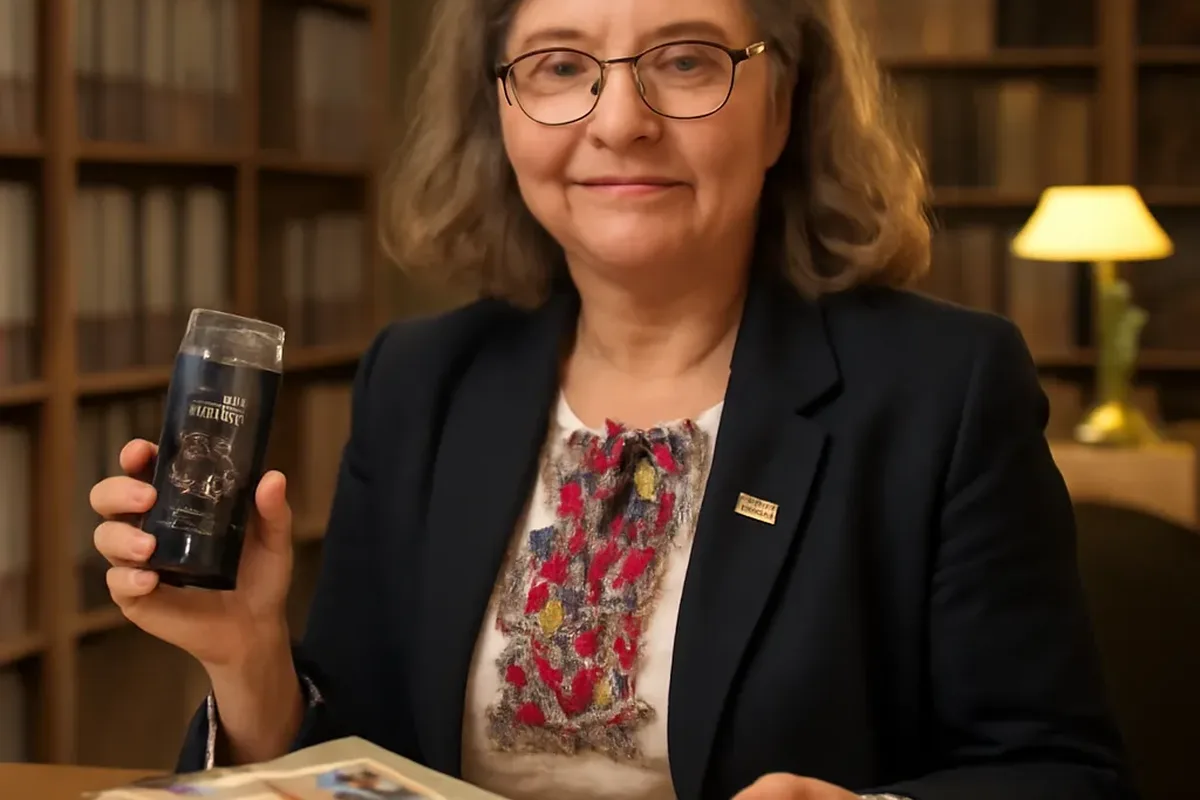
About Iryna Baran
Iryna Baran is an oral history archivist based in Winnipeg, Manitoba, who has worked with Ukrainian-Canadian community organizations, church parishes and settlement museums for more than twelve years. She trained in archival science and folklore documentation, and has personally recorded over 300 interviews with Ukrainian-Canadian elders across the Prairie provinces, Ontario and the Atlantic region, including several members of Prince Edward Island's Ukrainian community. Her recordings are held in regional archives and have been used by dozens of families to reconstruct migration stories that existed nowhere in writing.
Q1: Iryna, you talk about oral history collection as an urgent task, not just a nice-to-have. Why the urgency right now?
Anya: Iryna, you talk about oral history collection as an urgent task, not just a nice-to-have. Why the urgency right now?
Iryna:The math is simply unforgiving. The generation that either emigrated directly from Western Ukraine in the early twentieth century, or who grew up as the first Canadian-born children of those settlers, is now almost entirely gone or in very advanced age. Their children — the people who heard the stories firsthand around the kitchen table, who remember the accent, the songs, the specific way a grandmother described crossing the ocean — are themselves often in their seventies, eighties or nineties.
Every year that a family waits to sit down with a recorder is a year in which details soften, names get forgotten, and sometimes the person passes away before anyone asks a single structured question. I have lost count of the number of families who have told me, with real grief in their voice, "I wish I had asked while she could still remember." Unlike a parish record or a ship manifest, an oral memory cannot be requested from an archive after the person is gone. It only exists as long as someone is willing to speak it and someone else is willing to capture it. That is why I tell every family the same thing: the best time to record was ten years ago, and the second-best time is this weekend.
Q2: For someone who has never done this before, how do they get started with a first interview?
Anya: For someone who has never done this before, how do they get started with a first interview?
Iryna:Start small and start soon. You do not need professional equipment or a formal script for your very first session — you need a working recording device, thirty uninterrupted minutes, and permission. I always recommend beginning with a short, low-pressure conversation, perhaps twenty to thirty minutes, focused on a single theme such as "tell me about the house you grew up in" or "what do you remember about your mother's kitchen." This gives the elder a concrete, comfortable entry point rather than the intimidating prompt "tell me your life story," which tends to produce a blank stare.
Choose a familiar, quiet setting — their own living room or kitchen table works far better than an unfamiliar location. Explain clearly why you are recording: "I want our grandchildren to hear your voice and know where our family comes from." Most elders, once they understand the purpose is love and legacy rather than an interrogation, relax considerably. If you are new to interviewing family, our guide on how to start Ukrainian genealogy research pairs well with oral history work, since the two feed directly into each other.
Q3: What equipment do you actually recommend? Do families need to buy expensive gear?
Anya: What equipment do you actually recommend? Do families need to buy expensive gear?
Iryna:Absolutely not. The smartphone in your pocket is a perfectly capable oral history recorder. What matters far more than the device is the acoustic environment. Turn off the television, close the window if there is street noise, silence phone notifications, and if possible, place the phone on a small stack of books or a stand rather than holding it, so you get a steady, close audio source without handling noise.
If a family wants to invest a little more, a simple external microphone that plugs into a phone (a lavalier clip-on model costs very little) improves clarity enormously, especially for elders who speak softly or mix Ukrainian and English mid-sentence. I also strongly recommend recording video whenever the elder is comfortable with it — facial expressions, hand gestures describing a farm layout or an embroidery pattern, and even the room itself carry information that audio alone loses. Always do a fifteen-second test recording first and play it back before committing to a full session; nothing is worse than discovering after an hour that the microphone was muted.
Q4: What kinds of questions actually open up memory, versus ones that shut a conversation down?
Anya: What kinds of questions actually open up memory, versus ones that shut a conversation down?
Iryna:Broad, abstract questions like "what was your childhood like?" are surprisingly hard to answer because memory does not organize itself that way. Specific, sensory questions work far better: "What did the house smell like on Sunday mornings?" "What was the walk to church like in winter?" "Can you describe your mother's hands while she was baking?" These questions anchor the elder in a concrete moment, and from that anchor, entire chains of memory tend to unfold naturally.
I also encourage families to ask about objects. Pull out an old photograph, a piece of embroidery, a recipe card, or a letter, and ask the elder to describe it. Objects trigger a different kind of recall than open verbal prompts — they are tactile, visual anchors. Finally, resist the urge to correct or interrupt. If a date seems wrong or a name contradicts something you read in a census record, let it go during the interview itself; you can note the discrepancy afterward and gently revisit it in a later conversation. Interrupting to fact-check in the moment is the fastest way to make an elder self-conscious and guarded.
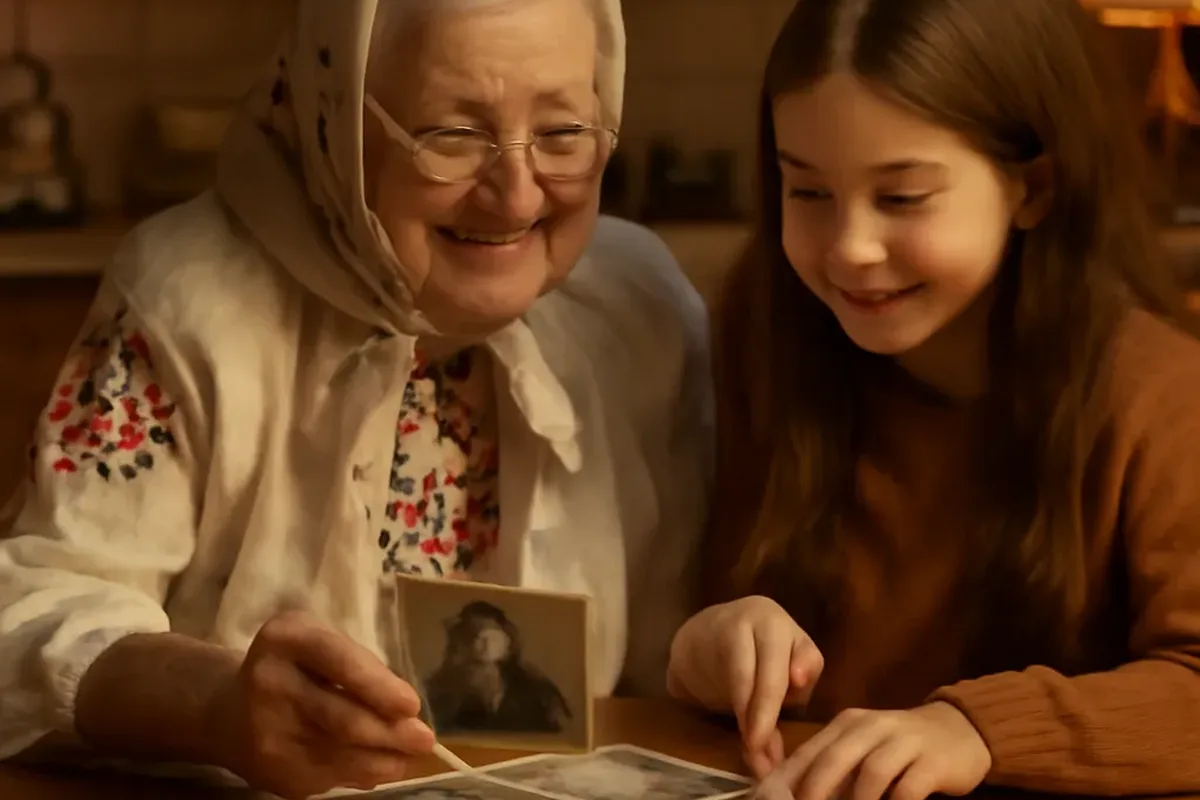
Elderly Ukrainian-Canadian woman being interviewed at her kitchen table with a smartphone recorder and old family photographs spread out.
Q5: Many Ukrainian-Canadian families carry difficult history — Holodomor survivors, wartime displacement, internment. How should families approach sensitive or traumatic topics?
Anya: Many Ukrainian-Canadian families carry difficult history — Holodomor survivors, wartime displacement, internment. How should families approach sensitive or traumatic topics?
Iryna:This is the area where I ask families to slow down the most. Many elders in this community carry memories connected to the Holodomor, forced collectivization, wartime displacement, or — for an earlier generation — internment during the First World War. These are not casual conversation topics, and pushing too hard, too fast, can cause real emotional harm or simply shut the interview down entirely.
My rule is: let the elder lead into difficult material rather than asking directly about it in an early session. Build trust over two or three lighter conversations first. When difficult topics do surface, acknowledge them with simple, warm language — "thank you for telling me that, I know that isn't easy" — rather than probing for more detail immediately. Always have a pause option ready; tell the elder explicitly that they can stop the recording at any point, and mean it. If your family's history touches on wartime internment, our piece on Ukrainian immigrants and internment history in Canada provides useful background context before you sit down for that conversation, so you are not asking questions from a place of total unfamiliarity.
Archivist's tip: Never record a sensitive topic as your very first question of the day. Warm up with a neutral, happy memory — a wedding, a harvest, a favourite dish — and let the harder material surface only once trust has been re-established in that specific sitting.
Q6: Once a family has recordings, how should they organize and preserve them for the long term?
Anya: Once a family has recordings, how should they organize and preserve them for the long term?
Iryna:This is where I see the most preventable loss. A recording sitting alone on a phone, with no backup and no metadata, is genuinely fragile — phones get lost, replaced, or simply age out, and files without labels become useless within a generation. As soon as possible after each session, back the file up in at least two separate places: a cloud storage account and an external hard drive, ideally in different physical locations.
Equally important is metadata. Rename each file with the date, the narrator's name, and a short topic description — for example, "2026-07-05_Baba-Kateryna_Galicia-emigration.mp3" — rather than leaving it as a generic phone-generated filename. Keep a simple written log alongside the recordings noting who is speaking, what topics were covered at approximately what timestamp, and any names or places mentioned that might need later verification. If your family has church-related material to preserve alongside these recordings, our guide to Ukrainian Orthodox church records in Canada explains how oral testimony and parish documents can reinforce each other.
Q7: What are the most common mistakes you see families make with these interviews?
Anya: What are the most common mistakes you see families make with these interviews?
Iryna:The mistakes cluster around a handful of recurring patterns:
- Waiting for a "perfect" occasion or setup instead of recording something imperfect today.
- Treating the first session as the only session, rather than a series of shorter, repeated conversations.
- Failing to back up recordings, leaving the only copy on a single phone.
- Interrupting constantly to correct dates or names instead of letting the story flow.
- Not asking permission or explaining the purpose, which can make an elder guarded or suspicious.
- Losing the accompanying context — photographs, letters, objects — that would have made the recording far more useful to future researchers.
Almost every one of these mistakes is avoidable with a little planning, and none of them require special training — just patience and a willingness to start imperfectly rather than not at all.
Q8: How does oral history actually connect back to formal genealogical research?
Anya: How does oral history actually connect back to formal genealogical research?
Iryna:Oral history and documentary genealogy are two halves of the same puzzle, and each strengthens the other enormously. An elder's memory of "the village near the big church with two towers" can help you identify a specific parish in a church record collection you would never have found by name alone. Conversely, a date or place found in a metrical book can help you gently confirm or refine what an elder remembers, without contradicting them directly.
I regularly see families use a recorded story about "grandfather's brother who never came to Canada" as the starting thread that eventually leads to locating an entire branch of the family still in Ukraine. If your family's stories reference village names or specific regions, our guide to Galician village maps and historical directories is an excellent companion resource for turning a remembered place name into an actual archival lead. And once you have a name and approximate village, organized research trips to Ukrainian ancestral regions can let you walk the ground your ancestors once walked and sometimes meet living relatives who remember the same family stories from the other side.
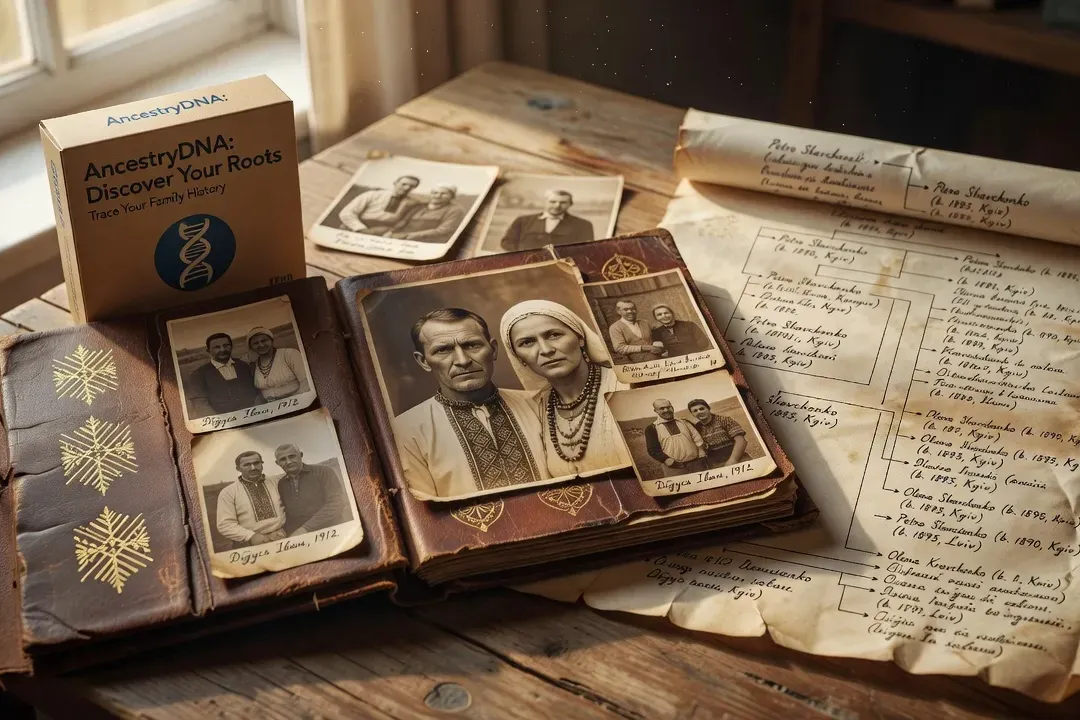
Handwritten genealogy chart alongside an old family photograph album used to cross-reference oral history recordings.
Q9: What would you say to a family who feels they have already waited too long?
Anya: What would you say to a family who feels they have already waited too long?
Iryna:First, be gentle with yourselves — almost every family I work with feels this way, and it is rarely as late as it seems. Even a single thirty-minute conversation captured today is infinitely more valuable than the perfect, comprehensive interview you imagine doing "someday." Start this week, not next season.
Second, remember that memory lives in more than one person. If the eldest generation is gone, their children, nieces, nephews and even long-time family friends often carry fragments of the same stories. Interview several people and cross-reference what they remember; overlapping details from independent sources are often more reliable than a single account. Finally, do not let perfectionism become another form of delay — a slightly awkward, unscripted recording made this weekend will still be treasured by your grandchildren fifty years from now.
Archivist's tip: If the person you most wanted to interview has already passed away, interview two or three people who knew them well instead. Overlapping secondhand memories, cross-referenced carefully, can reconstruct a surprising amount of what was lost.
Interview Preparation Checklist
| Step | What to do | Why it matters |
|---|---|---|
| 1. Ask permission | Explain why you want to record and get a clear "yes" | Builds trust and legal/ethical clarity |
| 2. Choose setting | Familiar, quiet room, TV off, phone on silent | Reduces noise and distraction |
| 3. Test equipment | Record 15 seconds and play it back | Avoids losing an entire session to a muted mic |
| 4. Start light | Open with a happy, sensory memory, not a hard topic | Eases the narrator into the conversation |
| 5. Bring objects | Photos, letters, embroidery, recipe cards | Objects trigger richer, more specific recall |
| 6. Do not interrupt | Let the story flow; note discrepancies for later | Keeps the narrator comfortable and talking |
| 7. Back up immediately | Save to cloud storage and an external drive same day | Prevents total loss from a lost or broken phone |
| 8. Label and log | Date, narrator's name, topic in the filename plus a written log | Makes the recording usable by future researchers |
3 Key Takeaways for Recording Ukrainian-Canadian Family Memory
- The window for recording firsthand and secondhand memories of early Ukrainian-Canadian settlement is closing quickly. A short, imperfect recording made this week is worth more than a perfect interview planned for someday.
- Good equipment matters less than a quiet room, clear permission, sensory questions, and patience — a smartphone is enough to start, and objects like photographs and letters unlock far richer recall than open-ended questions alone.
- Oral history and documentary genealogy reinforce each other constantly. A remembered village name or a half-remembered relative's story can unlock archival research, and archival records can help gently corroborate what elders recall. For families whose relatives never emigrated, our guide to researching the Lviv archives shows how to follow up on names and places surfaced during an oral history interview.
Preserving these voices is not simply a sentimental exercise — recorded testimony often becomes the single piece of evidence that connects a Canadian family to the specific village, parish or migration story that written records alone cannot supply. As Iryna Baran puts it, every recorded conversation is "a small act of rescue," pulling a family's history back from the edge of forgetting one question at a time.
Frequently Asked Questions
A smartphone is sufficient for a first interview. What matters most is a quiet room with background noise minimized, a steady phone position (rather than holding it), and a short test recording before you begin. An inexpensive clip-on lavalier microphone significantly improves clarity if you plan to do multiple sessions, and recording video whenever the narrator is comfortable captures gestures and expressions that audio alone misses.
Twenty to thirty minutes is ideal for a first session. Shorter, focused conversations on a single theme — such as a childhood home or a specific memory — are far more productive than attempting a full life story in one sitting. Plan for a series of shorter interviews over weeks or months rather than one long marathon session.
Let the narrator lead into sensitive material rather than asking directly in an early session. Build trust over two or three lighter conversations first, always mention that the recording can be paused at any time, and never open a session with a difficult topic — start with a warm, neutral memory instead.
Back up each recording in at least two separate locations, such as cloud storage and an external hard drive, immediately after the session. Rename files with the date, narrator's name and topic, and keep a simple written log noting who is speaking and what subjects are covered at approximate timestamps, so future family members can find specific material without listening to hours of audio.
Yes, often decisively. A remembered village name, church detail or relative's story can point researchers toward a specific parish or archival record collection that would otherwise be nearly impossible to identify by name alone. Oral history and documentary records work best together, with each helping to confirm or refine the other.
Interview siblings, children, nieces, nephews or long-time family friends who knew that person well. Overlapping secondhand memories from several independent sources, carefully cross-referenced, can reconstruct a surprising amount of what would otherwise be lost, even without the original narrator.