Two Churches, One People: Orthodox and Greek Catholic Origins
When Ukrainian immigrants began arriving in Canada in significant numbers after 1891, they carried with them a religious identity shaped by centuries of complicated history in western Ukraine. The overwhelming majority came from Austro-Hungarian Galicia and Bukovyna, regions where the Ukrainian Greek Catholic Church (also called the Ukrainian Catholic Church, a church that follows Eastern Byzantine rite and liturgy while recognizing the authority of the Pope in Rome) had been the dominant faith since the Union of Brest in 1596. A smaller but significant number, particularly from Bukovyna, belonged to the Orthodox tradition that had never accepted union with Rome.
This dual religious heritage would prove enormously consequential for how Ukrainian-Canadian community life organized itself, and it remains essential background for any genealogist trying to make sense of which church records might hold a family's baptismal, marriage, or burial entries. Unlike many immigrant groups who arrived with a single unified religious tradition, Ukrainian settlers brought a split inheritance that would eventually produce two entirely separate ecclesiastical structures in Canada, each with its own bishops, its own record-keeping conventions, and its own institutional archives.
For researchers beginning genealogical work, understanding this religious duality is often the single most important piece of context needed to locate the correct records. A family that self-identifies today simply as "Ukrainian Orthodox" or "Ukrainian Catholic" may have shifted allegiance one or more times across three generations in Canada, meaning that ancestors' baptismal records could plausibly exist in either tradition's archives depending on the decade and the parish available in their settlement district. Readers just beginning their research should first consult our overview of how to start Ukrainian genealogy research before diving into parish-specific record hunting.
The First Missionaries: Bringing Faith to the Prairie Settlements
The first waves of Ukrainian settlers who arrived on the Canadian prairies between 1891 and the mid-1890s found themselves almost entirely without clergy of their own rite. Roman Catholic and Protestant missionaries who encountered these Byzantine-rite immigrants were often uncertain how to serve a community whose liturgical language, married clergy tradition, and iconographic worship differed sharply from Western Christian practice. This vacuum created genuine spiritual crisis for families accustomed to regular sacramental life in their home villages.
The situation began to change with the arrival of Father Nestor Dmytriw in 1897, generally credited as the first Ukrainian Greek Catholic priest to conduct an extended mission among Ukrainian settlers in Manitoba. Dmytriw's visits to scattered homestead communities, often covering enormous distances on horseback or by wagon, established a pattern that would define Ukrainian religious life on the prairies for the following two decades: a small number of itinerant priests serving vast, thinly populated mission territories, with families sometimes waiting years between visits from an ordained clergyman capable of performing baptisms, marriages, or full liturgical services.
Basilian Fathers arriving from Galicia beginning in 1902, followed by Redemptorist missionaries and eventually diocesan clergy recruited directly from western Ukraine, gradually expanded the network of priests available to serve prairie settlements. The Basilian order in particular became closely associated with early Ukrainian Catholic institutional life in Canada, establishing monasteries, schools, and printing operations that supported both religious and cultural continuity among the immigrant population. Meanwhile, Ukrainian Orthodox families, lacking equivalent institutional support in the earliest years, often relied on Russian Orthodox mission clergy or occasional visiting Bukovynian priests until independent Ukrainian Orthodox structures could be organized.
Research tip: If your ancestors arrived before 1905 and settled in a remote bloc settlement, do not assume the absence of a nearby parish means no religious records exist. Itinerant missionary priests frequently recorded baptisms and marriages performed during mission tours in registers kept at a distant "mother parish," sometimes located a full day's travel away. Always check neighbouring district parish registers, not just the closest church to the homestead.
Parish Establishment Across Canada: A Timeline
The pace of formal parish establishment accelerated rapidly once settled Ukrainian communities reached sufficient population density and financial capacity to build permanent church structures and petition for resident clergy. The following table traces the founding of some of the earliest and most historically significant Ukrainian Orthodox and Greek Catholic parishes across the country, illustrating how church establishment followed the broader pattern of Ukrainian settlement from the prairies eastward and westward.
| Year | Location | Province | Parish / Milestone |
|---|---|---|---|
| 1897 | Stuartburn area | Manitoba | Father Nestor Dmytriw's founding mission tour among early settlers |
| 1901–1905 | Interlake and Dauphin districts | Manitoba | First permanent wooden churches built by settler labour |
| 1906 | Sifton | Manitoba | Early Ukrainian Greek Catholic parish serving Dauphin-area bloc settlement |
| 1910s | Vegreville and Mundare districts | Alberta | Basilian-established parishes and monastery, cultural hub for eastern Alberta |
| 1918 | Saskatoon | Saskatchewan | Formal organization of the independent Ukrainian Greek Orthodox Church of Canada |
| 1920s | Winnipeg, Edmonton, Saskatoon | Prairie cities | Cathedral parishes established as urban Ukrainian populations grew |
| 1930s–1950s | Toronto, Montreal, Windsor | Ontario, Quebec | New parishes founded to serve second-wave immigrant workers in industrial cities |
| 1950s–1980s | Charlottetown and small Atlantic centres | Prince Edward Island, Nova Scotia | Small mission congregations and periodic visiting clergy for scattered families |
This timeline illustrates a crucial genealogical principle: parish records for any given family will only exist from the date a functioning parish was established in their district, not necessarily from the date of their arrival in Canada. A family that homesteaded in 1899 but whose nearest parish was not formally organized until 1908 may have no local baptismal records for children born in the intervening years — those events, if recorded at all, would appear in the register of a distant mission parish or may never have been documented in any surviving Canadian church record.
The Great Schism of 1918: Why a Second Church Emerged
The single most important institutional event in Ukrainian-Canadian religious history is the 1918 organization of the Ukrainian Greek Orthodox Church of Canada, a rupture that permanently divided what had previously been an overwhelmingly Greek Catholic immigrant population. The causes were complex, combining genuine theological grievances with practical frustrations that had accumulated over two decades of frequently strained relations between Ukrainian Catholic laity and the largely non-Ukrainian Roman Catholic hierarchy that held ultimate ecclesiastical authority over Greek Catholic parishes in Canada.
Ukrainian Greek Catholic parishioners had long chafed at the fact that Canadian church property law placed parish assets under the legal control of the Roman Catholic bishop of the diocese rather than under Ukrainian community control, a structure many settlers viewed as a threat to the survival of their distinct rite. Compounding this tension, some Roman Catholic bishops attempted to suppress traditional Eastern practices such as married clergy and the use of the Julian calendar, actions perceived by many Ukrainian immigrants as a campaign of latinization designed to erase their religious and cultural distinctiveness rather than genuinely accommodate it within the universal Catholic communion.
The result was a wave of parish-level defections beginning around 1903 and accelerating dramatically after 1918, when disaffected Greek Catholic congregations across the prairies formally organized themselves as independent Orthodox parishes, ultimately consolidating under the Ukrainian Greek Orthodox Church of Canada headquartered initially in Saskatoon. For genealogists, this schism means that a single parish community's records can effectively split into two separate archival trails at a specific historical moment: pre-schism entries remaining in the original Greek Catholic parish register, while post-schism baptisms, marriages, and burials for families who followed their congregation into Orthodoxy begin appearing in an entirely new set of Orthodox parish records, sometimes housed at a different physical church building constructed nearby.
- Some entire congregations voted to leave the Greek Catholic Church and reorganize as Orthodox, taking their existing church building with them through property disputes that sometimes reached Canadian civil courts.
- Other communities split internally, with a majority remaining Greek Catholic while a minority faction built a new, separate Orthodox church nearby — producing two parishes in what had been a single-church district.
- Families sometimes changed affiliation individually rather than as part of a congregational decision, meaning siblings within the same family may appear in different denominational registers depending on when specific sacraments were performed.
Building a Parish: From Mission Field to Consecrated Church
The physical process of establishing a permanent Ukrainian parish in rural Canada followed a broadly consistent pattern across the prairie provinces, one that reflected both the limited resources available to immigrant homesteading communities and the deep commitment settlers placed on securing regular access to their faith. Understanding this process helps genealogists appreciate why certain parishes have continuous, well-organized records while others have significant gaps or losses.
- Mission stage — an itinerant priest visits periodically, often performing multiple baptisms and marriages backlogged from previous visits in a single day, recording them in a portable register or the register of a distant mother parish.
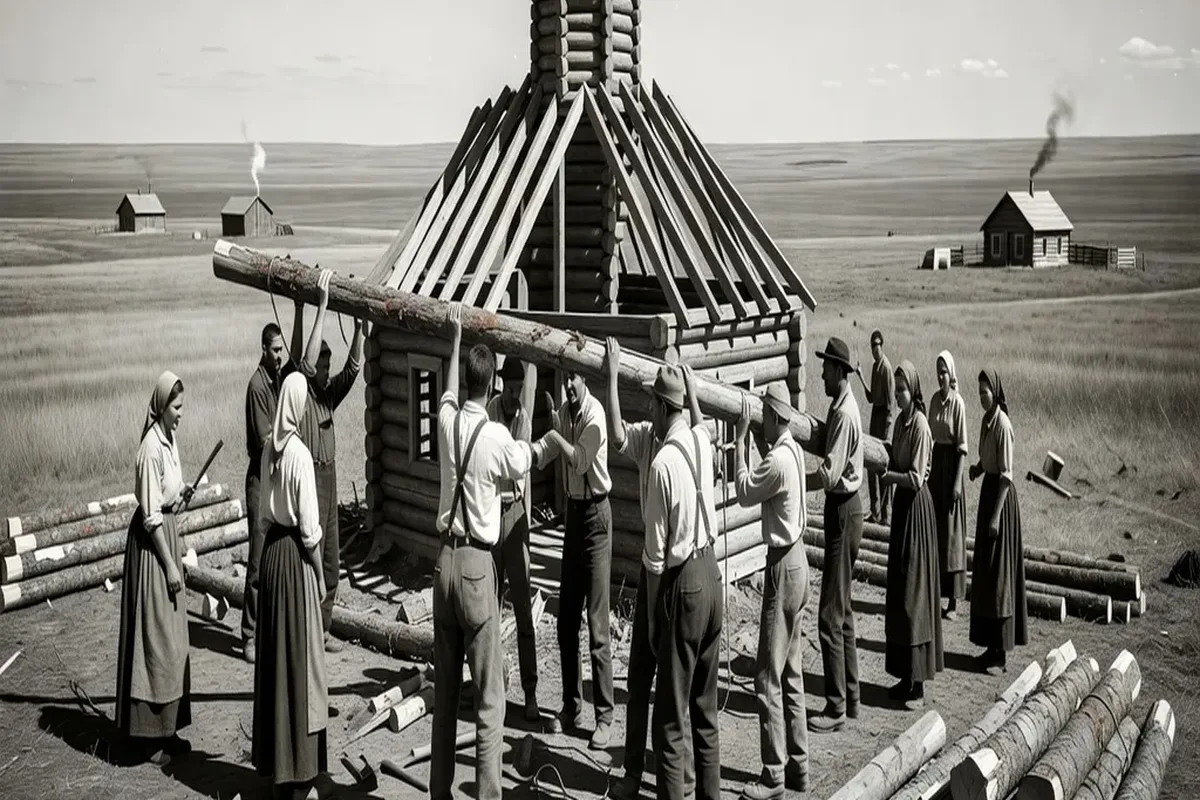
- Building fund and log church — the community pools labour and resources to construct a modest log or frame church, frequently before securing a resident priest, reflecting the priority settlers placed on having consecrated worship space even without permanent clergy.
- Resident clergy secured — once population and financial capacity allow, the diocese assigns a resident priest, and systematic, continuous record-keeping typically begins from this point forward.
- Formal parish incorporation — the congregation incorporates as a legal entity, often adopting a formal parish name honouring a saint or feast day, and begins maintaining registers according to diocesan standards.
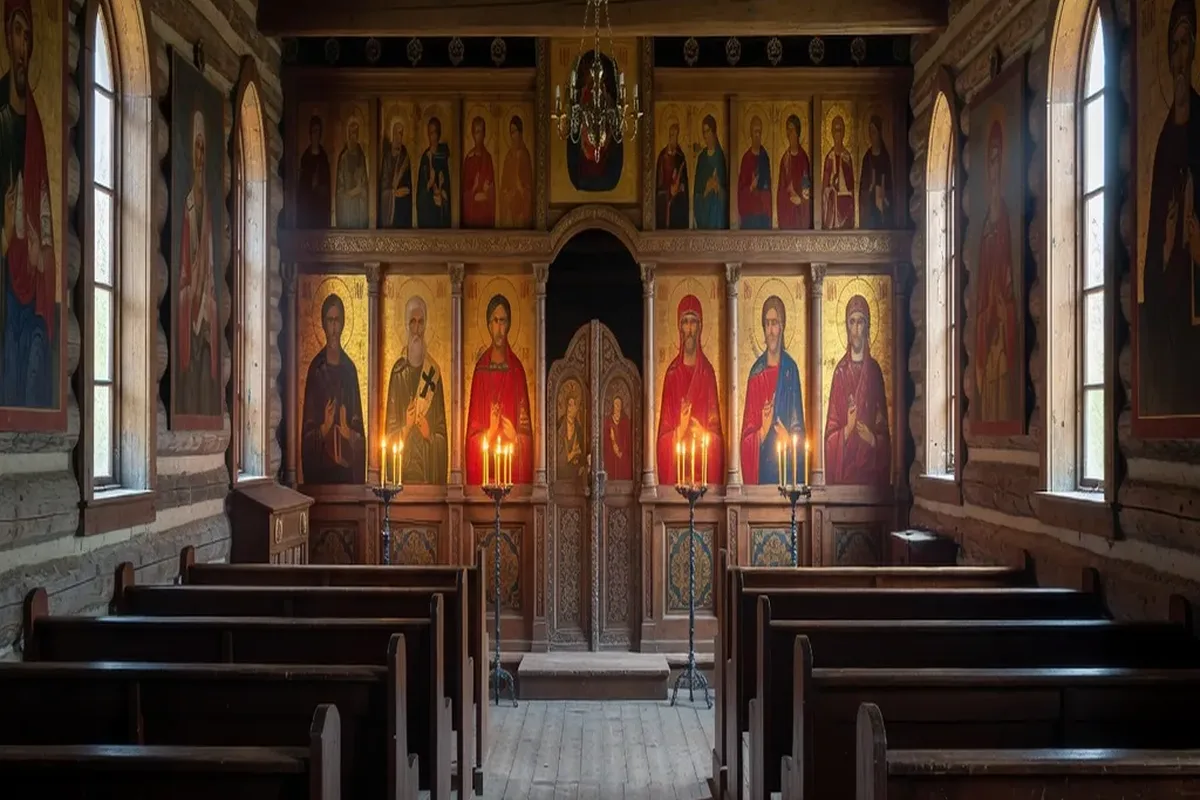
- Permanent structure — a larger, more architecturally elaborate church, often featuring the distinctive pysanka-inspired domes associated with Ukrainian church architecture in Canada, replaces the original modest building as the community prospers.
Historic Ukrainian Orthodox prairie church with onion domes and wooden construction typical of early twentieth century Canadian settlements.
Genealogists tracing a family through this progression should expect the character of surviving records to change at each stage. Mission-era entries are often terse, occasionally written from memory well after the actual event, and may contain inconsistent spelling of family names as the priest transcribed unfamiliar Ukrainian or Rusyn surnames phonetically. Records from the resident-clergy and formal-incorporation stages tend to be far more complete, consistently dated, and organized according to standardized diocesan register formats that include sponsor (godparent) names — details that can be invaluable for reconstructing extended family and community networks. For a deeper dive into how these entries were physically recorded, see our guide to reading old Cyrillic church records.
Orthodox vs Greek Catholic: Comparing the Record-Keeping Traditions
While both traditions descend from the same Byzantine liturgical heritage and share broadly similar approaches to recording sacraments, Ukrainian Orthodox and Ukrainian Greek Catholic parishes in Canada developed some distinct institutional characteristics that affect how their historical records are organized, preserved, and made accessible to researchers today.
| Feature | Ukrainian Greek Catholic | Ukrainian Orthodox |
|---|---|---|
| Ecclesiastical authority | Eparchies (dioceses) under the Vatican, with metropolitan structure established in Canada by 1956 | Ukrainian Orthodox Church of Canada, independent Canadian church body with its own synod |
| Earliest formal Canadian structure | Ruthenian (later Ukrainian) exarchate established 1912, first bishop appointed 1913 | Formally organized 1918, first bishop consecrated 1924 |
| Central archival body | Eparchial chanceries (e.g., Eparchy of Edmonton, Eparchy of Winnipeg) hold consolidated microfilm and original registers | Consistory of the Ukrainian Orthodox Church of Canada, with significant holdings at St. Andrew's College, Winnipeg |
| Typical register language | Ukrainian (Cyrillic) in early decades, transitioning to English by mid-twentieth century | Ukrainian (Cyrillic) with somewhat later transition to bilingual entries in some parishes |
| Calendar used for feast dating | Julian calendar retained for liturgical dates well into the twentieth century | Julian calendar retained by most parishes, with limited "New Calendar" adoption in some urban congregations |
| Access for genealogists | Requires written request to eparchial chancery; some collections digitized through diocesan genealogy programs | Requires request to Consistory archives; some parish registers deposited with provincial archives |
One practical consequence of this institutional divergence is that researchers frequently need to contact two entirely separate archival authorities if a family's religious history spans the 1918 schism or if siblings within a single household ended up in different parishes following a local congregational split. Our companion piece on Ukrainian Orthodox church records in Canada provides a detailed, record-by-record walkthrough of what the Orthodox consistory archives typically hold, while our guide to Ukrainian metrical books (metrychni knyhy) explains the standardized register format used by both traditions.
Parishes in PEI and Atlantic Canada
Prince Edward Island never developed the dense network of Ukrainian parishes found on the prairies, reflecting the comparatively small and geographically dispersed Ukrainian-Canadian population that settled on the Island over the twentieth century. Families researching PEI Ukrainian ancestry should understand that their forebears likely did not have access to a resident Ukrainian-rite priest for most of the Island's settlement history, a reality that shapes what kinds of religious records genealogists can realistically expect to find.
Ukrainian families in PEI and neighbouring Nova Scotia and New Brunswick more commonly relied on periodic visits from itinerant clergy travelling from larger Ukrainian communities in central Canada, or in many cases participated in local Roman Catholic or Anglican parishes for baptisms, marriages, and burials while maintaining Ukrainian cultural and, where possible, occasional Eastern-rite religious practice at home or through informal community gatherings. This pattern means that a PEI family's sacramental records may appear not in any Ukrainian parish register at all, but in the records of the nearest mainstream Christian parish that served their small rural community. Our detailed profile of Ukrainian settlers on Prince Edward Island traces the specific families and settlement patterns that shaped this smaller, more geographically scattered Atlantic Canadian Ukrainian community.
Key takeaway for Atlantic Canada researchers: Do not restrict your search exclusively to Ukrainian Orthodox or Greek Catholic parish archives if your family settled in PEI, Nova Scotia, or New Brunswick before the 1960s. Provincial vital statistics records, and the registers of the nearest Roman Catholic or Protestant parish actually serving the rural district, are often more productive starting points than searching for a dedicated Ukrainian-rite parish that may never have existed locally.
Reading Parish Registers: What Genealogists Will Find
Both Ukrainian Orthodox and Greek Catholic parish registers in Canada generally followed a standardized format inherited from Austro-Hungarian ecclesiastical record-keeping practice, organized into three primary categories of sacramental record that together constitute the core genealogical resource available from any given parish.
- Baptismal registers (khreshchennia) — typically record the child's name, date of birth and baptism, parents' full names including the mother's maiden name, and the names of one or more godparents (sponsors), who were frequently extended family members or close village neighbours from the same ancestral region.
- Marriage registers (vinchannia) — record both spouses' names, ages, parents' names, witnesses, and sometimes the specific village or parish of origin in the old country, making these among the most valuable documents for identifying ancestral villages in western Ukraine.
- Burial registers (pokhoron) — record date of death, age, cause of death where noted, and burial location, often the single best source for establishing approximate birth years when no baptismal record survives.
Beyond these core sacramental categories, many parishes also maintained membership rolls, building fund subscription lists, and correspondence files that, while not strictly genealogical records, can help establish which families belonged to a given congregation during a specific period and provide social context for community life. Genealogists working with Cyrillic-script entries should be prepared for significant surname spelling variation between records, a phenomenon covered in depth in our guide to Ukrainian surname spelling variants in Canadian records.
Weathered handwritten Ukrainian parish register page showing baptismal entries in Cyrillic script.
Where Parish Archives Are Kept Today
Locating the specific archive holding a family's parish records requires understanding both the denominational structure described above and the practical reality that record custody has shifted considerably over the past century as parishes closed, merged, or transferred their historical registers to centralized diocesan repositories for preservation and improved access.
| Denomination | Typical archive location | Access notes |
|---|---|---|
| Ukrainian Greek Catholic (Prairie eparchies) | Eparchial chancery offices in Winnipeg, Saskatoon, Edmonton, New Westminster | Written or email request to chancery archivist; some records microfilmed by genealogical societies |
| Ukrainian Orthodox Church of Canada | Consistory archives, Winnipeg; St. Andrew's College collections | Request through Consistory office; processing time varies by parish |
| Closed or merged rural parishes | Provincial archives (Provincial Archives of Alberta, Saskatchewan Archives, Archives of Manitoba) | Often the best first stop when a parish no longer exists as an active congregation |
| Digitized or indexed collections | Ukrainian genealogical societies, some university special collections | Increasingly searchable online; coverage remains partial and growing |
For families whose ancestral parish has closed entirely — a common outcome as rural Ukrainian-Canadian populations declined through the later twentieth century — provincial archives are frequently the most reliable starting point, since dioceses typically deposit the registers of defunct parishes with the relevant provincial archive rather than retaining them indefinitely in diocesan storage. Our overview of the top free Ukrainian genealogy websites and databases includes links to several indexes that can help identify which archive currently holds a specific parish's historical registers. Cultural organizations such as We Are Ukraine also maintain contacts with diaspora institutions that can sometimes point researchers toward parish collections held outside Canada's formal archival system.
A Research Strategy Built Around Parish History
Approaching Ukrainian-Canadian ancestry through the lens of parish history rather than simply searching for a family surname in isolation offers genealogists a powerful organizing framework, because it forces attention to the specific historical moment and institutional context in which any given ancestor's sacramental records were created. A family's religious record trail is inseparable from the broader institutional history of Ukrainian church establishment described throughout this guide.
- Identify the settlement district and approximate arrival decade of your ancestors, then determine which parish — Orthodox, Greek Catholic, or a neighbouring mainstream Christian congregation — would have served that district during the relevant period.
- Check whether the 1918 schism affected that specific parish community, since a congregational split may mean records for the same extended family exist in two separate denominational archives.
- Contact the appropriate eparchial chancery or Consistory archive directly, providing as much specific detail as possible about names, approximate dates, and settlement location to narrow the search.
- If the parish has closed, redirect inquiries to the relevant provincial archive, which frequently holds the deposited registers of defunct rural congregations.
- Cross-reference any parish findings against civil vital statistics records and immigration documentation, since discrepancies between church and civil records are common and often reveal additional genealogical clues rather than simple errors.
The history of Ukrainian Orthodox and Greek Catholic parish establishment across Canada is, at its heart, the history of how a scattered, often isolated immigrant population built durable institutions capable of preserving faith, language, and identity across generations — and, almost as a byproduct of that institutional achievement, created the very records that make it possible for their descendants today to trace a path back to the villages their ancestors left behind. For readers researching the broader migration story that brought these families to Canada, our overview of Galicia to Canada, 1891–1914 provides essential background on the settlement wave that produced this remarkable parish network.
Frequently Asked Questions
Both traditions share the same Byzantine liturgical rite, calendar conventions, and much of their historical heritage from western Ukraine. The essential difference is ecclesiastical authority: Ukrainian Greek Catholics recognize the Pope in Rome as their highest church authority while retaining Eastern liturgical practice, whereas Ukrainian Orthodox Christians belong to an independent Orthodox church body, the Ukrainian Orthodox Church of Canada, which does not recognize papal authority. In Canada, this split became formally significant after 1918, when many Greek Catholic congregations organized independent Orthodox parishes.
The first sustained missionary activity among Ukrainian settlers began in 1897 with Father Nestor Dmytriw's tours of Manitoba settlements. Permanent log and frame churches followed in the early 1900s as communities gained sufficient population and resources, with formal parish incorporation and resident clergy typically arriving between 1905 and the 1920s depending on the specific district's growth and financial capacity.
The 1918 schism resulted from a combination of theological grievances and practical frustrations, including disputes over parish property control held by non-Ukrainian Roman Catholic bishops, resistance to attempts at latinizing traditional Eastern practices such as married clergy, and a broader desire among Ukrainian immigrants for an independent, self-governing national church. These tensions had been building since the early 1900s and culminated in the formal organization of the Ukrainian Greek Orthodox Church of Canada in Saskatoon in 1918.
Because PEI never developed a dense network of dedicated Ukrainian parishes, families should check both the eparchial or Consistory archives of the nearest mainland Ukrainian diocese and, importantly, the registers of the nearest local Roman Catholic or Protestant parish, since many PEI Ukrainian families participated in mainstream Christian congregations for sacraments while maintaining Ukrainian cultural identity separately. Provincial vital statistics records are also an essential complementary source.
A typical baptismal entry records the child's name, date of birth and baptism, the full names of both parents including the mother's maiden name, and the names of one or more godparents. Entries are usually written in Ukrainian using Cyrillic script in earlier decades, transitioning to bilingual or English-only entries by the mid-twentieth century in many parishes. Godparent names can be especially valuable for identifying extended family and community networks from the same ancestral region.
For active parishes, contact the relevant eparchial chancery (for Greek Catholic parishes) or the Consistory of the Ukrainian Orthodox Church of Canada directly. If the parish has closed, the registers were most commonly deposited with the relevant provincial archive, such as the Provincial Archives of Alberta, Saskatchewan Archives, or Archives of Manitoba, which frequently hold consolidated collections of defunct rural parish records.